


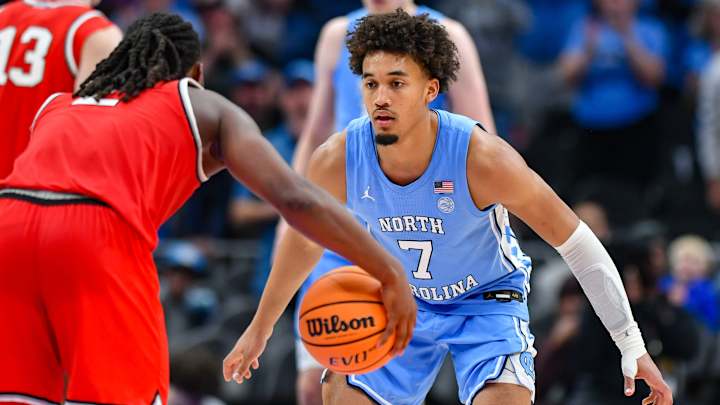
There are moments in a college basketball season when numbers stop feeling like statistics and start feeling like signals. Not trends. Not coincidences. Signals. What North Carolina is doing defensively through the early stretch of the 2025–26 season is one of those moments — the kind that quietly rewrites expectations before the rest of the country fully realizes what it’s seeing.
Because the last time UNC sustained this level of defensive consistency, Michael Jordan wasn’t an NBA legend. He was a student. Wearing Carolina blue. Learning under Dean Smith. And laying the foundation for a championship run that still defines the program more than four decades later.
That comparison alone should send a chill through the ACC.
Defense Isn’t Just Working — It’s Defining This Team
Everyone knows the old saying: defense wins championships. It’s repeated so often that it can feel cliché. But at North Carolina right now, it isn’t a slogan — it’s an identity.
Through the first 14 games of the 2025–26 season, the Tar Heels have not allowed more than 75 points in a single game. Only five opponents have managed to reach 70 points. In a modern era defined by pace, space, and three-point volume, that level of defensive control is extraordinary.
This isn’t happening against weak competition, either. UNC has faced athletic, well-coached teams that want to run, shoot, and spread the floor. And yet, night after night, those offenses leave looking frustrated, rushed, and uncomfortable.
That consistency matters more than any single dominant performance. Great defensive teams don’t just have one lockdown night — they suffocate opponents over time. That’s exactly what this group is doing.
A Feat That Hasn’t Been Seen Since 1981–82
To understand how rare this is, you have to go back to the 1981–82 season — a season that ended with North Carolina cutting down the nets.
That team, led by Dean Smith and powered by Michael Jordan, James Worthy, and Sam Perkins, went an entire season without allowing more than 75 points in any game. They played 34 contests and never let an opponent breathe offensively.
That level of defensive discipline in today’s game borders on unthinkable.
College basketball has changed dramatically since then. Possessions are faster. Spacing is wider. The three-point line has reshaped offensive philosophy. Teams routinely take 25–35 threes per game. And yet, despite all of that, this UNC team is matching a defensive benchmark set in an era that no longer exists.
That doesn’t mean this group is the ’82 team — but it does mean they’re operating in rare historical air.
Doing It Without Their Best Defender (For a While)
What makes this stretch even more impressive is that much of it came without Seth Trimble, arguably one of the best on-ball defenders in the country.
Trimble’s absence during large portions of the non-conference schedule could have been an excuse for defensive slippage. Instead, UNC adapted. Other players stepped into larger roles. Team defense tightened. Communication improved.
That speaks volumes about coaching and buy-in.
Elite defenses aren’t built on one player. They’re built on trust, rotations, effort, and collective accountability. This Tar Heels group has embraced all of it.
And now, with Trimble back in the mix, the ceiling only rises.
Length, Versatility, and Relentless Pressure
One of the most noticeable differences between this UNC team and recent versions is size across the floor.
This roster is long. Everywhere.
Bigs can switch onto guards. Wings can slide down to protect the rim. Guards disrupt passing lanes instead of simply containing dribbles. That versatility allows Hubert Davis to deploy aggressive defensive schemes without sacrificing structure.
Opponents struggle to find clean driving lanes. Entry passes are contested. Three-point looks are rushed or pushed farther from the arc. And when shots do go up, UNC is often in position to finish possessions with rebounds.
Defense isn’t just about stopping shots — it’s about ending possessions. North Carolina has been elite at both.
Defense Creating Offense the Carolina Way
Perhaps the most “UNC” part of this defensive resurgence is how it fuels the offense.
For decades, North Carolina has thrived when defense turns into transition. Rebounds leading to outlet passes. Deflections turning into runouts. Stops creating rhythm.
That blueprint is back.
This team doesn’t need to be perfect offensively for long stretches because the defense keeps them within control of games. And when the Tar Heels do find offensive flow, it often starts with a stop on the other end.
That balance is critical in March.
Hubert Davis’ Defensive Evolution
Early in Hubert Davis’ tenure, the focus naturally leaned toward offense. Shooting. Spacing. Pace. And while those elements still matter, this season marks a clear shift.
This team defends with purpose.
Rotations are sharper. Closeouts are controlled. Help defense is earlier and more disciplined. There’s a clear emphasis on preventing easy paint touches and forcing opponents into uncomfortable decisions late in the shot clock.
That doesn’t happen overnight. It comes from repetition, accountability, and a shared understanding of expectations.
Davis hasn’t just asked this team to defend — he’s demanded it.
Why the ACC Should Be Paying Attention
ACC play is about to test this streak in ways non-conference games can’t. Familiar opponents. Physical matchups. Coaches who know UNC’s tendencies.
But that’s also where elite defenses reveal themselves.
If North Carolina continues to hold teams under 75 points once league play ramps up, the conversation changes quickly. This stops being a fun early-season stat and becomes a defining feature of the conference race.
Every contender will have to answer the same question:
How do you score consistently against this?
That’s a question ACC teams haven’t had to ask about UNC in quite some time.
The Psychological Edge of Defense
Defense does more than stop points — it breaks confidence.
Opposing shooters hesitate.
Ball-handlers rush reads.
Teams abandon game plans.
When offenses don’t trust what they’re seeing, mistakes multiply. UNC has already shown it can impose that mental pressure for 40 minutes.
That’s how tournament games are won.
Still Room to Get Better — And That’s the Scary Part
What may be most unsettling for the rest of the ACC is that this doesn’t feel like a finished product.
There are still rotations to clean up.
Still moments of over-help.
Still possessions where communication can improve.
And yet, the baseline is already historically strong.
As Trimble fully reintegrates, as younger players gain experience, and as conference play sharpens focus, this defense has a chance to become even more suffocating.
That’s not a projection — it’s a warning.
History Isn’t Repeating — But It’s Echoing
No one is saying this team will mirror the 1981–82 championship run. History doesn’t work that way. But echoes matter.
And when UNC is doing something it hasn’t done since Michael Jordan was on campus, that’s not coincidence. That’s identity resurfacing.
North Carolina basketball has always been at its most dangerous when defense leads the way — when opponents leave the floor exhausted, frustrated, and out of answers.
That version of UNC is back.
And if this defensive standard holds, the ACC isn’t just dealing with a contender.
It’s dealing with a problem.




