


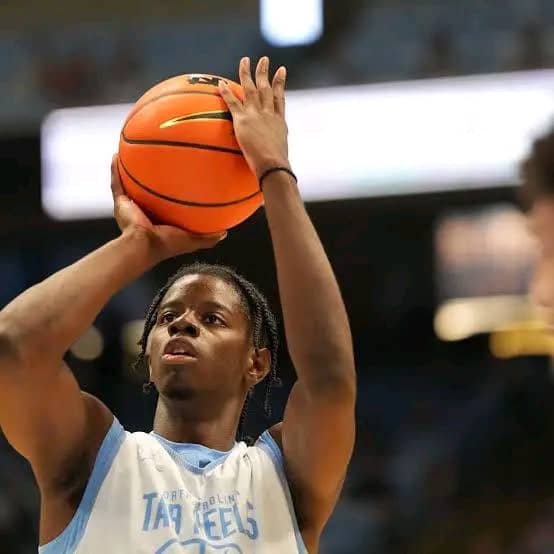
There’s a certain look that seasoned college basketball fans recognize instantly. It isn’t loud. It isn’t performative. It’s not accompanied by bold proclamations or social-media theatrics. It’s quieter than that—focused, intent, almost unsettling in its calm. When Caleb Wilson looks into the camera and talks about motivation, you don’t hear bravado. You hear something more familiar to North Carolina fans: a player who has internalized expectations, stored away perceived slights, and decided—very deliberately—that his response will come on the court. For a program built on discipline, accountability, and understated competitiveness, that mindset feels strikingly on brand.
At North Carolina, motivation has always mattered. But how players carry it—and how they channel it—often tells you just as much about their future as their stat lines do. Wilson’s recent comments about keeping reminders on his phone, about deliberately staying “pissed,” weren’t meant to shock. They were meant to explain. And for UNC fans, they offered a revealing window into the competitive engine driving one of the program’s most intriguing young guards.

A Player Shaped by Expectation
Caleb Wilson didn’t arrive in Chapel Hill without attention. Recruited as a high-level prospect with a versatile skill set, Wilson was viewed as a player capable of fitting seamlessly into UNC’s guard lineage—smart, composed, defensively responsible, and capable of scoring when needed. But like many young players at blue-blood programs, he quickly learned that expectations don’t pause once you sign.
At North Carolina, talent is assumed. What separates players is consistency, resilience, and the ability to handle scrutiny. For Wilson, that scrutiny came early and often. Minutes fluctuated. Roles shifted. Performances were dissected. In a fan base accustomed to greatness, patience can be thin—even for underclassmen still learning the pace and physicality of the college game.
Rather than resist that pressure, Wilson absorbed it.
“There’s a lot that comes with wearing this jersey,” one UNC staff member said privately. “Some guys push back against it. Caleb leaned into it.”
That distinction matters. In a program where trust is earned through habits—defensive positioning, ball movement, practice effort—Wilson’s approach began to stand out long before his public comments ever did.
The Chip That Doesn’t Show
When Wilson spoke about motivation, what struck many observers wasn’t the message itself, but the delivery. There was no finger-pointing, no calling out critics by name. Just a simple acknowledgment that he keeps reminders of perceived disrespect close at hand—not to broadcast them, but to remember them.
That kind of motivation isn’t new at UNC.
Michael Jordan famously used imagined slights to fuel his competitiveness. Tyler Hansbrough played every possession as if someone had personally offended him. Even quieter leaders like Joe Forte and Kendall Marshall carried an edge beneath their composure.
Wilson’s version fits that lineage. He doesn’t wear his emotions loudly. He doesn’t seek confrontation. But teammates say he’s intensely competitive, especially in practice. Missed assignments linger with him. Defensive breakdowns frustrate him more than missed shots.
“He hates losing reps,” one teammate said. “Even in drills.”
That internal pressure, when managed correctly, is often what turns promising players into reliable ones.
Learning the Carolina Way
One of the defining features of UNC basketball under Dean Smith—and carried forward through Roy Williams and Hubert Davis—has been the belief that players must earn their moments. Freshmen rarely arrive as finished products. Sophomores are expected to grow. Juniors and seniors lead.
Wilson’s early career has followed that arc more closely than some might realize. While fans often focus on scoring totals, UNC’s staff evaluates guards through a broader lens: defensive awareness, decision-making, communication, and adaptability. Wilson’s progress in those areas has been steady, even when it hasn’t been flashy.
Defensively, he’s become more reliable guarding multiple positions. Offensively, he’s learned when to attack and when to move the ball. Perhaps most importantly, he’s shown an ability to respond to coaching—an underrated skill at the college level.
“Coach Davis is big on trust,” Wilson said earlier this season. “If you’re doing the little things, the rest comes.”
That understanding didn’t happen overnight. It came through film sessions, tough practices, and moments when Wilson had to accept reduced roles while continuing to compete.
Motivation Without Distraction
In an era when many players use social media as an extension of their competitive identity, Wilson’s approach feels notably restrained. His motivation is private. The “list” he referenced isn’t a manifesto—it’s a reminder system.
That distinction aligns closely with UNC’s culture. Historically, the program has valued players who let performance speak for itself. Confidence is encouraged. Self-promotion is not.
“There’s a reason certain guys thrive here,” a former UNC assistant once said. “They’re motivated, but they’re not distracted by proving something to everyone every night.”
Wilson appears to understand that balance. His comments weren’t a declaration of war on critics; they were an explanation of how he stays locked in during a long season. College basketball, after all, is a grind—physically and mentally. Motivation fades if it isn’t refreshed.
For Wilson, keeping reminders close is a way to stay sharp, especially during stretches when minutes are limited or shots aren’t falling.
The Guard Room Standard
UNC’s guard tradition casts a long shadow. From Phil Ford to Jeff Lebo, from Raymond Felton to Marcus Paige, the bar has always been high—not just for scoring, but for leadership and composure.
Wilson is acutely aware of that history.
“You don’t come here without knowing who played here before you,” he said. “That matters.”
Within the current roster, Wilson’s role is still evolving. He isn’t asked to dominate the ball. He isn’t expected to carry the offense every night. Instead, he’s being groomed as a player who can impact winning in multiple ways—on-ball defense, secondary scoring, spacing, and tempo control.
Those roles rarely produce viral highlights. They do, however, produce trust from coaches.
And trust, at UNC, often leads to opportunity.
Turning Internal Pressure Into Production
The challenge with internal motivation is managing it. Players who carry too much can press—forcing shots, overreacting to mistakes, or trying to prove too much too quickly. Wilson’s growth has included learning when to let the game come to him.
Early in his UNC tenure, there were moments when his urgency worked against him. He wanted to make an impact immediately, sometimes at the expense of patience. Over time, that urgency has been refined.
Now, his confidence shows up in subtler ways: taking open shots without hesitation, making the extra pass, staying disciplined defensively even after a missed opportunity.
That maturation is what UNC’s staff has been watching closely.
“He’s starting to understand pace,” one assistant noted. “That’s a big step for guards here.”
Motivation in the Modern College Game
Wilson’s comments also reflect a broader reality of modern college basketball. Players are evaluated constantly—by fans, analysts, draft boards, and social media. Motivation often comes from navigating that noise without being consumed by it.
For Wilson, the answer has been control. He controls what he remembers. He controls how he responds. And he controls the effort he brings daily.
That approach resonates with UNC’s coaching philosophy, which emphasizes daily consistency over emotional peaks.
“You don’t win championships on emotion alone,” Hubert Davis has said. “You win them on habits.”
Wilson’s motivation, as he describes it, is less about anger and more about accountability—to himself.
What This Means for UNC Moving Forward
As the season progresses, UNC’s success will depend on depth, versatility, and buy-in. Guards who can defend, make smart decisions, and contribute without dominating the ball are invaluable—especially in March.
Wilson’s mindset positions him well for that role.
He may not always be the leading scorer. He may not be the loudest voice in the locker room. But players driven by quiet competitiveness often become postseason assets. They handle pressure. They accept roles. They rise when opportunities come.
UNC fans have seen this movie before.
Why This Resonates in Chapel Hill
The reaction to Wilson’s comments wasn’t about drama. It was about recognition. Carolina fans recognize players who internalize doubt and convert it into discipline. They recognize players who don’t need external validation to stay motivated.
There’s comfort in that familiarity.
Wilson’s words suggested a player who understands where he is, what is expected of him, and how to navigate the space between potential and production. That understanding doesn’t guarantee stardom—but at UNC, it often precedes meaningful contributions.
The Bigger Picture
Ultimately, Caleb Wilson’s motivation story isn’t about disrespect alone. It’s about growth. It’s about learning how to compete at one of college basketball’s most demanding programs. And it’s about choosing a response that aligns with the culture he joined.
There’s still time left in his UNC journey. Roles will evolve. Performances will fluctuate. But the foundation he’s describing—the internal drive, the quiet edge, the refusal to forget—suggests a player invested in becoming more than just a name on the roster.
For North Carolina, that kind of motivation has always mattered.
And for Caleb Wilson, it may be the fuel that defines his time in Chapel Hill.




