


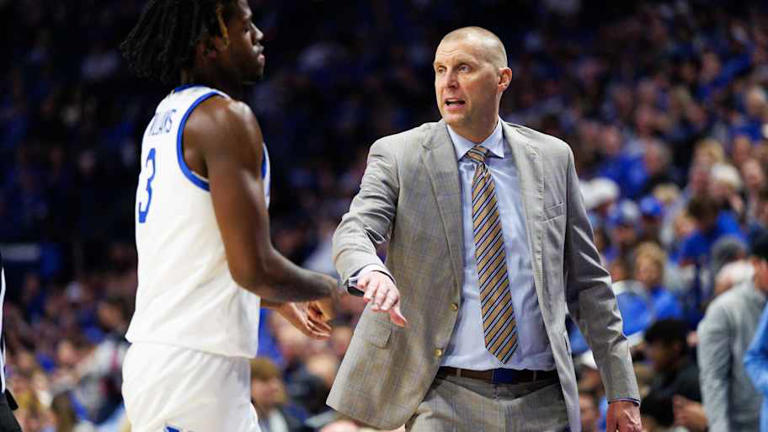
For much of college basketball, the logic feels simple: when a player is hot, you ride him. Feed him the ball, keep him on the floor, and let the rhythm dictate the game. That belief is especially strong at Kentucky, where fans have been conditioned for decades to expect elite talent, quick adjustments, and decisive coaching when momentum tilts in either direction. So when Kam Williams — fresh off a career night and shooting the ball as well as anyone in the country — spent most of Kentucky’s loss to Alabama watching from the bench, the confusion was immediate, loud, and unavoidable.
Williams entered the matchup against Alabama coming off a 26-point performance, highlighted by eight made three-pointers and a shooting stretch that had him hitting nearly 65 percent from deep over his previous three games. For a Kentucky team struggling to generate consistent offense, particularly against high-major competition, Williams looked like a ready-made solution. Yet in a game where the Wildcats trailed by as many as 21 points in the first half and desperately needed shooting, Williams logged just six minutes before halftime and attempted only one shot. He then sat for the first 10 minutes of the second half before finally re-entering with Kentucky down 17.
The numbers only fueled the frustration. During the stretch Williams was on the floor late in the game, Kentucky mounted its best push, cutting the deficit to single digits for the first time since early in the first half. He finished with five points, one rebound, and one block in limited minutes, but the lingering question remained: why wasn’t he given more of a chance sooner?
After the game, Kentucky head coach Mark Pope addressed that question directly, offering insight into a decision that, on the surface, seemed baffling to much of the fanbase. His explanation revealed not just a single-game choice, but a broader tension Kentucky is navigating as it searches for its identity in Pope’s second season.
A Game That Slipped Away Early
Kentucky’s problems against Alabama extended far beyond one rotation decision. The Wildcats allowed the Crimson Tide to dictate the tempo early, surrendering open looks from three-point range and struggling to contain dribble penetration. Alabama built its lead behind sharp ball movement, spacing, and confident shooting, while Kentucky labored through possessions, often settling for contested shots late in the clock.
By halftime, the Wildcats were shooting just 37.9 percent from the field and a dismal 22.2 percent from three-point range. Against one of the least efficient power-conference defenses in the country by advanced metrics, Kentucky’s offense looked stagnant and disjointed. That context made Williams’ limited role even more glaring. If there was ever a night to lean on a shooter with confidence and momentum, this seemed like it.
But Pope insisted the decision wasn’t as simple as riding the hot hand.
Going Big — And the Cost of It
One of Pope’s primary explanations centered on lineup experimentation. Kentucky, he said, made a conscious effort to go bigger against Alabama, a decision that pushed Williams off the floor at times.
“We’re searching a little bit in that sense,” Pope said. “We were trying to work on a bigger lineup that wasn’t super functional today. Otega was giving us a huge lift, but there will be ways that we can work Kam in.”
That comment revealed a lot about where Kentucky is right now. The Wildcats are not a finished product. Pope is still probing combinations, testing personnel, and trying to balance offensive spacing with defensive physicality. Against Alabama, that search came at a cost. Bigger lineups slowed Kentucky’s pace, cramped driving lanes, and limited clean kick-out opportunities — precisely the situations where a shooter like Williams thrives.
The presence of Otega Oweh also factored heavily into the equation. Oweh was one of Kentucky’s most effective players on the night, attacking downhill, drawing fouls, and providing energy on both ends. With Oweh playing well and Kentucky experimenting with size, Williams became the odd man out.
From a coaching standpoint, the logic is understandable. From a results standpoint, it remains deeply debatable.
“He Needs to Be More Aggressive”
Perhaps the most revealing part of Pope’s explanation came when he shifted the focus back to Williams himself.
“Kam also needs to be more aggressive and take advantage of the opportunities he has,” Pope said.
That statement reframed the conversation. This wasn’t just about minutes — it was about trust, assertiveness, and what Pope expects from his players when they do get on the floor. In Pope’s view, Williams didn’t fully capitalize on the chances he was given, limited though they were.
It’s a delicate balance. Shooters often rely on rhythm, confidence, and repetition. Asking a player to be instantly aggressive after sitting for long stretches can be difficult, especially for someone whose primary value is spacing and shot-making. Still, Pope’s message was clear: opportunity alone isn’t enough. Players must seize it.
This philosophy aligns with comments Pope made earlier in the week about Kentucky’s shooting as a whole.
“It’s been subpar for us, for sure, up until now,” Pope said. “But I think our ceiling is really high there. I think that it has been due to a lot of things. I think we get slowed down and more impatient, which is a bad combination when the game gets tough sometimes for us. And that’s something that we’re growing out, we’re learning more about.”
Williams’ breakout against Bellarmine was part of that growth. The challenge now is sustaining it against elite competition — and doing so in a way that fits within the team’s larger structure.
A Bigger Issue Than One Player
While Williams’ minutes became a focal point, the bigger issue for Kentucky is systemic. Against Alabama, the Wildcats recorded fewer than 10 assists, a statistic Pope bluntly called “not good basketball” earlier in the postgame. Ball movement stalled, possessions became predictable, and shooters were often left waiting rather than being actively involved.
In that environment, even the hottest shooter can disappear. Williams’ limited touches were as much a symptom of Kentucky’s offensive struggles as they were a product of rotation decisions. The Wildcats simply didn’t create enough advantages to force defensive collapses and generate open looks.
That reality complicates the narrative. Feeding the hot hand requires the offense to function well enough to do so. Against Alabama, Kentucky rarely reached that point.
The Fan Perspective — And Why This Feels Different
Still, frustration among fans is understandable. Kentucky basketball has long been defined by stars stepping up in big moments, and Williams looked like a player capable of doing exactly that. Seeing him glued to the bench while the offense sputtered felt like a missed opportunity — and a familiar one for a fanbase already uneasy about the team’s direction.
This isn’t just about one game. It’s about trust in the process, belief in player development, and confidence that adjustments will come quickly enough to matter. Pope is still early in his Kentucky tenure, but the scrutiny is intense, and rotation decisions are magnified under the program’s bright lights.
Williams’ situation also highlights a broader challenge facing modern college basketball: balancing analytics, matchups, and development with feel, momentum, and instinct. Coaches are asked to be both meticulous planners and reactive managers — often simultaneously.
What Comes Next for Kam Williams
The good news for Kentucky is that this story isn’t finished. Williams has proven he can shoot at a high level, and Pope has made it clear that there will be ways to incorporate him more effectively. The path forward likely involves clearer roles, quicker hooks when lineups stagnate, and a renewed emphasis on pace and ball movement.
For Williams, the message is equally clear: aggression matters. Whether he plays six minutes or 26, Pope wants him hunting shots, demanding the ball, and forcing the defense to react. That assertiveness could be the difference between a situational shooter and an indispensable piece.
A Season Still Searching for Identity
Kentucky’s loss to Alabama didn’t define its season, but it exposed lingering questions. Who closes games? What lineups maximize both spacing and toughness? And how quickly can the Wildcats translate practice growth into game execution?
Kam Williams sits squarely at the intersection of those questions. His shooting offers answers Kentucky desperately needs, but only if the team — and the coaching staff — find the right balance between patience and urgency.
For now, Pope’s explanation provides context, if not complete comfort. The hot hand wasn’t ignored out of indifference, but out of experimentation, philosophy, and expectation. Whether that approach evolves could shape the rest of Kentucky’s season.
One thing is certain: the next time Kam Williams catches fire, all eyes will be on how quickly — and how confidently — Kentucky chooses to feed him.




