


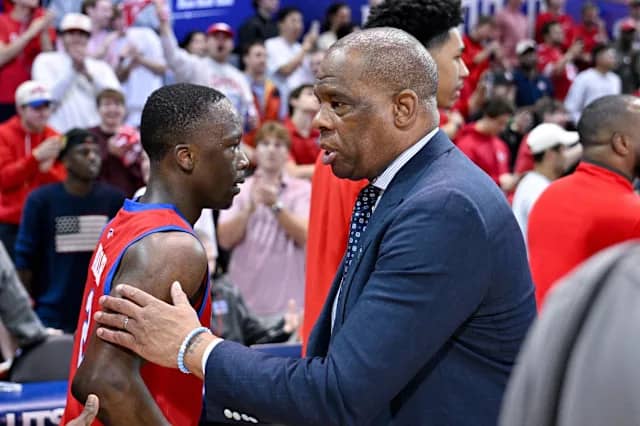
North Carolina’s 97–83 loss at SMU was not just another road stumble in ACC play. It was the kind of game that forces uncomfortable conversations, exposes unresolved weaknesses, and leaves a program staring into a mirror it may not like. Afterward, Hubert Davis didn’t search for clever phrasing or sugarcoat the result. He delivered a blunt assessment that cut straight to the heart of the issue:
“It starts and ends with defense.”
Those six words didn’t just summarize Saturday afternoon at Moody Coliseum — they framed a larger concern for UNC basketball as the season pushes deeper into conference play. For a team that had recently been praised for its defensive growth, the collapse against SMU felt jarring, alarming, and potentially instructive. Whether the Tar Heels learn the right lessons from it may define the rest of their season.
A Game That Slipped Away Almost Immediately
From the opening minutes, the warning signs were there. SMU didn’t just score — it scored comfortably. The Mustangs dictated tempo, spacing, and matchups, building an early cushion and never truly relinquishing control. They led for more than 33 of the game’s 40 minutes, a staggering statistic that underscores just how little North Carolina ever seized momentum.
Boopie Miller was the engine behind it all. The SMU point guard delivered a masterclass in control, finishing with 27 points and 12 assists, slicing through UNC’s defense with patience and poise. Whether operating in isolation, ball-screen action, or drive-and-kick scenarios, Miller consistently got to his spots — and when help arrived, he punished it with pinpoint passes.
Hubert Davis acknowledged as much.
He explained that UNC tried to take the ball out of Miller’s hands, but the effort only exposed other cracks. Teammates stepped up, hit shots, and capitalized on defensive rotations that were late, hesitant, or poorly connected.
This wasn’t one breakdown. It was systemic.
When Defensive Identity Disappears
Perhaps the most troubling aspect of the loss was how far it diverged from what UNC had been building earlier in the season. Coming into the game, the Tar Heels were among the ACC leaders in field-goal percentage defense. That reputation vanished in 40 minutes.
SMU shot 60 percent from the field, including an eye-opening 70 percent in the second half. Against a team that prides itself on physicality and length, those numbers should be almost impossible. Instead, they became reality.
Davis described it plainly: SMU got wherever it wanted offensively.
UNC defenders struggled to contain the ball at the point of attack. Drives weren’t stopped early, help rotations came too late, and closeouts were ineffective. Once SMU gained confidence, the floodgates opened.
Defense, especially at this level, is about collective effort — pressure on the ball, disciplined positioning, trust in rotations. Against SMU, North Carolina looked fractured. Each action felt reactive rather than anticipatory, a half-step behind in nearly every sequence.
Pressure That Broke the Offense
While defense was the headline, the ripple effects reached the offensive end as well. One of Davis’ most revealing comments came when he discussed how far from the basket UNC was forced to initiate its offense.
The Tar Heels were starting possessions near half court, pushed back by SMU’s ball pressure, denial, and physicality. That distance matters. Every dribble, pass, and cut became more difficult, more predictable, more exhausting.
UNC still shot a respectable percentage overall, but the flow was gone. Sets took longer to develop. Post entries were contested or delayed. The offense rarely arrived on time.
Davis emphasized that SMU’s defense made everything feel hard — and that’s exactly what good defensive teams aim to do.
Against elite competition, UNC cannot rely on talent alone. They need players who can break down pressure consistently, and when that doesn’t happen, the entire system bogs down.
Frontcourt Neutralized by Physicality
Henri and Caleb Wilson are central to UNC’s offensive balance. When they can establish position early and catch the ball comfortably, the Tar Heels become difficult to guard. SMU understood that — and attacked it relentlessly.
Davis pointed to physicality and well-timed double teams that disrupted rhythm before it could develop. Entry passes were denied. Catches came further from the rim. By the time the ball arrived, the advantage was gone.
This wasn’t just about two players being limited. It was about how defensive pressure upstream affected everyone downstream. When guards can’t enter the ball cleanly, bigs suffer. When bigs are neutralized, spacing collapses. When spacing collapses, shooters hesitate.
It becomes a cycle — and against SMU, UNC never broke it.
Seth Trimble: A Lone Bright Spot
In a game filled with frustration, Seth Trimble stood out as a competitor who refused to disappear. He finished with 22 points, attacking the basket, making plays, and providing some semblance of offensive aggression when the Tar Heels desperately needed it.
Davis acknowledged that Trimble was one of the few players able to break down SMU’s defense at times. But one player is not enough — especially on the road, in conference play, against a confident opponent.
Trimble’s effort highlighted both his importance and the team’s dependency. For UNC to reach its ceiling, that kind of pressure-breaking ability must come from multiple sources.
The Three-Point Illusion
Interestingly, UNC shot the ball fairly well from the field and even had success from beyond the arc. Jarin knocked down three three-pointers, his best stretch of the season, and the Tar Heels didn’t struggle to score in isolation.
Yet Davis was clear: offensive efficiency doesn’t excuse defensive failure.
You cannot win road games when the opponent shoots 60 percent, regardless of how well you score. The math simply doesn’t work. Defense, rebounding, and ball security remain the foundation — and UNC failed at the first pillar.
That reality made the loss more sobering. This wasn’t a night where shots just didn’t fall. This was a night where the underlying structure collapsed.
A Test That ACC Play Will Repeat
What makes Davis’ postgame comments resonate so strongly is their forward-looking nature. This wasn’t about SMU alone. This was about what’s coming.
ACC opponents are watching. They see the blueprint: pressure the ball, deny entries, play physically, and test UNC’s composure. This will not be the last time the Tar Heels face this style — it will be the norm.
Davis acknowledged that this is what UNC will continue to see moving forward. The question is whether they respond with growth or allow the issue to linger.
Championship teams don’t avoid adversity. They absorb it, dissect it, and evolve.
Why the Quote Should Worry — and Motivate — UNC Fans
“It starts and ends with defense” is not a throwaway line. It’s a standard. And when your head coach says it after a loss like this, he’s telling you exactly where the margin for error lies.
UNC has talent. It has size. It has depth. What it must rediscover is consistency, especially in hostile environments where effort and connectivity matter more than schemes.
The concern for fans is not that the Tar Heels lost — road losses happen. It’s how they lost, and why they lost. Defensive identity isn’t optional at this level. It’s the difference between a good team and a dangerous one.
The Season Is Still There to Be Defined
Despite the disappointment, this loss does not define UNC’s season — but it can shape it. The Tar Heels still have time to respond, recalibrate, and reassert who they want to be.
Davis’ message was not one of panic, but of accountability. Defense is effort. Defense is trust. Defense is habit.
If UNC recommits to those principles, this loss can become a turning point rather than a warning sign unheeded.
But if the lesson is ignored, the quote will echo again — louder, more urgently — as opportunities slip away.
For now, one sentence says it all. And every Tar Heel fan knows it’s true.




