


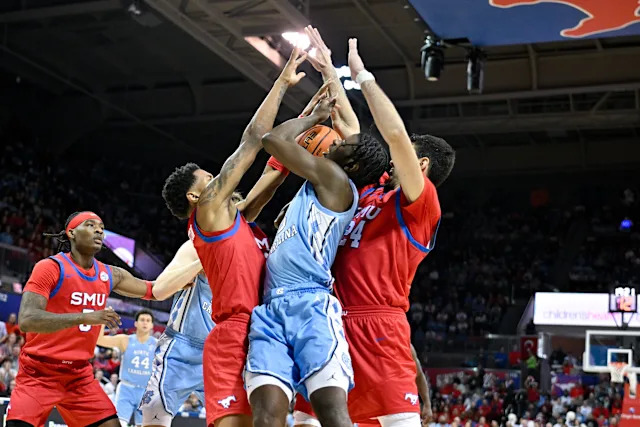
There are losses that sting because of the score, and then there are losses that linger because of the questions they leave behind. North Carolina’s 97–83 defeat to SMU fell firmly into the second category. The Tar Heels didn’t just lose a game — they ran headfirst into a blueprint, one that challenged the very identity of a team built around one of the most productive and physically imposing frontcourts in college basketball. And by the time the final horn sounded, it was clear this wasn’t just about SMU. It was about what the rest of the ACC — and beyond — was watching closely.
UNC fans haven’t stopped talking about it. Message boards, radio shows, film breakdowns — all circling the same question: How did SMU make Caleb Wilson and Henri Veesaar look human? And perhaps even more importantly, how does North Carolina respond before others copy the formula?
The Moment That Told the Story
The warning sign came almost immediately.
On North Carolina’s first extended possession, the ball moved crisply around the perimeter. Four passes. Good spacing. Patience. Then the entry pass found Caleb Wilson on the left block — exactly where UNC wants the ball to go. Wilson took one strong dribble, began to turn middle, and suddenly found himself swallowed by bodies. A second defender came from behind. A massive center loomed in front. Arms everywhere.
Travel. Turnover.
It wasn’t just a mistake. It was a preview.
From that moment forward, SMU dictated the terms of engagement. Every post touch was contested. Every catch was fought for. Every move toward the rim came with consequences. UNC’s frontcourt wasn’t erased, but it was disrupted — pushed off rhythm, forced into difficult decisions, and dragged into a physical battle that never eased.
The Numbers Behind the Disruption
Caleb Wilson entered the game averaging nearly 20 points and over 11 rebounds per contest, producing at a level that had already sparked national attention. Against SMU, he finished with 13 points and seven rebounds — solid numbers for most players, but a noticeable drop from his usual dominance.
Henri Veesaar, who had been scorching efficient throughout December, shot just 4-of-11 from the floor. He still found ways to score and compete, but rarely in the spots where he’s most comfortable.
Even more telling: SMU matched UNC in post scoring, 36–28, tying the Tar Heels’ season-low output in that category. For a team that has consistently leaned on its interior advantage, that number landed like a cold splash of water.
SMU’s Physical Blueprint
So what exactly did SMU do?
First, they committed to physicality on the catch. Wilson and Veesaar were rarely allowed to receive the ball cleanly. SMU defenders leaned, bumped, rode hips, and forced catches farther from the rim than UNC prefers.
Second, they mixed their double teams. Rather than sending help predictably from the perimeter, SMU often doubled from the big man — collapsing with size instead of speed. That choice mattered. It took away Wilson’s ability to pivot and see over the defense, shrinking his passing angles and forcing quicker decisions.
Third, SMU didn’t just defend the post — they defended the entry pass itself. UNC frequently found itself initiating offense near half court, burning clock just to get the ball inside. Every dribble, cut, and pass felt contested, as Hubert Davis later acknowledged.
“They were physical,” Davis said. “They tried to get us off our spots and make our passes and drives difficult. And they were able to do it.”
The Role of Size and Foul Trouble
SMU’s frontcourt combination of Samet Yigitoglu and Jaden Toombs didn’t light up the scoreboard — they combined for just 16 points — but their presence altered everything.
At 7-foot-2 and over 270 pounds, Yigitoglu provided a deterrent simply by existing in the paint. His ability to absorb contact without yielding position allowed perimeter defenders to stay home longer, knowing help was behind them.
Meanwhile, Veesaar’s foul trouble compounded the issue. Picking up his second foul late in the first half limited his aggressiveness, and a quick third after halftime forced him into survival mode. That caution showed in contested finishes and defensive positioning.
Physical pressure plus whistle trouble is a dangerous combination, especially against a team that thrives on interior rhythm.
Why Wilson Looked Frustrated — And Why That Matters
One of the more revealing aspects of the game wasn’t just the stat line — it was Wilson’s body language.
The freshman star has handled attention and physical play remarkably well this season, but against SMU, frustration crept in. Forced catches, rushed moves, turnovers born from pressing — all signs of a player trying to fight through discomfort rather than flow around it.
SMU head coach Andy Enfield was candid afterward.
“We tried to make it hard for him to catch it,” Enfield said. “Push him out, double him in the scoring area, and make other people make shots.”
That’s the key. SMU wasn’t daring Wilson to score. They were daring UNC to beat them without him controlling the game.
The Ripple Effect on UNC’s Offense
When UNC’s frontcourt stalled, the effects rippled outward.
Post touches came later in the shot clock, limiting kick-out opportunities. Guards hesitated, unsure whether to force the ball inside or reset. And as SMU collapsed the paint, the Mustangs’ shooters punished UNC on the other end — hitting over 50 percent from three and shooting 60 percent overall.
Jarin Stevenson summed it up simply.
“Having that presence down there shrinks the defense,” he said. “That also helped them hit their threes.”
In other words, SMU’s physicality didn’t just slow UNC down — it tilted the entire floor.
Conference Play Changes Everything
None of this should come as a total surprise. Conference play brings familiarity, deeper scouting, and opponents willing to sell out to take away what you do best.
The difference now is that UNC has a visible blueprint working against it.
Some ACC teams won’t have SMU’s size. Others won’t match their physical depth. But many will try to replicate the principles: early contact, varied doubles, denial of comfort catches, and patience on the defensive end.
The question becomes whether UNC can stay a step ahead.
How Can UNC Counter?
The good news for Tar Heel fans: answers exist.
1. Quicker Decisions in the Post
Wilson and Veesaar don’t need to abandon post play — they need to speed it up. One-dribble moves, quicker reads, and immediate kick-outs can punish aggressive doubles.
2. Better Spacing and Relocation
If opponents are going to collapse, UNC’s perimeter players must make defenses pay. That means sharper relocation, quicker swings, and confidence shooting off the catch.
3. Using Wilson as a Playmaker
Instead of always posting Wilson deep, UNC can initiate offense through him at the elbow or high post — forcing doubles farther from the rim and opening cutting lanes.
4. Early Seals and Transition Opportunities
The easiest post touches are the ones you get before the defense is set. UNC must prioritize early seals, rim runs, and transition entries to avoid half-court wrestling matches.
5. Embracing the Physicality
This might be the most important adjustment. Physical games aren’t going away. Learning to welcome contact, draw fouls, and maintain composure will be crucial for a frontcourt that will see this every night in the ACC.
The Bigger Picture
This loss doesn’t redefine North Carolina’s season. But it does clarify it.
UNC is still built around a dominant interior. Wilson and Veesaar are still among the most formidable frontcourt duos in the country. One game doesn’t erase that. What it does is raise the bar — forcing growth, adaptability, and evolution.
Hubert Davis said it best afterward: this is something the team must “learn and grow from.”
And for UNC fans, that’s the part worth watching.
Because if the Tar Heels figure out the counter — if they turn this discomfort into development — this game won’t be remembered as a warning.
It’ll be remembered as the moment UNC got better.




