


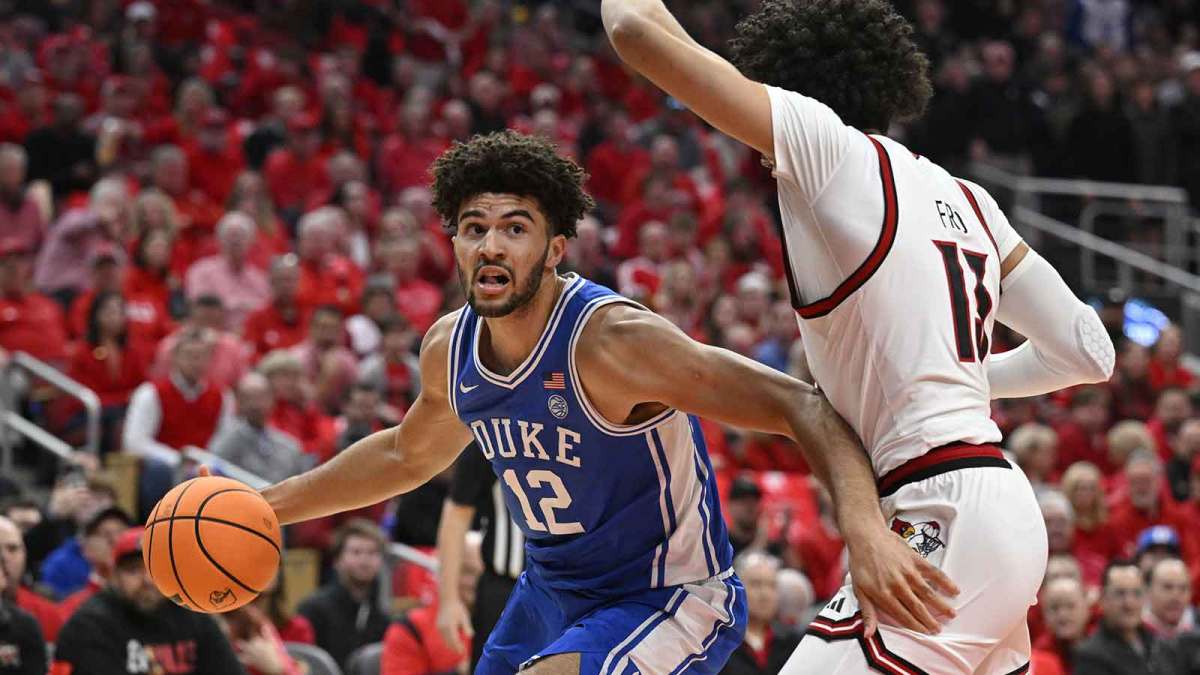
The noise inside the KFC Yum! Center was real. The energy was justified. And for the better part of 20 minutes, it felt like Louisville had finally found the formula to knock off Duke.
Then Jon Scheyer went to work.
What followed was not just a comeback, but a masterclass in in-game coaching, defensive recalibration, and composure under pressure — the kind of response that separates talented teams from championship-caliber programs. Duke’s 84–73 win over Louisville on Tuesday night was about far more than one road victory in January. It was a reminder that when Duke locks into its identity, it becomes one of the most dangerous teams in college basketball.
The Blue Devils erased a nine-point halftime deficit, suffocated Louisville offensively in the second half, and walked out of one of the ACC’s most hostile environments with their third straight win — and perhaps their most impressive performance of the season.
A Hostile Start: Louisville Sets the Tone Early
Louisville entered the matchup ranked No. 20 nationally, desperate to prove it belonged among the ACC’s elite. From the opening tip, the Cardinals played like a team with nothing to lose.
They attacked Duke’s defense with pace and confidence, hitting shots early and feeding off a crowd of 17,000-plus fans who sensed a marquee upset brewing. Louisville’s ball movement was sharp, their spacing clean, and their shooting nearly flawless in stretches of the first half.
Ryan Conwell led the charge, scoring efficiently and stretching Duke’s perimeter defense. Reserve center Aly Khalifa added an unexpected wrinkle, knocking down perimeter shots that forced Duke’s bigs into uncomfortable closeouts. At one point, Louisville led by as many as 12, and Duke looked rattled.
For a Blue Devils team that had been searching for defensive consistency over the past few weeks, the first half felt uncomfortably familiar. Rotations were late. On-ball pressure was inconsistent. Louisville found seams in transition and capitalized.
At halftime, Duke trailed 42–33. The momentum, the crowd, and the confidence all belonged to the Cardinals.
But inside Duke’s locker room, panic never entered the equation.
Jon Scheyer’s Halftime Pivot
Jon Scheyer has preached composure since taking over the program. Tuesday night was the clearest example yet of why that philosophy matters.
Rather than overhaul the game plan, Scheyer focused on details — the kind that don’t show up in box scores but define winning basketball. Duke didn’t need to reinvent itself. It needed to remember who it was.
The message was simple:
Guard the ball
Communicate on switches
Contest without fouling
Control the glass
Play Duke defense
Scheyer has often said that defense is an attitude before it’s a scheme. In the second half, Duke played like a team that believed it again.
The Turning Point: A 16–6 Run Changes Everything
The game flipped in the opening minutes of the second half.
Duke came out aggressive, physical, and locked in. The Blue Devils opened the half on a 16–6 run, turning a nine-point deficit into a lead in less than five minutes. The crowd, once deafening, grew noticeably quieter.
Duke’s perimeter defenders fought over screens instead of switching lazily. Help defense arrived on time. Louisville’s driving lanes disappeared, replaced by contested jumpers late in the shot clock.
That stretch wasn’t flashy — it was dominant.
It was the moment Louisville realized the game had changed, and Duke realized it was in control.
Cameron Boozer: The Calm in the Storm
Freshman phenom Cameron Boozer once again looked unfazed by the moment.
Against a physical Louisville frontcourt, Boozer delivered a complete performance:
27 points, 8 rebounds, 4 assists, and elite efficiency (10-of-12 shooting).
What stood out most wasn’t the scoring — it was how Boozer scored. He didn’t force shots. He punished mismatches, finished through contact, and made quick decisions when help arrived. His footwork in the post was textbook, and his touch around the rim belied his age.
Scheyer didn’t hesitate to praise him afterward.
“What he’s doing is unbelievable,” Scheyer said. “But it’s not just the scoring. It’s his poise, his decision-making, his willingness to do whatever the team needs.”
In a building where many freshmen would have shrunk, Boozer looked like a veteran.
Isaiah Evans and the Supporting Cast Step Up
While Boozer led the way, Duke doesn’t win this game without its supporting cast.
Isaiah Evans was everywhere, finishing with 23 points, six rebounds, and four steals. His defensive activity disrupted Louisville’s rhythm, and his ability to convert in transition fueled Duke’s run.
Evans has quietly become one of Duke’s most reliable two-way players — a guard who can score without compromising defensive integrity.
Caleb Foster and Dame Sarr provided timely contributions, particularly on the defensive end, where their length and anticipation cut off passing lanes. Duke forced 14 Louisville turnovers and converted them into 16 points — a margin that proved decisive.
Defense Returns: Duke’s Identity Reemerges
The biggest story of the night wasn’t the comeback — it was how Duke finished.
Louisville scored just 26 points in the second half.
After shooting lights-out early, the Cardinals managed only 40% shooting for the game and struggled to generate clean looks once Duke tightened the screws. Duke’s rotations were crisp. Closeouts were controlled. Help defense arrived early instead of late.
Scheyer acknowledged that defense had been a point of emphasis following recent struggles.
“We went back to basics,” Scheyer said. “Guarding the ball, moving when the ball moves, being in a stance. It’s stuff you teach at youth camps, but it matters.”
It showed.
For a team that had allowed three straight opponents to shoot over 53%, this performance felt like a reset — a reminder of what Duke can be when its defensive foundation is intact.
Louisville’s Missed Opportunity
To Louisville’s credit, this wasn’t a collapse born of effort. The Cardinals played hard and executed their game plan early. But Duke’s adjustments exposed areas Louisville couldn’t overcome.
As the second half wore on, Louisville struggled to generate offense outside of isolation plays. Ball movement slowed. Shot quality declined. And as Duke’s lead grew, frustration set in.
By the final media timeout, fans were already heading for the exits — a testament to how thoroughly Duke had seized control.
Ryan Conwell led Louisville with 24 points and seven rebounds, but he received little help once Duke adjusted its coverage.
Why This Win Matters for Duke
January road wins are valuable. January road wins against ranked conference opponents are program-defining.
This game reinforced several truths about Duke:
They can win ugly
Duke didn’t rely on hot shooting or highlight plays. They won with defense, rebounding, and discipline.
Scheyer can adjust
The second-half turnaround was coaching-driven. Duke didn’t just play harder — they played smarter.
This team has depth
Boozer may be the star, but Duke’s supporting cast continues to evolve.
Defense is the ceiling-raiser
When Duke defends like this, it belongs in the national title conversation.
Looking Ahead: SMU Comes to Durham
Duke now returns home to host SMU, a team capable of testing their discipline and focus. The challenge for Scheyer will be ensuring this performance isn’t a one-night revival but the start of sustained defensive consistency.
If the Blue Devils bring the same intensity, communication, and attention to detail they showed in Louisville, they won’t just be ACC contenders — they’ll be national threats.
Final Thought: A Statement Without Celebration
After the game, Scheyer praised his players but quickly turned the page.
That, more than anything, captured the significance of the night.
This wasn’t a season-defining win. It was a standard-setting win — one that reminded everyone, including Duke itself, what the Blue Devils are capable of becoming.
And if Tuesday night was any indication, Duke’s best basketball may still be ahead.




