


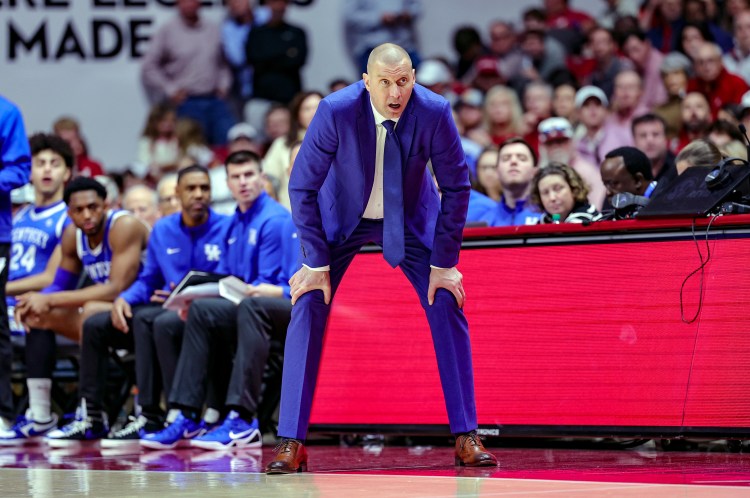
There are certain programs in college basketball where time moves differently. At most schools, a new coach is granted patience, context, and grace. Losses are framed as “part of the build.” Growing pains are expected. At Kentucky, however, the clock starts ticking the moment you walk through the door at the Joe Craft Center. Every possession is magnified. Every rotation choice is scrutinized. Every loss—especially at Rupp Arena—feels heavier than it should.
That reality is now crashing down on Mark Pope.
Kentucky’s loss to Missouri to open SEC play 0–2 was not just another mark in the loss column. It was symbolic. A home loss in conference play. An offense that once again looked disjointed and toothless. A defense that struggled to contain dribble penetration, failed to rotate on shooters, and lacked the physical edge Kentucky fans expect. And perhaps most concerning of all: a team that didn’t appear to have clear answers when adversity hit.
For the first time since 2013, Kentucky dropped its SEC home opener. That alone would be enough to sour the mood in Lexington. But when paired with how the Wildcats are losing—and how uncomfortable the basketball has looked even in wins—it has led to a question fans never expected to ask this soon:
Is Mark Pope already in trouble?
Let’s Be Clear: Mark Pope Is Not on the Hot Seat—Yet
Before emotions run wild, let’s establish an important truth. Mark Pope is almost certainly not on the hot seat right now. Not with the athletic department. Not with the administration. Not in any real, tangible sense that would suggest his job security is immediately threatened.
Kentucky did not hire Mark Pope with the expectation that he would be judged on a two-week stretch of SEC basketball. This was a long-term hire, rooted in belief in his basketball IQ, his understanding of modern offense, his ability to connect with players, and—perhaps most importantly—his deep ties to the Kentucky program itself.
Firing him after one season, or even entertaining that idea, would be organizational malpractice.
And yet… that doesn’t mean the conversation happening among fans is irrational. It doesn’t mean the concern is unfounded. It doesn’t mean the alarm bells are imaginary.
Because while Pope may not be on the hot seat, the seat is warming in the minds of a fanbase that has seen this movie before—and didn’t like how it ended last time.
The Eye Test Is Failing Kentucky
What’s most troubling about this Kentucky team isn’t just the record. It’s the product.
The offense, at times, is downright painful to watch. Spacing collapses. Ball movement stagnates. There are long stretches where the Wildcats look unsure of where their scoring is supposed to come from. Too many possessions end with late-clock bailouts rather than intentional actions designed to create advantages.
This is not what fans were promised.
Mark Pope arrived with a reputation as an offensive mind. His teams at BYU were known for pace, spacing, shooting, and flow. Kentucky fans expected a modern offense that would free players, punish defenses, and make life miserable for opponents.
Instead, what they’re seeing looks hesitant and disorganized.
Defensively, the issues are just as glaring. Kentucky struggles to keep the ball in front of them. Help defense arrives late—or not at all. Closeouts are undisciplined. Rebounding effort fluctuates wildly. And when the game tightens, the Wildcats don’t appear to have a defensive identity they can fall back on.
For a program that once prided itself on toughness and clarity of purpose, that’s jarring.
The Rotations Are Fueling Frustration
If there’s one thing that accelerates fan unrest faster than losses, it’s rotations that don’t make sense.
Kentucky fans have watched multiple games where lineups feel experimental at the wrong moments. Players who appear to have momentum are pulled. Others are given extended runs despite struggling on both ends. Chemistry never seems to settle.
Now, to be fair, roster construction matters here. Pope inherited a complex situation, and blending transfers, young players, and holdovers is not easy. Early-season experimentation is normal.
But the concern is that this doesn’t feel like purposeful tinkering—it feels like searching. And when a coach appears to be searching, fans start wondering whether he truly knows what he has.
At Kentucky, uncertainty is poison.
The Weight of the Logo Matters
This is where context becomes everything.
Mark Pope isn’t just coaching any SEC program. He’s coaching Kentucky. The most scrutinized brand in college basketball. A place where Final Fours are expectations, not dreams. Where Rupp Arena losses linger for years. Where the fanbase doesn’t just watch games—they live them.
Kentucky fans were willing to accept a reset. They were willing to embrace a new voice. Many welcomed Pope precisely because he felt like a cultural reboot—a coach who “got” Kentucky in a way the previous era no longer did.
But goodwill only lasts so long when the product on the floor doesn’t match the promise.
The Missouri Loss Was a Breaking Point
Losing to Missouri at home stung in a way other losses didn’t.
Missouri is not viewed as an SEC heavyweight. Fair or not, Kentucky fans expect to beat teams in the bottom half of the league at Rupp Arena. Period. Especially early in conference play. Especially when you’re trying to establish momentum and belief.
When Kentucky couldn’t do that—when they couldn’t impose themselves at home—it triggered something deeper than frustration. It triggered doubt.
Because if Kentucky can’t win games like that, where are the wins coming from?
Is This Just Year-One Pain—or Something More?
This is the heart of the uncomfortable question.
Is this simply what rebuilding looks like under a new coach? Or are we seeing early signs that the fit might not be right?
It’s unfair to conclude the latter right now. But it’s also dishonest to ignore that the fear many fans had when Pope was hired—is he cut out for this job?—is starting to surface.
Kentucky isn’t forgiving. It doesn’t wait for coaches to grow into the role. It demands that you arrive ready.
And right now, Mark Pope looks like a coach still learning the margins of what this job requires.
Why a Total Collapse Is the Only True Danger
For Pope to truly find himself on the hot seat, things would have to spiral dramatically.
We’re talking about:
A losing SEC record
Continued home losses
No visible improvement offensively or defensively
Recruiting momentum stalling
Rupp Arena growing restless
That’s the scenario where pressure becomes real.
The problem? This team, as currently constructed and performing, doesn’t look immune to that kind of collapse if things don’t change quickly.
That’s not a prediction. It’s a warning.
What Must Change—and Fast
If Mark Pope wants to quiet the noise, several things need to happen:
Offensive Identity – Kentucky must establish what it does well and lean into it relentlessly. No more drifting.
Rotation Clarity – Players need defined roles. Confidence grows from consistency.
Defensive Buy-In – Effort and discipline are non-negotiable at this level.
Home Court Edge – Rupp Arena must become a weapon again, not a pressure cooker.
If improvement is visible—even if wins don’t immediately follow—fans will breathe easier.
But if Kentucky continues to look lost, the conversation will only grow louder.
Final Thought: The Question Isn’t About Firing—It’s About Fit
Right now, the question surrounding Mark Pope isn’t “Should Kentucky move on?”
It’s “Is this going to work?”
That’s a far more dangerous question, because it lingers. It colors every game. It turns every loss into a referendum. And once that doubt takes hold at Kentucky, it’s incredibly hard to shake.
Mark Pope has time. He has support. He has opportunity.
But at Kentucky, time feels shorter, expectations feel heavier, and patience wears thinner with every uncomfortable night at Rupp Arena.
And that’s why—even this early—the question is already being asked.




