


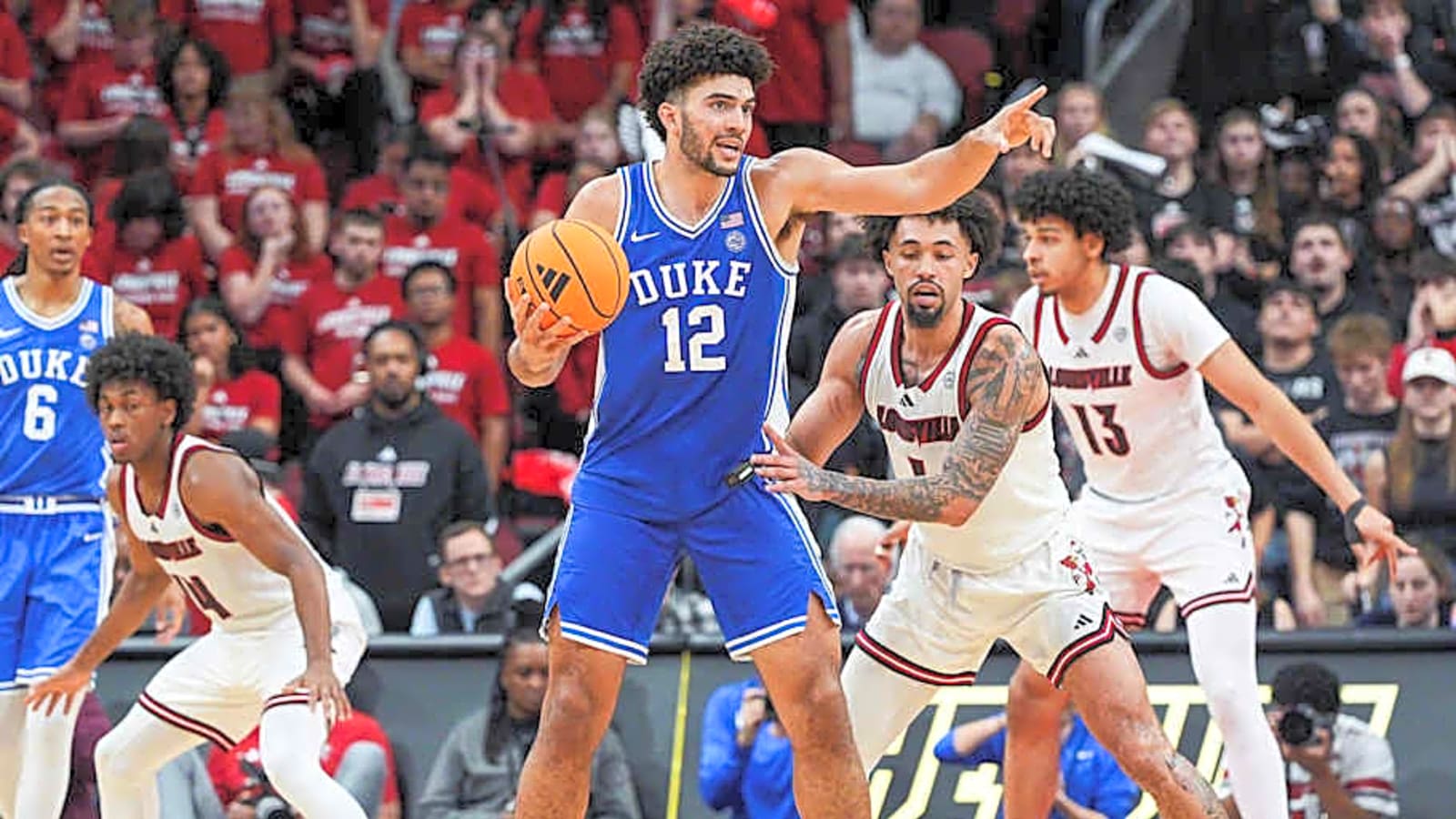
At this point in the season, Cameron Boozer is no longer just Duke basketball’s next great freshman story — he’s becoming one of the most dominant newcomers college basketball has seen in years. What began as sky-high expectations attached to a famous last name has rapidly transformed into something much bigger: a statistical profile that not only stacks up against Duke legends, but also eclipses the recent benchmarks set by the nation’s best players.
Duke isn’t even halfway through its 2025–26 regular season, yet Boozer has already placed himself shoulder-to-shoulder with Cooper Flagg, Marvin Bagley III, RJ Barrett, and Zion Williamson on one of the most telling offensive lists in program history. And if the trends continue, it may only be a matter of time before he stands alone.
After pouring in 27 points during Duke’s 84–73 comeback road win over No. 20 Louisville inside the KFC Yum! Center, Boozer officially tied Cooper Flagg and Marvin Bagley III with eight career 25-point games as a Blue Devil. That number, achieved in just 15 games, already puts him in elite company — and he’s still only 18 years old.
Joining Rare Air in Duke History
Duke basketball has never lacked elite freshmen. The program’s recent history reads like an NBA draft board, with one-and-done stars routinely rewriting record books before moving on to the professional level. Yet even by those lofty standards, Boozer’s early scoring pace stands out.
Here’s where Boozer currently sits among Duke freshmen with the most 25-point performances:
16 — Zion Williamson (2018–19)
14 — RJ Barrett (2018–19)
8 — Marvin Bagley III (2017–18)
8 — Cooper Flagg (2024–25)
8 — Cameron Boozer (2025–26)
7 — Brandon Ingram (2015–16)
What makes Boozer’s placement remarkable is not just the company he keeps, but how quickly he’s arrived there. Williamson and Barrett had a full season of games to reach their totals. Boozer is doing it before Duke has even reached the midpoint of ACC play.
The freshman power forward’s performance against Louisville was the latest example of his poise under pressure. With Duke trailing early and struggling to find rhythm on the road, Boozer became the stabilizing force — scoring efficiently, rebounding through contact, and facilitating offense when defenses collapsed around him.
More Than Points: A Statistical Profile That Demands Attention
While the scoring milestones are eye-catching, Boozer’s overall statistical résumé is what truly elevates him into national conversation. Through 15 starts under head coach Jon Scheyer, Boozer is averaging:
23.3 points per game
9.7 rebounds per game
4.2 assists per game
1.9 steals per game
0.7 blocks per game
He’s doing so with remarkable efficiency, shooting 58.0 percent from the field, 37.3 percent from three-point range, and 77.0 percent at the free-throw line.
For a 6-foot-9, 250-pound freshman, those numbers reflect more than raw talent. They speak to basketball IQ, feel for the game, and an ability to adapt to defensive schemes designed specifically to stop him.
Opposing coaches have already begun throwing doubles, quick digs, and hard hedges at Boozer — yet his production hasn’t dipped. Instead, he’s responded by becoming a more complete offensive weapon.
The Metric That Separates Him From Everyone Else
If there’s one statistic that truly underscores Boozer’s historic start, it’s his offensive rating.
Boozer currently owns a 134.7 offensive rating, a figure that doesn’t just lead the ACC — it outpaces the final marks of each of the last five Naismith Award winners by a significant margin:
Cooper Flagg (2024–25): 123.0
Zach Edey (2023–24): 128.8
Zach Edey (2022–23): 125.9
Oscar Tshiebwe (2021–22): 124.2
Luka Garza (2020–21): 124.0
To be at least five points higher than all of them — as a freshman, halfway through the season — is extraordinary. It places Boozer not just in Duke lore, but firmly into the national Player of the Year discussion.
Advanced metrics reward efficiency, decision-making, and impact per possession — areas where freshmen typically struggle as they adjust to the college game. Boozer, however, looks entirely comfortable.
Built for the Modern Game
Part of what makes Boozer so difficult to guard is his versatility. He can score with his back to the basket, face up slower defenders, stretch the floor with his shooting, and punish switches with his strength.
Unlike some freshmen who rely heavily on athleticism, Boozer’s game is rooted in fundamentals. His footwork allows him to create angles in the post. His passing vision forces defenses to think twice before sending help. And his understanding of spacing allows Duke’s offense to flow naturally around him.
There’s also an element of maturity that stands out. Boozer rarely forces shots. He plays within the system, trusting that the offense will reward him. That patience, combined with his scoring instincts, is what makes him so efficient.
The Weight — and Advantage — of a Legacy
As the son of former Duke national champion and two-time NBA All-Star Carlos Boozer, expectations followed Cameron long before he ever suited up in Cameron Indoor Stadium. For some players, that pressure can be overwhelming.
For Boozer, it appears to be fuel.
Growing up around the game has clearly shaped his approach. He understands preparation. He understands adjustments. And he understands that consistency, not highlight plays, is what separates good players from great ones.
Jon Scheyer has spoken repeatedly about Boozer’s professionalism — from his work habits to his willingness to be coached. That mindset has allowed Boozer to transition seamlessly into a leadership role, even as a freshman.
Duke’s Identity Is Taking Shape Around Him
Perhaps the most telling sign of Boozer’s impact is how Duke plays when games tighten. In hostile environments, when momentum swings and shots stop falling, the Blue Devils have increasingly turned to their freshman forward.
Against Louisville, Duke erased a deficit without holding a halftime lead — a growing trend during ACC play. Boozer’s ability to anchor the offense, score efficiently, and make the right read has been critical in those comeback scenarios.
At 14–1 overall and 3–0 in ACC play, Duke remains unbeaten in conference action, even while navigating stretches of uneven starts. That resilience reflects both coaching and personnel — and Boozer is central to both.
A Clear National Player of the Year Frontrunner?
While the season is far from over, it’s becoming increasingly difficult to ignore Boozer’s candidacy for National Player of the Year honors.
Historically, freshmen face an uphill climb in these races. But Boozer’s combination of volume scoring, efficiency, rebounding, and playmaking places him in rare territory — especially when compared directly to recent winners.
If Duke continues to win, and Boozer maintains anything close to his current pace, the conversation won’t just be about whether he’s the best freshman in the country. It will be about whether he’s the best player, period.
What Comes Next
Duke’s next test comes against No. 24 SMU, as the Blue Devils return home to Cameron Indoor Stadium. Tipoff is set for 2 p.m. ET on ESPN, and it will mark another opportunity for Boozer to add to his rapidly growing résumé.
Opponents will continue to adjust. Defenses will become more physical. Scouting reports will grow thicker. Yet all signs suggest Boozer is prepared for what’s coming.
This isn’t a hot streak. It’s a foundation.
Final Thought
Cameron Boozer tying Cooper Flagg on a historic Duke scoring list is impressive on its own. But when placed alongside his efficiency metrics, all-around production, and team impact, it becomes something much more meaningful.
This isn’t just a freshman making noise. This is a player reshaping expectations — for Duke, for freshmen, and for what dominance looks like at the college level.
And with half a season still to play, the most remarkable part may be this:
Cameron Boozer’s story at Duke feels like it’s only just beginning.




