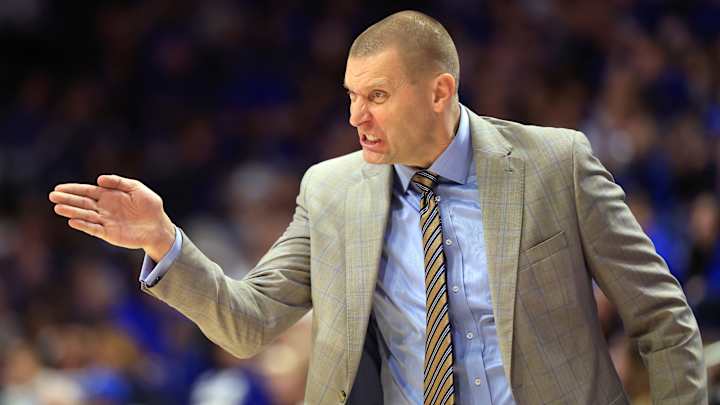
Kentucky basketball is not where Big Blue Nation expected it to be. Not with a $22 million roster, not with an offseason that promised clarity, toughness, and a new identity, and certainly not with a fan base still emotionally drained from a football season that fell apart when it mattered most. So when CBS Sports handed Mark Pope a blunt “D” grade — and Pope didn’t argue it — the moment landed harder than most expected. It wasn’t coach-speak. It wasn’t deflection. It was honesty. And that honesty, more than the grade itself, has forced an uncomfortable but necessary question: does that letter really capture what’s happening at Kentucky right now, or is the story more complicated than a single evaluation can explain?
Straight to the Point: Why the “D” Hit a Nerve
CBS Sports didn’t invent Kentucky’s problems. It simply put a letter on them. The “D” grade was a reflection of unmet expectations, roster imbalance, and a season that has felt disjointed from the opening tip. For a program like Kentucky, grades are rarely given with patience or context — and that’s part of the territory. But what made this moment different was Pope’s response. He didn’t push back. He didn’t argue circumstances. He agreed.
That alone tells you everything you need to know about where this program stands internally.
Mark Pope didn’t inherit a rebuild in the traditional sense. He inherited a brand, a standard, and a fan base conditioned to expect immediate coherence. Last season, he caught lightning in a bottle. A transfer-heavy roster, battered by injuries, still managed to reach the Sweet 16 while beating eight AP Top-15 teams. Kentucky played fast, spaced the floor, and leaned into offensive freedom — even if the defense lagged behind. Many fans complained about the style, but the results spoke loudly enough to keep the noise manageable.
Then came the offseason.
When Listening Too Closely Becomes a Problem
Pope listened. Maybe too much.
The criticism was clear: Kentucky needed more size, more toughness, more “SEC-ready” bodies. Less finesse. Less reliance on shooting. More physicality. In response, Pope pivoted hard. He abandoned the roster balance that made last season work and built a frontcourt overloaded with players who all operate in the same areas of the floor.
Mo Dioubate. Jayden Quaintance. Brandon Garrison. Malachi Moreno. Four bigs. Four interior scorers. Four players who thrive on the block or in pick-and-roll situations. None of them are consistent perimeter threats. None of them stretch the defense. All of them occupy the same offensive real estate.
That’s not versatility. That’s congestion.
Kentucky doesn’t just struggle to score at times — it struggles to function. Defenses don’t have to guess. They pack the paint, clog driving lanes, and dare the Wildcats to beat them from the outside. And most nights, Kentucky simply can’t.
That’s not a talent issue. That’s a construction issue.
The Wing Problem No One Can Ignore
The forward spots were supposed to provide balance. They haven’t.
Kam Williams was expected to be a key shooting piece at the three. Outside of one explosion against Bellarmine, he’s shooting just 24 percent from deep. Trent Noah, the best natural floor-spacer among Kentucky’s forwards, struggles defensively and can’t stay on the floor consistently. Andrija Jelavic has more range than most of the frontcourt, but not enough to command defensive respect.
The result? Every forward Kentucky plays is shooting under 25 percent from three-point range.
That’s not sustainable basketball in 2026.
Teams don’t close out. They don’t rotate hard. They don’t panic. They load up inside, force contested jumpers late in the shot clock, and live with the results. That’s why games feel harder than they should. That’s why Kentucky looks stuck.
Guards Without Identity
The problems don’t stop inside.
Jaland Lowe was brought in with the hope that his efficiency would improve in a better system. It hasn’t. He’s shooting 21 percent from three and continues to take difficult shots. Denzel Aberdeen is streaky by nature. Jasper Johnson can shoot, but his minutes are limited, and he’s still adjusting to the physicality of college basketball.
Otega Oweh was supposed to be the stabilizer — the voice, the tone-setter, the senior who had seen it all. Instead, he’s been inconsistent, turnover-prone, and publicly questioning his own effort. That matters.
Collin Chandler has been Kentucky’s most reliable shooter, but even his numbers are slipping as defenses crowd him, knowing no one else consistently makes them pay.
This is how a team ends up with “no identity.”
Defense Was Supposed to Be the Fix
The irony is that Pope’s pivot was supposed to fix the defense. Bigger bodies. More rim protection. More physical presence.
It hasn’t worked.
Jayden Quaintance averaged three blocks per game last season. Through three games this year, he has two. The system has neutralized his strengths. The rebounding numbers are down. Rotations are slow. Communication breaks down. Kentucky isn’t just bad defensively it’s unsure.
And when a team is unsure, effort becomes inconsistent. Confidence fades. Roles blur.
That’s the real issue CBS Sports graded.
Why Pope Agreeing Matters
Mark Pope agreeing with the “D” grade wasn’t an admission of failure. It was an acknowledgment of reality. This roster, as currently constructed, does not reflect a clear plan. It reflects reaction. And reaction, in college basketball, is dangerous.
But here’s where the headline becomes more complicated than it appears.
Kentucky’s situation isn’t hopeless. It’s flawed not broken.
The talent is real. The effort isn’t absent. The locker room hasn’t fractured. What’s missing is alignment. Pope didn’t lose the program. He lost the balance.
And balance can be corrected.
The Grade vs. the Context
CBS Sports graded outcomes. It didn’t grade intent. It didn’t grade transition. It didn’t grade the reality of integrating a wildly different roster philosophy in one offseason.
That doesn’t mean the grade is wrong. It means it’s incomplete.
Kentucky’s problems are visible. They’re structural. But they’re also fixable — with rotation adjustments, lineup honesty, and a willingness to accept that the offseason pivot may have gone too far.
The “D” grade tells you Kentucky hasn’t met expectations. It doesn’t tell you whether the season is lost.
That distinction matters.
Why This Moment Matters More Than the Grade
The most important part of this story isn’t the letter. It’s the response.
Mark Pope didn’t deflect. He didn’t blame injuries. He didn’t point fingers. He owned it.
In a program that has often been allergic to accountability, that matters.
Now comes the harder part: correcting it.
Because Big Blue Nation isn’t asking for excuses. It’s asking for coherence. For identity. For a team that knows who it is and plays like it.
The “D” grade might be accurate today. But whether it defines Kentucky’s season depends entirely on what Pope does next.
And that’s why this story is far from over.