


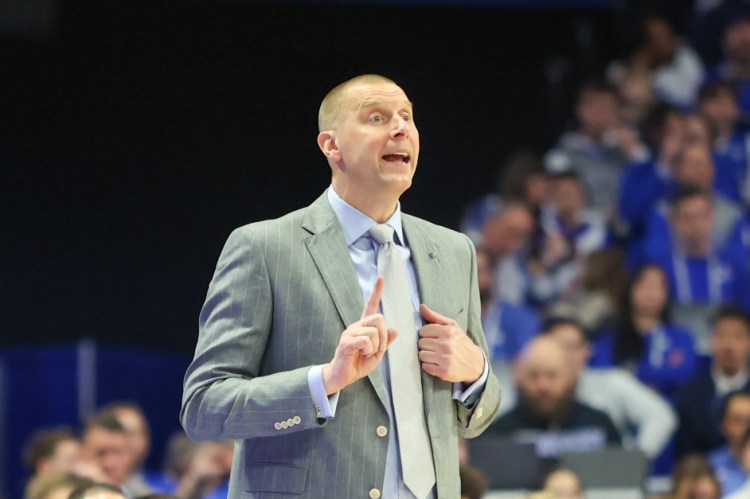
“I spend a lot of time feeling like I’d like to curl up in bed and kill myself, but that’s actually not what we do.”
Everyone knows the pressure of coaching basketball at the University of Kentucky.
The Big Blue Nation has high expectations for the team year in and year out, and with such a passionate fan base, that pressure is relentless. Winning is not merely encouraged at Kentucky — it is expected. Anything short of national contention is often met with frustration, criticism, and scrutiny that few programs in college basketball can truly match.
For Mark Pope, that pressure is not theoretical. It is personal.
Pope understands what Kentucky basketball represents because he once lived it as a player. A former Wildcat, Pope won a national championship in 1996 under Rick Pitino and has long spoken about how the program shapes not just players, but lives. Since being hired as head coach of the Wildcats, he has referenced that history repeatedly, acknowledging the responsibility that comes with leading one of the most tradition-rich programs in all of sports.
However, during a press conference on Friday, Pope made an unusually candid and alarming statement that has since drawn significant attention online and across the college basketball landscape.
“There’s no time for indulging and feeling terrible,” Pope said. “I spend a lot of time feeling like I’d like to curl up in bed and kill myself, but that’s actually not what we do. We raise up and we get to work and we find answers.
“And that’s actually where the great part of life comes from — answering the bell when everybody thinks you can’t do it…”
The statement immediately stood out, not just because of its emotional weight, but because of how rarely such language is used publicly by a sitting head coach at a blue-blood program. While Pope’s intent appeared to center on resilience and perseverance, the phrasing itself sparked concern and debate among fans, media members, and mental health advocates alike.
The Weight of the Kentucky Job
To understand the context of Pope’s remarks, one must understand the Kentucky basketball ecosystem.
Kentucky is not just a college basketball program — it is an identity. The Wildcats’ fan base spans generations, regions, and even continents. The program’s eight national championships, countless NBA alumni, and decades of dominance have created a culture where success is measured at the highest level.
Coaches at Kentucky are not judged solely on wins and losses. They are evaluated on recruiting rankings, NBA draft picks, style of play, tournament performance, and even how convincingly victories are achieved. The scrutiny is constant, magnified by social media, sports talk radio, and a national spotlight that never truly fades.
For Pope, this season has been particularly challenging. As expectations collide with early struggles and inconsistency, criticism has intensified. Every lineup decision, rotation change, and late-game outcome has been dissected, often publicly and harshly.
Pope’s quote appears to be a reflection of that environment — not an admission of intent, but an expression of emotional exhaustion in a role that offers little margin for error.
A Rare Glimpse Behind the Curtain
What made Pope’s comment resonate so strongly is how rare it is for coaches, especially at programs like Kentucky, to speak openly about emotional strain.
Coaches are typically expected to project confidence, composure, and control at all times. Vulnerability is often discouraged, seen as weakness in a profession that rewards toughness and certainty. Pope’s words cut against that expectation, revealing a human side that is often hidden behind podiums and press conferences.
That honesty, however, came with consequences.
While some fans praised Pope for his transparency and willingness to address the mental burden of leadership, others expressed concern about the phrasing itself. In today’s sports landscape, where mental health awareness has become increasingly prominent, language matters — especially when spoken by influential figures.
Public Reaction and Online Discourse
Following the press conference, clips of Pope’s statement circulated rapidly on social media. The reaction was swift and divided.
Some supporters defended Pope, emphasizing the broader message of resilience and accountability. They pointed out that the quote was not an expression of intent, but rather a metaphor for emotional fatigue — a way of describing how overwhelming the job can feel at times.
Others, however, were unsettled by the wording, arguing that such language should be handled with greater care, particularly given the platform Pope occupies. Mental health advocates noted that even metaphorical references can carry weight and unintended impact.
What is clear is that the quote struck a nerve, forcing a conversation that extends beyond basketball and into the realities of leadership, pressure, and emotional well-being.
A Familiar Echo From Rick Pitino
It is worth noting that Pope’s mentor, Rick Pitino, made a somewhat similar comment in 2024 following a loss to Creighton. Pitino, who coached Pope during his playing days at Kentucky, has also been known for his emotional candor and intensity.
That connection adds another layer to the discussion. Both men have experienced the highs and lows of elite coaching, and both have spoken openly about how consuming the profession can be. In that sense, Pope’s comment may reflect a lineage of coaches shaped by environments where winning is demanded and anything less feels like failure.
The Broader Conversation Around Coaching Mental Health
Pope’s statement arrives at a time when mental health in sports is receiving more attention than ever before. Athletes across leagues have spoken openly about anxiety, depression, and burnout. Coaches, however, are often left out of that conversation, despite facing immense pressure and isolation.
Unlike players, coaches cannot rotate out of criticism. They cannot escape blame with graduation or the draft. Their performance is judged continuously, and job security is often tied to results that depend on dozens of variables beyond their full control.
In that context, Pope’s remarks may serve as an uncomfortable but necessary reminder that coaches, too, are human.
What Comes Next for Pope and Kentucky
On the court, Kentucky still has time to define its season. Adjustments can be made, rotations refined, and momentum rebuilt. Off the court, Pope will continue to face scrutiny — not only for results, but now for how he communicates under pressure.
It remains to be seen whether Pope will clarify or further address his comments. What is certain is that the spotlight will not dim. At Kentucky, it never does.
For now, Pope’s quote stands as one of the most emotionally raw statements made by a Wildcats coach in recent memory — a moment that peeled back the curtain on the immense toll of leading one of college basketball’s most demanding programs.
Whether viewed as troubling, courageous, or simply human, it has undeniably sparked a conversation that extends far beyond wins, losses, and box scores.




