


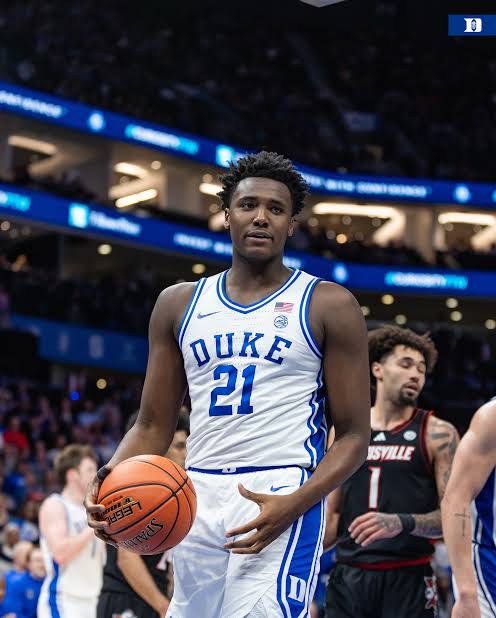
On a night that began with uncertainty and an all-too-familiar slow start, Duke men’s basketball found clarity in an unexpected place. It didn’t come from a pregame adjustment scribbled on Jon Scheyer’s whiteboard, nor from a dominant opening run meant to quiet early nerves. Instead, it arrived in the steady, composed emergence of Patrick Ngongba II — a player who didn’t start the game, but may have finished it having altered the Blue Devils’ trajectory. In front of a charged Cameron Indoor crowd, Ngongba’s career night and Duke’s recommitment to disciplined, suffocating defense powered a hard-earned win over No. 24 SMU — and in the process, raised a question that could shape Duke’s rotation moving forward.
A bold tweak — and a familiar problem early
Jon Scheyer entered the matchup clearly determined to confront one of Duke’s most persistent issues this season: slow starts. Against quality opponents, the Blue Devils had too often found themselves digging early holes, relying on late-game execution to escape. This time, Scheyer attempted to flip the script.
The Duke head coach unveiled a more defense-oriented starting lineup, inserting Maliq Brown into the starting five for the first time in his career. Freshman stretch forward Dame Sarr also earned a start, giving Duke more length, switchability, and rim protection on paper. The move sent a clear message — defense first, set the tone, absorb the early punch.
But basketball doesn’t always cooperate with intentions.
SMU came out aggressive, confident, and unbothered by Duke’s adjustments. Within just over three minutes, the Mustangs sprinted to a 13–3 lead, exploiting defensive breakdowns and attacking before Duke could settle in. Brown, tasked with anchoring the defense early, quickly picked up his second foul at the 16:47 mark. Scheyer was forced to adjust — and that adjustment changed the game.
Patrick Ngongba II checked in.
Ngongba’s moment arrives — and he doesn’t look back
From the instant Ngongba stepped onto the floor, the energy shifted. The sophomore forward didn’t rush, didn’t overextend, and didn’t try to do too much. Instead, he did something far more impactful: he played within himself — and dominated the margins.
Ngongba tied a career-high with 17 points in 27 minutes, finishing efficiently and confidently. He went 5-for-6 from the free throw line, converting when Duke needed steadiness most. More importantly, he grabbed three critical offensive rebounds — possessions that broke SMU’s momentum and reinforced Duke’s physical presence inside.
Perhaps most telling of all: Ngongba recorded just two fouls.
For a player who had struggled with foul trouble in ACC play — including four fouls in Duke’s previous game at Louisville — this discipline was as significant as the points themselves. Against SMU, Ngongba showed growth not just as a scorer, but as a defender who understood positioning, timing, and restraint.
That combination — production without fouling — is exactly what Duke has been searching for in the frontcourt.
Defense becomes Duke’s foundation again
While Ngongba’s offensive efficiency stood out, this win was ultimately rooted in defense. Duke didn’t just survive SMU’s early surge — it absorbed it, adjusted, and gradually imposed control.
After falling behind by double digits, the Blue Devils began stringing together stops. Ngongba and Cayden Boozer provided immediate interior stability, cutting off driving lanes and forcing SMU into contested looks. Duke’s rotations sharpened, help defense arrived on time, and passing lanes tightened.
Within minutes, Duke erased the deficit.
The Blue Devils trimmed the margin to 15–14 less than four minutes after being down by 10, signaling that the early chaos would not define the night. Free throws from Cayden Boozer gave Duke an 18–17 lead — one it would never relinquish.
This stretch wasn’t flashy, but it was revealing. Duke didn’t rely on a scoring run fueled by tough shot-making. Instead, it leaned on discipline, communication, and physicality — the very traits that have defined Duke at its best under Scheyer.
Enduring SMU’s response — and proving maturity
To SMU’s credit, the Mustangs refused to fade quietly. Even without their leading scorer, senior guard Boopie Miller, they continued to apply pressure, especially in the second half.
Duke led by six at halftime and pushed the advantage to as many as 13 early in the second half. But SMU countered with multiple surges, exploiting brief lapses and testing Duke’s composure. With 4:33 remaining, the Mustangs clawed back to within three, turning the game into a grind.
This is where Duke’s growth became most evident.
Instead of panicking, the Blue Devils trusted their defensive identity and executed in the half-court. Cameron Boozer delivered calm, clutch free throws. Isaiah Evans, whose offensive role continues to expand, stepped up with poise. Duke made SMU earn every look down the stretch — no cheap fouls, no rushed possessions.
With 1:44 left and Duke holding a 73–70 lead, the Blue Devils closed the door the way elite teams do: at the line, on the glass, and with disciplined defense.
Ngongba as Duke’s potential third option
Perhaps the most intriguing takeaway from the night wasn’t just that Duke won — it was how it won and who helped make it possible.
Cameron Boozer remains Duke’s offensive anchor, delivering consistency night after night. Isaiah Evans has steadily emerged as a dynamic scoring threat, capable of creating mismatches and momentum-shifting plays.
But against SMU, Duke found something else: a reliable third option.
With junior guard Caleb Foster scoreless after recording a career-high in the previous game, Duke needed production from elsewhere. Ngongba answered that call decisively. His ability to score efficiently inside, draw fouls, and extend possessions provided balance that Duke has occasionally lacked.
More importantly, Ngongba didn’t need touches drawn up specifically for him to be effective. He scored within the flow of the offense — off rebounds, cuts, and smart positioning. That adaptability makes him especially valuable as the season progresses.
What this means for Duke’s rotation
This performance raises a real, unavoidable question: has Patrick Ngongba II earned a larger — perhaps more consistent — role in Duke’s rotation?
Scheyer’s decision to start Maliq Brown was




