


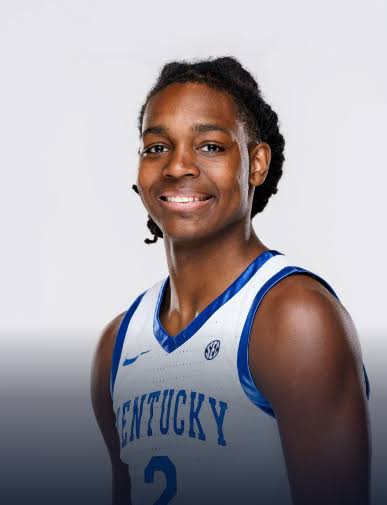
If you look only at the box scores, it is easy to understand why some Kentucky fans are nervous. A freshman guard adjusting to SEC basketball, uneven shooting nights, turnovers that feel loud, and moments where the game seems just a half-second too fast. But if you listen closely to Mark Pope, you hear something very different. You hear a coach who believes the most important part of the process is already happening. The light bulb is flickering, and in Pope’s experience, once it fully turns on, everything else follows.
With Jaland Lowe sidelined, Kentucky’s backcourt responsibilities have shifted dramatically. The metaphor Pope used earlier in the season still applies: the keys to the Ferrari have been handed over. Now, those keys are shared among Jasper Johnson, Denzel Aberdeen, and Collin Chandler. It is not an easy assignment, especially in the SEC, and especially for a freshman whose basketball background looks nothing like the one Pope himself grew up in.
Johnson’s journey from Overtime Elite to running a structured, read-heavy SEC offense was never going to be seamless. That reality, however, has not stopped fans from reacting to every misstep as if it were a final verdict. Pope, on the other hand, is evaluating Johnson through a very different lens. He is not judging him by mistakes alone. He is judging him by what he sees between those mistakes.
On Monday night, Pope took to the airwaves to push back on the growing narrative that Johnson is overwhelmed. In doing so, he offered a window into how coaches evaluate growth long before it shows up cleanly in the stat sheet.
“Jasper has got a really underappreciated ability to pass the ball,” Pope said, a statement that immediately reframes the conversation.
Passing is often the last thing fans notice when a freshman guard is struggling. Turnovers get amplified. Missed shots feel decisive. But passing, especially advanced passing, is about vision, anticipation, and trust in structure. Pope’s offense demands all three, and it is exactly where Johnson’s learning curve has been steepest.
The jump from OTE to the SEC is not just about speed or physicality. It is about discipline. OTE, by design, plays more like AAU basketball. Freedom is encouraged. Reads are simpler. Creativity often outweighs precision. That environment can produce elite individual talent, but it does not prepare players to immediately orchestrate an offense built on timing, spacing, and layered decision-making.
Pope acknowledged this head-on.
“There is a learning curve,” he admitted. “We talked about this earlier as Jody was talking about Joe Crawford. It made me think of Jasper and the experience he’s going through right now. Every rookie goes through this experience.”
That comparison matters. Joe Crawford, now remembered fondly by Kentucky fans, did not arrive as a finished product. His early career included plenty of inconsistency, but the program invested in his growth because they saw foundational skills that could not be taught overnight. Pope sees Johnson in a similar phase.
What separates Pope’s evaluation from surface-level criticism is specificity. He is not offering vague encouragement. He is pointing to exact reads and exact actions that signal progress.
“He’s getting more comfortable with finding seams and finding gaps and finding space to make plays,” Pope explained.
Those words matter. Finding seams is not accidental. It means a guard understands how defenders are positioned before the play even develops. Finding gaps requires patience and awareness, especially in ball-screen situations where one wrong step collapses spacing. Finding space to make plays means a player is beginning to manipulate defenders rather than react to them.
Perhaps most telling was Pope’s comment about Johnson’s ability to hit the roll man.
“He’s one of our most talented guys at hitting the roll, actually.”
In a vacuum, that might sound like faint praise. In Pope’s offense, it is anything but. Kentucky relies heavily on ball-screen action. The entire structure of the offense depends on guards making quick, accurate decisions when the defense commits. Can you hit the big when the help defender tags late? Can you deliver the ball at the right angle so the roller can finish or kick out? These are not freshman-level expectations. These are the reads that separate functional offenses from elite ones.
Johnson’s growing comfort in that area suggests something important. He is no longer just surviving possessions. He is starting to see them.
That does not mean the mistakes disappear overnight. In fact, the opposite is often true. As young guards expand their decision-making, turnovers can temporarily increase. The player tries passes he would not have attempted earlier. He pushes the pace. He trusts reads that are still forming. Coaches often welcome that phase, even when fans do not.
Very few young point guards step onto the floor and run the show immediately. Kentucky fans have been spoiled by rare exceptions. The run of point guards under John Calipari created unrealistic expectations about how quickly mastery should arrive. What often gets forgotten is that even those guards struggled early, but their struggles were framed differently because of roster context and star power around them.
Johnson does not have that luxury. With Lowe out, his responsibilities have accelerated. He is learning in real time, against elite competition, with the spotlight fixed firmly on every possession.
Yet within that pressure, Pope sees something else: confidence building quietly beneath the noise.
Johnson is also a strong rim finisher, another trait that has been easy to overlook amid the focus on mistakes. When guards begin to balance playmaking with scoring aggression, defenses have to make choices. If Johnson continues to threaten the rim while improving his reads, the entire offense opens up. Roll men get easier looks. Shooters benefit from cleaner kick-outs. Transition opportunities increase.
This is why Pope remains calm while fans panic. He understands where Johnson is in the developmental arc. He also understands that growth rarely moves in a straight line.
For Kentucky, the timing matters. Conference play does not wait for freshmen to mature. But teams that peak late often look very different than they did in January. If Johnson’s vision continues to sharpen, the early growing pains may be remembered as necessary steps rather than warning signs.
There is also a psychological component at play. Young guards need belief from their coach as much as instruction. Publicly defending Johnson’s vision sends a message not only to fans but to the player himself. Pope is telling Johnson that the process is working, even if the results are not always clean yet.
That trust can be transformative. When players feel trusted, they play freer. When they play freer within structure, creativity returns. That balance is where Pope’s offense thrives.
None of this guarantees stardom. Development is not linear, and the SEC is unforgiving. But it does suggest that the panic surrounding Johnson may be premature. Coaches evaluate patterns. Fans react to moments. Right now, those two perspectives are not aligned.
If Pope is right, the version of Jasper Johnson Kentucky sees in February and March may look nothing like the one fans are currently dissecting. The reads will be faster. The mistakes quieter. The confidence visible.
And when that happens, the same conversations that feel anxious today will be rewritten as evidence of growth.
Because sometimes, the most important progress is happening where the box score cannot see it yet.




