


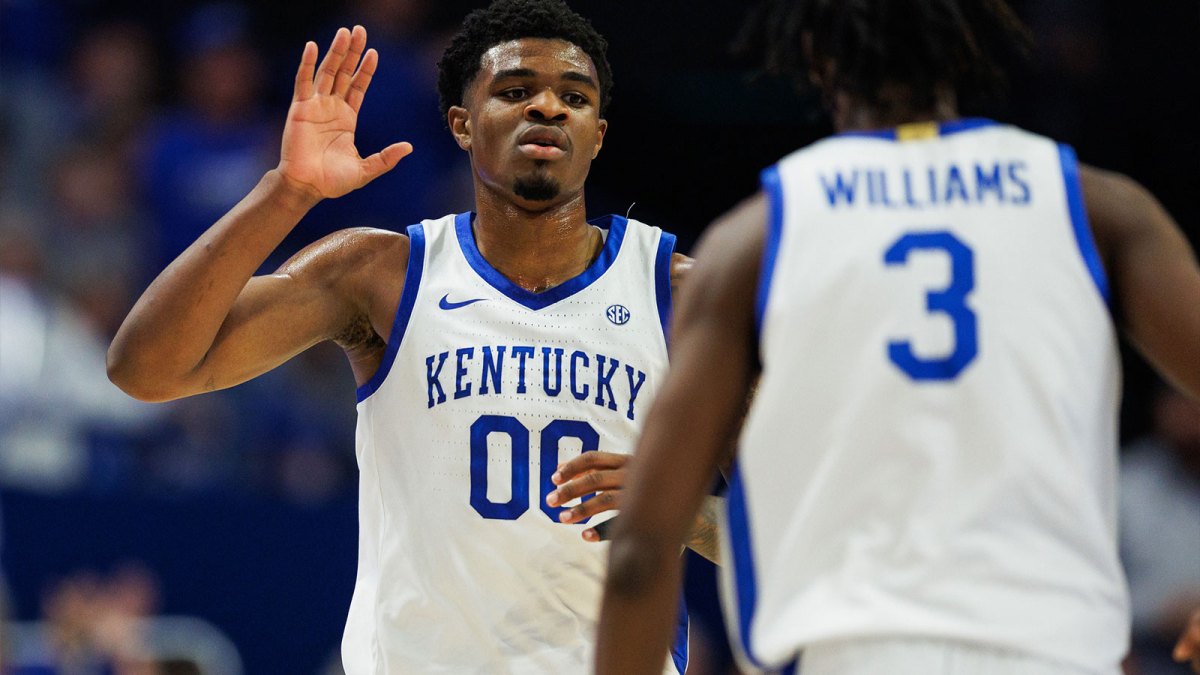
Kentucky basketball fans witnessed a game Wednesday night that will be talked about for weeks. Trailing 38-22 at halftime against the LSU Tigers at the Maravich Center, the Wildcats staged an improbable comeback that seemed almost impossible on paper. When Malchai Moreno drained the game-winning shot to seal a 75-74 victory, many eyes turned to the heroics that made such a comeback possible. Chief among them was Otega Oweh, whose performance was described as “heroic” by Kentucky head coach Mark Pope—especially considering the fact that Oweh almost didn’t make it to the court that night.
Oweh’s impact went far beyond the stat sheet. Though he recorded a game-high 21 points on six-of-13 shooting from the field, including three-of-six from beyond the arc, he also contributed four rebounds, two steals, and an assist. These numbers, impressive in any context, become extraordinary when placed alongside the adversity he overcame. According to Pope, Oweh had missed shootaround that morning due to illness, battling through symptoms that might have kept a lesser player on the bench. Yet, when it mattered most, Oweh stepped onto the floor, lifted his team, and led Kentucky through one of its most memorable comebacks of the season.
“You think about Otega,” Pope said after the game. “You know, Otega Oweh, another heroic performance from him—and he couldn’t even make it to shootaround this morning. He was so sick.”
Pope’s acknowledgment goes beyond mere praise; it contextualizes the difficulty of what Oweh achieved. Shootaround is a critical part of preparation for any game, particularly for a high-stakes matchup like Kentucky vs. LSU. Missing it can throw off rhythm, timing, and confidence. Yet, Oweh’s ability to shake off illness, focus on the task at hand, and deliver a performance that energized the Wildcats speaks to his resilience, preparation, and mental toughness.
“He’s been really under the weather and just battled through it tonight,” Pope continued. “So there’s all those dynamics, but it’s a credit to these guys for staying in there and finding a way to do it.”
Kentucky’s comeback against LSU was more than just a collection of individual heroics; it was a testament to teamwork, perseverance, and leadership under pressure. The Wildcats had struggled through the first half, falling behind by 16 points as LSU appeared to dominate the pace and flow of the game. Shots weren’t falling, turnovers crept in, and the Tigers’ defense forced Kentucky into mistakes. But the second half told a completely different story. The Wildcats poured in 53 points, methodically eroding LSU’s lead while Oweh and his teammates elevated their play.
Pope didn’t just single out Oweh for his scoring; he also emphasized his leadership on the floor. “There were 15 times in the second half where we could have folded—and there were more than that in the first,” Pope said. “But they just kept hammering away. I think Otega’s leadership was great, I think D.A.’s (Denzel Aberdeen’s) leadership was great. I thought we got a lot of great concerted efforts where our guys did a good job not paying attention to the scoreboard and just trying to continue to compete harder and harder.”
Leadership in basketball isn’t always measured in points. It’s measured in the ability to motivate teammates, maintain composure under pressure, and set an example through effort. Oweh’s combination of scoring efficiency, defensive awareness, and unrelenting energy clearly inspired those around him, creating a momentum shift that few saw coming. Senior guard Denzel Aberdeen echoed these sentiments after the game, praising Oweh’s ability to drive downhill and create scoring opportunities not just for himself but for his teammates. “Otega was getting downhill and creating plays for us,” Aberdeen said. “It lifted our energy and gave us confidence when we needed it the most.”
Statistically, the performance stood out as one of Oweh’s most efficient games this season. Six made field goals on 13 attempts, three made 3-pointers on six attempts, four rebounds, two steals, and an assist may look like solid numbers on paper, but when paired with the context of illness and the pressure of an intense second-half comeback, they become exceptional. It’s one thing to score points when your body is healthy; it’s another to do so when every muscle feels heavy, every breath is labored, and every defensive possession tests your stamina.
Beyond Oweh, Kentucky’s team effort was remarkable. While the spotlight often falls on the player making the game-winning shot—Moreno, in this case—the Wildcats’ collective resilience made that moment possible. Pope’s comments highlighted this, focusing on the perseverance of multiple players. In the second half, Kentucky had numerous opportunities to give in to the deficit, but the players kept competing. Pope’s reference to “concerted efforts” points to a team culture that emphasizes process over results, effort over panic, and persistence over frustration.
Analyzing the second half, Kentucky’s offensive adjustments were key to the comeback. The Wildcats increased ball movement, forced LSU to rotate defensively, and took advantage of mismatches that opened up driving lanes for Oweh, Moreno, and Aberdeen. The ability to capitalize on these opportunities under pressure is a hallmark of an experienced and confident squad, even in the face of adversity. Defensive energy also played a crucial role; forcing turnovers and converting them into transition opportunities helped close the gap in a hurry.
Pope’s praise of Oweh also underscores the importance of intangible qualities in basketball. Talent can be measured in points, rebounds, and assists, but courage, resilience, and determination are harder to quantify yet often more decisive. Oweh’s willingness to push through illness and still compete at a high level reflects these qualities. It’s a lesson in leadership by example, one that elevates not just the individual but the entire team.
The Wildcats’ record now stands at 11-6 as they look to carry this momentum into their next matchup against the Tennessee Volunteers. With Oweh in form and a renewed sense of confidence from the LSU comeback, Kentucky has a blueprint for success even when faced with challenging circumstances. The game also serves as a reminder that leadership and heroics aren’t always about scoring the final shot; sometimes, it’s about setting the tone, pushing teammates, and refusing to let external factors—illness, fatigue, or pressure—determine the outcome.
Looking ahead, the Wildcats will need more performances like Oweh’s if they hope to make a deep run in conference play and beyond. Teams will adjust, defenses will tighten, and the margin for error will shrink. Having a player capable of inspiring the squad and contributing in multiple facets of the game—even when not at full strength—is invaluable. Kentucky’s coaching staff will likely continue to lean on Oweh not just for scoring but for leadership and energy, setting a standard for younger players on the roster.
This game also provides insight into Mark Pope’s coaching philosophy. His willingness to publicly acknowledge Oweh’s struggle and resilience illustrates a culture of appreciation and recognition. Pope doesn’t merely celebrate results; he celebrates effort, process, and overcoming adversity. By highlighting Oweh’s heroic performance, Pope reinforces the idea that Kentucky basketball values courage, grit, and teamwork—qualities that often define championship-caliber teams.
For fans, moments like this are what make college basketball compelling. The combination of skill, strategy, adversity, and leadership creates narratives that go beyond wins and losses. Oweh’s performance is now part of Kentucky basketball lore—a reminder that sometimes the most heroic efforts come not from flawless execution but from fighting through obstacles and inspiring those around you.
As the Wildcats prepare for Tennessee, questions remain: Can they replicate this level of energy and resilience? Will Oweh continue to lead by example even when faced with physical or mental challenges? How will the team sustain the confidence gained from such a dramatic comeback? While these questions remain, one thing is clear: Kentucky basketball is in capable hands when players like Otega Oweh rise to the occasion, defying expectations and demonstrating what it truly means to be heroic.
Ultimately, this game will be remembered not just for Moreno’s dagger or the final scoreline but for the story of a player who overcame illness, the leadership that inspired a team, and a coach who recognized the heroism behind the stats. Oweh’s performance is a reminder that heroics in sports aren’t just about the obvious moments; they’re about heart, perseverance, and elevating everyone around you.
Kentucky basketball’s victory over LSU may be one game among many in a long season, but it serves as a microcosm of what makes this program special: talented players, dedicated coaching, and the kind of resilience that turns potential defeats into unforgettable triumphs. Otega Oweh’s heroic night will be replayed in highlight reels, but more importantly, it will be remembered as a testament to courage, leadership, and the intangible qualities that define winners both on and off the court.




