


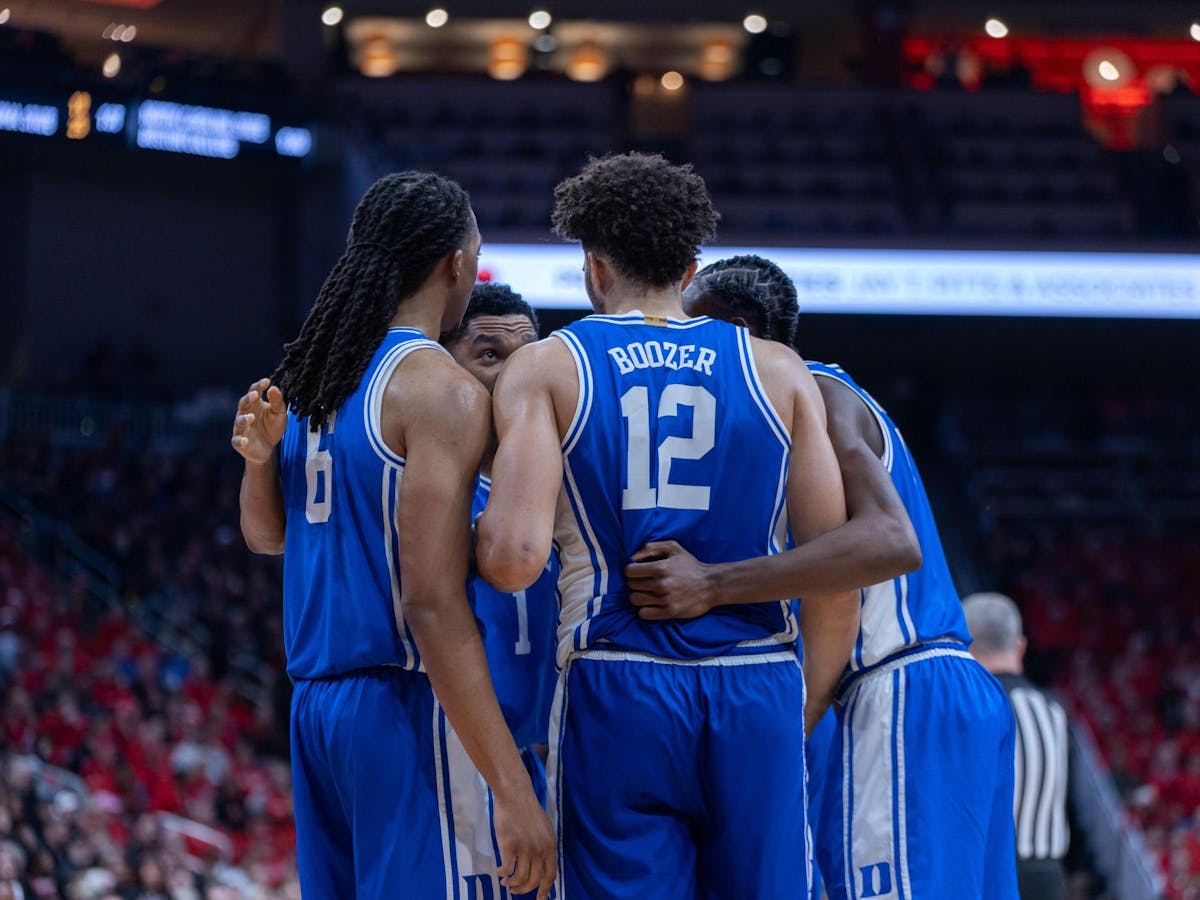
There’s nothing like a late-night tipoff in Berkeley, California, to remind a team just how long and unforgiving a college basketball season can be. For Duke, an ACC program accustomed to spotlight games and national scrutiny, the setting alone could have been a trap. An 11 p.m. Eastern tip. A cross-country flight. A sold-out Haas Pavilion. And a Cal team eager to measure itself against one of the sport’s blue bloods.
None of it mattered in the final accounting.
Despite one of its poorest shooting performances of the season and yet another sluggish start, Duke walked off Pete Newell Court with a convincing 71-56 win, improving to 5-0 in ACC play and reinforcing a growing truth about this year’s Blue Devils: perfection is optional, winning is not.
This was not a game Duke won with elegance. It was won with discipline, adaptability, and a relentless commitment to exploiting strengths even when weaknesses threatened to overwhelm them.
After edging SMU by seven points at Cameron Indoor Stadium earlier in the week, Duke headed west for a two-game California swing against Cal and Stanford. By the time the ball went up in Berkeley, it was nearly midnight back in Durham. Jet lag, unfamiliar rims, a different basketball, and a hostile crowd all hovered as potential excuses.
Jon Scheyer wasn’t interested.
“The transition, I think, East Coast to West Coast is, I don’t want to say it’s easy, because you have to adjust and all that,” Scheyer said postgame. “But these guys [Cal and Stanford] have to do it all the time. We have to do it once. And I thought, for us, we’re a no-excuse program. We were just ready to roll. Whatever time we were playing, we’d be ready.”
That mindset mattered, because Duke didn’t look ready early. The Blue Devils missed their first four three-point attempts, three of them coming from sophomore wing Isaiah Evans, one of the team’s most reliable perimeter shooters. The offense sputtered. Free throws clanged. And once again, Duke struggled to establish rhythm in the opening minutes.
Slow starts have quietly become a trend during ACC play. In nearly every conference game, Duke has needed time to settle in, adjust to defensive pressure, and recalibrate its shot selection. Against Cal, those early struggles were magnified by historically poor shooting numbers.
Duke finished the game shooting just 7-of-32 from three-point range. From the free-throw line, the Blue Devils were even worse, converting only 47.1 percent of their attempts — the lowest mark of the season and one of the poorest single-game performances under Scheyer.
Yet somehow, none of it mattered.
“I thought we took great shots. We just weren’t making a lot of them,” Scheyer explained. “Even the free throws we weren’t making. I’m thinking still about how I can help them, because I thought most of the threes we took were good shots.”
Cal simply could not match Duke where it mattered most: inside.
Once the Blue Devils leaned fully into their interior advantage, the game tilted decisively. Duke outscored Cal 42-16 in the paint, a staggering margin that told the real story of the night. In the second half alone, Duke owned the interior by a 24-2 margin, fueled by offensive rebounding, physicality, and the dominance of Cameron Boozer.
The freshman phenom delivered one of his most complete performances of the season, finishing with 21 points and 13 rebounds, including four on the offensive glass. Time and again, Boozer punished Cal defenders with strength, patience, and elite positioning. When Duke’s perimeter shots refused to fall, Boozer became the stabilizer, the constant, the anchor.
None of this was accidental.
Scheyer emphasized the importance of “inflection points” — moments where teams must recognize what is and isn’t working and adjust accordingly.
“They didn’t have an answer for us in the paint,” Scheyer said. “So, for our guys, we’re asking them to understand the inflection points in the game. Understand what our strengths are to another opponent. I thought we did a great job just hammering that thing inside the last 10, 15 minutes of the game.”
That adaptability separates good teams from elite ones. Duke didn’t stubbornly chase threes. They didn’t panic. They trusted the game plan and trusted their personnel.
Sophomore Isaiah Evans echoed his coach’s mentality, even while offering a candid aside about the unfamiliar Wilson Evolution ball used in ACC play — a basketball he admitted isn’t his preference compared to Nike.
“It’s not something I like to make excuses about,” Evans said, though he acknowledged it may have impacted free-throw shooting. “We’re a no-excuse team.”
The numbers support that claim. Despite shooting poorly from both the floor and the line, Duke’s 15-point victory represented its largest ACC margin of victory this season. That alone underscores how complete the performance was in areas that don’t show up neatly in shooting percentages.
Defensively, Duke remained composed. Cal never found sustained offensive rhythm, struggled to score in the half court, and failed to generate consistent second-chance opportunities. Duke’s rebounding, particularly on the offensive end, became a weapon rather than a necessity.
And while the Blue Devils continue to flirt with inconsistency in the opening minutes of games, their composure late has been unwavering. After nearly 20 contests, Duke’s lone blemish is a one-possession loss — a remarkable statistic given the youth of the roster and the ongoing adjustments Scheyer has managed.
Perhaps most telling is how this team prepares.
“We do a lot of things different than other people,” Evans said. “We got here two days early. We did cold plunges in the morning the next day. We didn’t sleep on the plane on the way here, because we wanted to get that first night’s rest to shape our sleep schedule.”
Those details matter over a long season. They reflect a program that understands winning on the road requires planning, discipline, and buy-in long before tipoff.
As Duke looks ahead to Stanford and deeper into ACC play, the blueprint is becoming clearer. The Blue Devils do not need to be perfect shooters to win. They do not need explosive starts. What they need — and consistently display — is the ability to adapt, dominate their advantages, and close games with authority.
This team wins ugly when necessary. It wins pretty when allowed. And perhaps most importantly, it keeps winning even while leaving obvious room for growth.
That combination should worry the rest of the ACC.
Because if Duke is 5-0 in conference play while shooting under 50 percent from the free-throw line and missing 25 threes in a single game, the ceiling remains tantalizingly high.
Wins don’t require flawlessness. They require solutions.
On a late night in Berkeley, Duke found theirs — again.




