


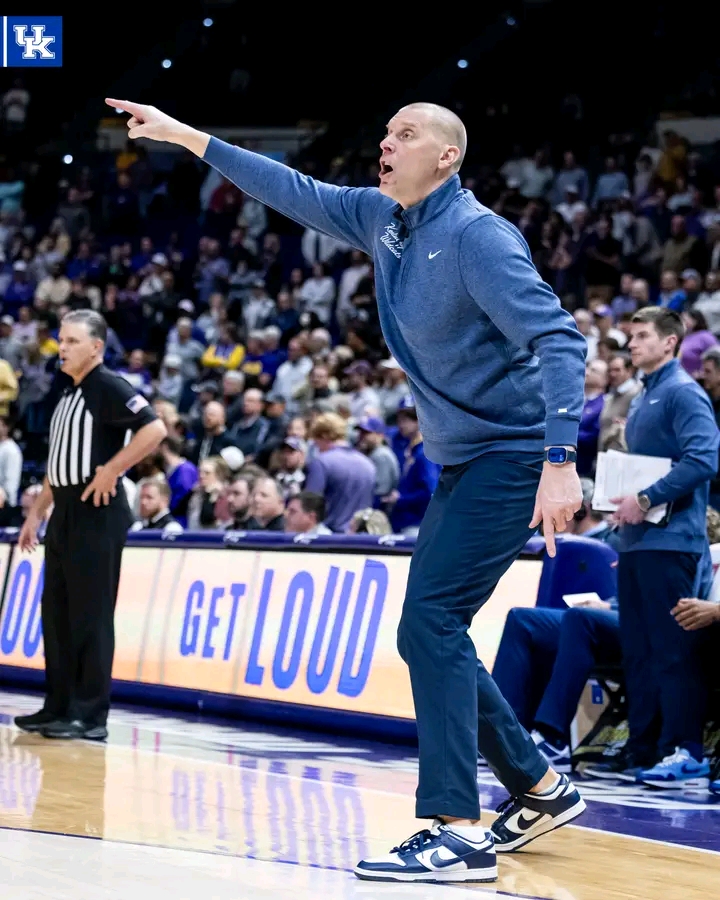
For a few breathless seconds inside the Maravich Center, Kentucky basketball felt alive again. The frustration of early-season injuries, the anxiety of close losses, and the doubt that had quietly crept into Big Blue Nation all vanished as Malachi Moreno’s buzzer-beater ripped through the net. It wasn’t just a game-winning shot. It felt like a reminder. A reminder that this season, written off by many far too early, still has chapters left to be written. But as thrilling as that moment was, it also raised a bigger, unavoidable question: where does Kentucky actually stand when it comes to March Madness?
According to USA TODAY Sports’ opening bracketology for the 2025–26 season, the answer is both encouraging and unsettling.
The Wildcats are in the field. Barely.
USA TODAY projects Kentucky as a No. 10 seed in the South Region, matched up with St. John’s in the first round. On paper, that’s a relief for a fanbase that just weeks ago was wondering whether the NCAA Tournament was slipping away entirely. In reality, it’s also a warning sign. A 10 seed in January is not a position of comfort. It’s a reminder that while Kentucky’s season has stabilized, it is far from secure.
To understand how the Wildcats landed here, you have to rewind to the start of conference play, when optimism met reality in a hurry.
Kentucky entered the season with lofty expectations. A retooled roster, a new coaching era, and the ever-present standard of championship contention created an atmosphere of cautious excitement. The talent was evident. The upside was undeniable. But the margin for error quickly disappeared.
Injuries disrupted continuity. Poor shooting plagued winnable games. Defensive lapses turned manageable deficits into losses. And perhaps most concerning, the roster often looked like a collection of parts that hadn’t quite figured out how to function as a whole.
The low point came early in SEC play. An 0-2 conference start, capped by a deflating loss to Missouri in which Kentucky appeared to give the game away, sent shockwaves through the fanbase. Suddenly, the conversation wasn’t about seeding or matchups. It was about survival.
Was this team even an NCAA Tournament team?
That question lingered longer than anyone in Lexington was comfortable admitting.
Then came the response.
Kentucky steadied itself with back-to-back wins, the second of which will live in program lore for years. Trailing LSU by as many as 18 points on the road, the Wildcats clawed their way back with resilience that had been missing earlier in the season. When the moment demanded poise, it was Malachi Moreno — not the primary option on the play — who delivered the defining shot.
That win didn’t just improve Kentucky’s record. It changed the tone around the program.
Momentum, however, doesn’t guarantee security. And bracketologists aren’t paid to be sentimental.
USA TODAY Sports’ decision to place Kentucky as a 10 seed reflects exactly where the Wildcats sit in the national picture: relevant, but vulnerable.
A 10 seed is typically reserved for teams with visible flaws but enough quality wins to justify inclusion. It’s the territory of squads that have shown flashes of high-level play without proving consistency. That description fits Kentucky almost too perfectly.
The matchup itself is fascinating. A first-round meeting with St. John’s would reunite Kentucky with Rick Pitino, a familiar figure whose history with the program adds intrigue to any potential clash. Kentucky already defeated the Red Storm earlier this season, which would provide confidence in that scenario. But the fact that such a matchup even exists in projections underscores how thin the Wildcats’ margin truly is.
This is not the Kentucky teams of old strolling into March as a protected seed. This is a team that still needs to earn its place every night.
The broader SEC picture doesn’t offer much comfort either.
According to USA TODAY’s bracketology, the conference as a whole is underwhelming in terms of top-end respect. Only two SEC teams are projected as top-four seeds. Vanderbilt sits comfortably as a No. 2 seed, while Florida checks in as a No. 4. Beyond that, the league quickly becomes crowded with bubble teams and mid-level seeds.
Kentucky is firmly in that second tier.
Being a 10 seed in the SEC means the Wildcats are not being judged solely against their own history, but against a conference that is still fighting to establish national dominance this season. The lack of multiple elite SEC seeds limits Kentucky’s opportunities for signature wins, making every Quad 1 matchup even more critical.
And that is where the real concern lies.
Right now, Kentucky’s résumé is light where it matters most. The Wildcats have wins that inspire confidence and losses that raise eyebrows, but they lack the consistent success against top-tier opponents that separates safe tournament teams from nervous ones.
Bracketology in January is not destiny, but it is direction. And the direction Kentucky is pointed in suggests that the Wildcats are one bad week away from the bubble conversation reigniting.
To move from “barely in” to “comfortably safe,” Kentucky must start stacking wins against Quad 1 competition. Close losses no longer help. Moral victories have expired. The Wildcats need tangible results that the selection committee cannot ignore.
That task will not be easy.
The SEC grind is relentless. Road games are unforgiving. Injuries have already tested Kentucky’s depth, and the margin for error remains razor-thin. But there are reasons for cautious optimism.
The LSU comeback revealed something important about this team: it does not fold. Earlier in the season, a deficit like that would have spelled doom. Instead, Kentucky stayed connected, trusted the process, and made plays when it mattered most. That growth is not insignificant.
Individual roles are becoming clearer. Players like Moreno are gaining confidence. The rotation is stabilizing. Defensive effort, while still inconsistent, has shown improvement in key stretches. These are the types of developments that often precede a midseason surge.
Still, optimism must be balanced with realism.
A 10 seed is not a cushion. It’s a challenge.
Teams in that range are frequently one injury, one bad matchup, or one cold shooting night away from missing the tournament altogether. For Kentucky, the road ahead will determine whether this season becomes a story of resilience or regret.
The good news is that control still rests largely in the Wildcats’ hands. Opportunities remain. The SEC schedule will provide chances to climb. Each Quad 1 win pushes Kentucky closer to safety. Each stumble tightens the grip of uncertainty.
USA TODAY’s opening bracketology does not condemn Kentucky. It challenges it.
The Wildcats are alive in the March Madness race, but they are far from comfortable. The LSU miracle did not erase the early struggles, but it did prove something vital: this team still believes in itself.
Now comes the harder part. Turning belief into consistency. Turning moments into momentum. Turning a 10 seed into something more secure.
Because if Kentucky wants to stop asking how safe it really is, it must start answering that question on the court — one win at a time.




