


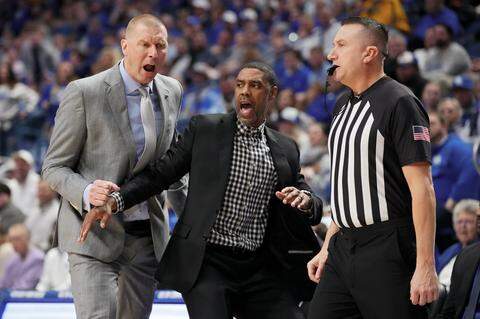
At Kentucky, basketball is never just basketball. It is memory, inheritance, expectation, and pressure layered over 94 feet of hardwood. That reality has shaped every coach who has stood on the sideline at Rupp Arena since Adolph Rupp stepped away in 1972. Some leaned into the heat. Others fought it. All of them, eventually, collided with the referees.
That collision has long been part of the Kentucky basketball experience. Arguments, technical fouls, ejections, viral moments before viral moments existed — they are woven into the program’s modern history. Which is why Mark Pope’s relationship with officials, and the way his first technical foul finally arrived, stands out so sharply against everything that came before it.
The one thing Pope did differently was not avoiding conflict altogether. It was delaying it longer than anyone else ever has.
Since Rupp stepped down, seven men have led Kentucky basketball. Seven personalities. Seven temperaments. Seven different thresholds for frustration. And until Pope, none of them waited very long to let the referees know exactly how they felt.
Joe B. Hall inherited the program directly from Rupp, an impossible task in itself. The pressure was immediate, and so was the friction. Hall picked up his first technical foul in just his fourth game as Kentucky’s head coach. That night, against North Carolina at Freedom Hall, the game turned rough late. Missed calls piled up. Hall, convinced his team was being wronged, erupted.
He was hit with two technical fouls — it took three in those days to earn an ejection — both stemming from what he believed were obvious missed calls. According to the Lexington Herald’s report from the game, the officiating “wasn’t on the highest order.” Kentucky fell to 1-3, a brutal start to Hall’s tenure, and the message was clear early: coaching Kentucky meant fighting on every front, including the one with the whistle.
Eddie Sutton followed Hall in 1985, and he didn’t take long either. Sutton’s first technical came in just his sixth game as Kentucky’s coach. The Wildcats entered Allen Fieldhouse unbeaten at 5-0, but Kansas jumped out early. When UK’s Kenny Walker was called for a foul on 7-foot-1 center Greg Dreiling, Sutton exploded. Believing the call should have gone the other way, Sutton charged several feet onto the court before being physically restrained by an assistant.
The result was predictable. A technical foul. Kansas went on to win 83-66, and Kentucky found itself in a 14-1 hole after Sutton’s outburst. Sutton, to his credit, offered perspective afterward.
“A bad call,” he said. “He knocked Walker to the floor. You always expect you won’t get the benefit of the calls on the road. But listen, the officials didn’t beat us. A good Kansas team did.”
That was Sutton in a nutshell: fiery in the moment, measured after the fact. Still, his first technical arrived quickly, a reflection of both his competitive nature and the environment he had stepped into.
Then came Rick Pitino, and with him, a new level of sideline energy.
Pitino took over a program buried under NCAA sanctions and chaos, and he coached like a man trying to pull Kentucky back to life by sheer force of will. It took him just four games to earn his first technical foul. That came during a 111-75 win over Tennessee Tech at Rupp Arena, of all places. With 14 minutes remaining and Kentucky leading by 18, Pitino was whistled for arguing after Sean Woods didn’t get a foul call on a shot attempt.
Some believed Pitino was simply trying to ignite his team, which was in the middle of an 8-2 lull. After the game, he brushed it off.
“The refereeing was fine,” Pitino said. “If we had lost, it would have been bad.”
The irony didn’t stop there. Tennessee Tech coach Frank Harrell was later hit with a technical for being outside the coaching box. His defense was memorable.
“I said, ‘Look at Coach Pitino. He’s at halfcourt,’” Harrell said. “I wasn’t nearly as far out as Coach Pitino on that same exact play. That’s the way life is at Rupp Arena. There are 20,000 referees in the stands.”
Three days later, Kansas beat Kentucky 150-95. Pitino earned two technicals in that game. Three technicals in five games. The tone was set.
“For all of you for all the future, I don’t comment on officiating,” Pitino told reporters afterward. “If you’d like to comment — which you very rarely do — you comment on it. But don’t ask me about officiating because I will not say a negative nor positive word.”
History suggests that vow didn’t last long.
Tubby Smith followed Pitino, and by Kentucky standards, he was calmer — though that’s relative. It took Smith 43 games before he was hit with his first technical foul, which came in game four of his second season during a win over Colorado in the Puerto Rico Shootout.
Smith was almost apologetic afterward.
“It’s disappointing,” he said. “You never want to get a technical. I apologize.”
According to beat writer Jerry Tipton, Smith’s frustration was justified. The technical came after his son, backup guard Saul Smith, was knocked to the floor while battling for a rebound.
“It was getting a little physical,” Smith said. “And I wanted to make sure, ‘Hey, watch all the pushing going on.’ That’s all. All I said was, ‘Who’s supposed to be watching that?’”
Smith received seven technical fouls over 10 seasons. His successor, Billy Gillispie, matched that number in just two years.
Gillispie’s first technical came in his ninth game. The referee was Doug Shows, a familiar name in Kentucky history. During an 83-69 loss to Houston, Gillispie stepped onto the floor, gesturing furiously for a foul call as multiple Kentucky players were knocked down in a scramble.
That was just the beginning. Gillispie earned three more technicals that season alone, including a memorable one for grabbing the basketball and refusing to give it back to an official during a 93-52 loss at Vanderbilt. Those were difficult years, and the sideline chaos often mirrored the program’s broader instability.
Then came John Calipari, whose presence alone commanded attention.
It might surprise some that Calipari actually held the modern-era record for the most games coached at Kentucky before receiving a technical foul — at least until Mark Pope arrived. Calipari didn’t earn his first UK technical until game 48 of his tenure, which came in his second season.
That game was a blowout win over Mississippi Valley State, 85-60. Even then, Calipari found something to argue about. His first technical came after a no-call on a baseline drive. The second followed just 18 seconds later, when referee Mike Stuart assessed another technical from across the court as Calipari stared him down.
“Are you going to make me scream or come over here like a man?” Calipari yelled before being ejected.
“That’s the first time I’ve been thrown out of a game, college or pro,” Calipari said afterward — a statement that wasn’t entirely true. He had been ejected before, at UMass. His claim that he “didn’t say two words” to the officials that day was also disputed by those sitting courtside.
Calipari would be ejected four more times at Kentucky. His sideline volatility became part of the theater.
Which brings us to Mark Pope.
When Pope arrived in Lexington, expectations were enormous, but his demeanor immediately stood out. Where others prowled, Pope observed. Where others barked, Pope instructed. He did not work officials relentlessly. He did not chase calls. He did not weaponize anger.
And for 51 games, it worked.
Pope made it through his entire first season — one of the most stressful jobs in college sports — without receiving a technical foul. According to UK assistant coach Cody Fueger, who has been with Pope for all 11 years of his head coaching career, that wasn’t an accident.
Pope respects officials. He rarely curses in their direction. He believes constant arguing gives referees power and drains focus from his players.
The closest he came before his first technical at Kentucky was a road game at Alabama, where Terry Oglesby took an extended verbal lashing from Pope and followed him down the sideline. Cooler heads prevailed that night.
“But Terry’s given him one in the past,” Fueger noted, referencing Pope’s BYU days.
Those moments are memorable precisely because they are so rare.
Pope’s first technical at Kentucky finally came against Missouri, and it came for one reason: protecting his players.
Jayden Quaintance, just four games removed from major knee surgery, was swarmed by Missouri players and knocked hard to the floor. No whistle came. Pope exploded. He stomped. He swore. The frustration was audible on the broadcast.
Referee Rob Rorke eventually had enough and assessed the technical. Pope kept pacing. Officials approached. Some thought a second technical — and Pope’s first career ejection — might follow.
It didn’t.
“That’s what gets him,” Fueger said later. “Protecting our players. If someone’s hurting our guys, that’s when all gloves are coming off.”
And that is the difference.
Every Kentucky coach since Rupp has fought the refs. Many did it loudly, early, and often. Pope waited. He absorbed. He restrained. And when he finally crossed the line, it wasn’t about ego, theatrics, or momentum. It was about a player on the floor and a whistle that never came.
By Kentucky basketball standards, that may be the most telling detail of all.




