


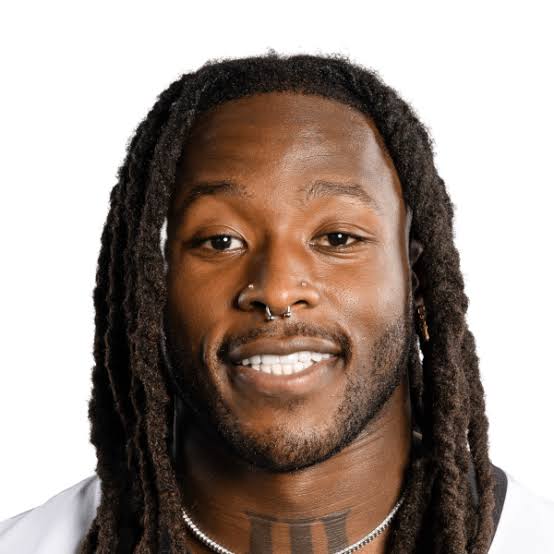
The New Orleans Saints have reached a crossroads—one that many NFL franchises face but few navigate smoothly. When a beloved star begins to age, contract realities tighten, and the roster needs a reset, difficult decisions must be made. According to a recent mock draft, the Saints may already be preparing for that moment, projecting New Orleans to select a generational running back as a long-term replacement for Alvin Kamara.
It’s a move that would send shockwaves through the fan base, not because Kamara has suddenly lost his value, but because it signals a philosophical shift—one that acknowledges the realities of roster construction, cap management, and the modern NFL.
Kamara has been the face of the Saints’ offense for nearly a decade. Replacing him is not about disrespect. It’s about timing.
And timing, in the NFL, is everything.
Alvin Kamara’s Legacy in New Orleans
Alvin Kamara is more than just a running back in New Orleans. He is one of the most iconic offensive players in franchise history.
Since being drafted in the third round in 2017, Kamara has:
Earned multiple Pro Bowl selections
Posted six seasons of 1,300+ scrimmage yards
Become one of the league’s most feared dual-threat weapons
Helped anchor the Saints’ offense during the post-Drew Brees transition
Kamara’s vision, balance, receiving ability, and knack for scoring in space made him nearly impossible to defend at his peak. Few backs in NFL history have blended power and finesse as effortlessly.
But football is unforgiving.
Kamara is now approaching his late 20s, has accumulated heavy usage, and carries a contract that becomes increasingly difficult to justify for a team in the middle of a retool. His production is still valuable—but the explosive dominance that once defined him has begun to taper, as it does for nearly every running back in NFL history.
The Saints know this. Front offices always know before fans do.
Why the Saints Are Looking Ahead
New Orleans has spent years pushing money forward, restructuring contracts, and delaying a full reset. That strategy kept the Saints competitive, but it also left them with limited flexibility.
At some point, the bill comes due.
The Saints’ offense needs an identity refresh. Quarterback uncertainty remains. The offensive line is aging in spots. And while Kamara remains productive, the Saints must decide whether to ride out his remaining prime—or transition before decline accelerates.
According to the latest mock draft, New Orleans may already be leaning toward the latter.
Selecting a generational running back would allow the Saints to:
Add a cost-controlled offensive cornerstone
Reset the offense around youth and explosiveness
Reduce long-term cap strain
Preserve Kamara’s value or prepare for a clean transition
It’s not about replacing Kamara tomorrow. It’s about preparing for the next era.
The “Generational” Tag — What It Really Means
The term “generational” is often overused in draft discourse, but when evaluators apply it to a running back, it carries specific meaning.
A generational RB typically offers:
Elite vision and patience
Home-run speed
Three-down versatility
Pass-catching excellence
Immediate NFL readiness
Durability and physical toughness
In other words, a player who doesn’t just fill a role—but defines an offense.
The mock draft suggests the Saints could target a prospect capable of stepping in as an instant impact player, one whose skill set mirrors Kamara’s versatility while adding more power and downhill explosiveness.
For a team searching for offensive stability, that type of player is incredibly appealing.
How a New RB Fits the Saints’ Offense
Even without a franchise quarterback firmly in place, running back remains one of the easiest positions to translate from college to the NFL. A special RB can:
Ease pressure on the quarterback
Create favorable down-and-distance situations
Serve as a safety valve in the passing game
Dictate defensive personnel and alignments
The Saints’ offense has struggled with consistency, particularly in finishing drives. A dynamic back with burst and tackle-breaking ability could immediately change that equation.
More importantly, the Saints’ system has historically thrived with versatile backs. From Reggie Bush to Pierre Thomas to Kamara, New Orleans has always maximized players who can threaten defenses in multiple ways.
Drafting a generational RB would be less of a departure and more of a return to form.
What This Means for Alvin Kamara
This projection does not mean Kamara is finished—or even unwanted.
If anything, it could extend his value.
A younger RB could:
Reduce Kamara’s workload
Keep him fresher late in games and seasons
Allow him to shift into a more specialized, explosive role
Create matchup nightmares with two elite backs on the field
There’s also the business side. If the Saints believe Kamara’s contract no longer aligns with their competitive window, drafting his successor gives them leverage—either to restructure, trade, or transition without panic.
NFL teams that wait too long to replace stars often pay the price. The Saints appear determined not to make that mistake.
Fan Reaction Will Be Divided — And Understandable
Saints fans are fiercely loyal, and Kamara is a franchise favorite. Any suggestion of replacing him will be met with resistance.
That reaction is emotional—and fair.
But the NFL is not sentimental.
Teams that survive long-term success are proactive, not reactive. They replace stars before decline becomes collapse. They draft replacements while the current player still has value.
The Saints did it before. They may be preparing to do it again.
The Bigger Picture: A Soft Reset in New Orleans
This mock draft selection fits into a broader theme surrounding the Saints: a soft reset rather than a full rebuild.
Instead of tearing everything down, New Orleans appears to be:
Infusing youth at premium skill positions
Maintaining competitiveness while resetting cap flexibility
Prioritizing explosive playmakers
Preparing for life beyond its recent core
A generational RB becomes a foundational piece—someone who can anchor the offense regardless of who lines up at quarterback.
That’s a smart bet.
Final Thoughts
Replacing Alvin Kamara will never be easy. His impact on the Saints goes far beyond statistics. He represents an era, an identity, and a standard of excellence.
But the NFL rewards those who plan ahead.
If the Saints truly have a chance to draft a generational running back—one capable of reshaping the offense for the next five to seven years—it would be irresponsible not to consider it.
This mock draft may only be a projection, but it reveals a truth the Saints can no longer avoid:
The future is coming.
And New Orleans appears ready to meet it head-on.




