


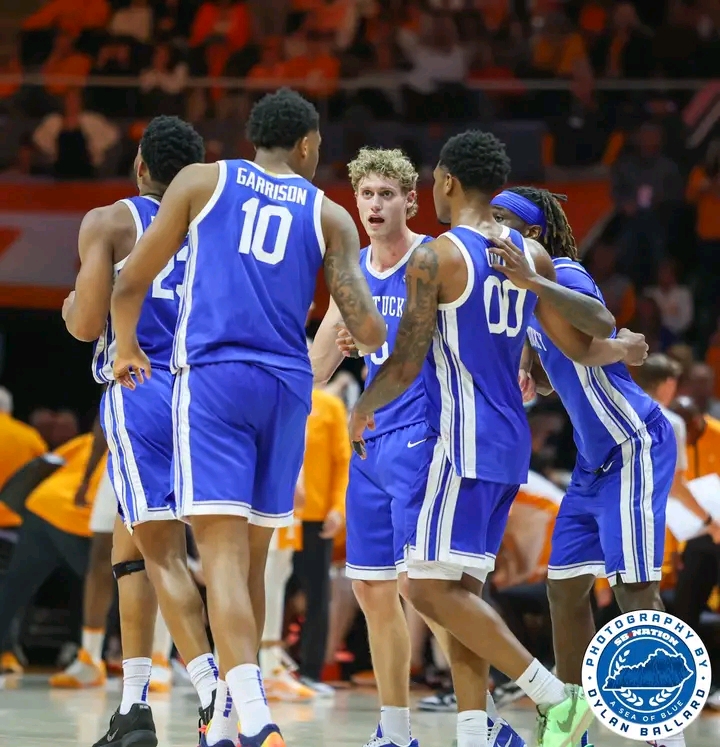
For nearly 25 minutes inside Thompson-Boling Arena, Kentucky basketball looked finished.
Not just beaten — broken.
The Wildcats were down 17 points on the road against Tennessee, struggling to generate offense, losing the rebounding battle, and getting swallowed whole by a Volunteers team that fed off its home crowd and defensive pressure. The environment was hostile, the margin was growing, and everything about the game screamed inevitability.
And yet, Kentucky walked out of Knoxville with an 80–78 victory, silencing a raucous crowd, extending a remarkable run of resilience, and reminding everyone why this program is never truly out of a fight.
According to UK basketball writer Ryan Black, the comeback wasn’t sparked by a single shot, a highlight dunk, or even a late-game steal.
It started with something far less obvious — and far more telling.
The Scoreboard Lied About Kentucky’s State of Mind
Kentucky’s first-half performance was messy. The Wildcats struggled to initiate offense, Tennessee dictated pace, and the Volunteers’ physicality disrupted Kentucky’s rhythm on both ends of the floor. Missed rotations led to open looks. Loose balls went Tennessee’s way. Kentucky didn’t look connected.
But Ryan Black pointed out something crucial in his breakdown: Kentucky never panicked.
Even as the deficit ballooned, there was no visible finger-pointing. No slumped shoulders. No sense that the Wildcats were emotionally out of the game. The bench remained engaged. Players continued communicating. And perhaps most importantly, Kentucky kept running its offense instead of resorting to hero ball.
That composure, Black emphasized, would become the foundation for everything that followed.
Halftime Wasn’t About Motivation — It Was About Clarity
Teams down 17 on the road often need an emotional jolt at halftime. A fiery speech. A drastic lineup change. A full schematic overhaul.
Kentucky didn’t get any of that.
Instead, the halftime message was simple: clean it up.
Black noted that the Wildcats weren’t losing because of effort — they were losing because of execution. Missed box-outs. Late closeouts. Poor spacing on offense. Tennessee wasn’t doing anything magical; Kentucky was giving the Volunteers too many extra chances.
The second half began not with a scoring explosion, but with something more important: discipline.
Kentucky started contesting shots without fouling. They secured defensive rebounds. They valued possessions. And slowly, almost imperceptibly, the momentum began to shift.
The Comeback Began on the Defensive End
The box score will tell you who scored the points. Ryan Black focused on who changed the tone.
Kentucky’s defensive intensity ramped up immediately after halftime. Passing lanes were disrupted. Tennessee was forced deeper into the shot clock. The Vols, comfortable early, suddenly looked rushed.
Black highlighted how Kentucky stopped overhelping and trusted individual defenders to stay in front. That adjustment cut off Tennessee’s rhythm and limited second-chance opportunities — a massive factor in shrinking the deficit.
The Wildcats didn’t need steals. They needed stops.
And they got them.
Offense Came From Trust, Not Force
One of the most impressive elements of Kentucky’s comeback, according to Black, was how patient the Wildcats remained offensively.
Down double digits, it would’ve been easy to start launching contested shots or forcing drives. Instead, Kentucky worked the ball, trusted the extra pass, and waited for Tennessee to blink.
That patience paid off.
Shots began to fall not because Kentucky rushed, but because they created better looks. Ball movement improved. Spacing opened driving lanes. Tennessee’s defense, once suffocating, started to crack.
What stood out to Black was that Kentucky’s scoring surge didn’t come from a single player trying to take over — it came from collective confidence.
The Crowd Got Quiet Before the Score Got Close
One of the subtle turning points Ryan Black pointed out had nothing to do with points.
It was the crowd.
As Kentucky chipped away at the lead, possession by possession, the once-deafening Tennessee crowd grew uneasy. Missed shots drew groans instead of cheers. Defensive stops didn’t ignite the same roar. The arena, once a weapon, became a pressure cooker.
Kentucky fed off that silence.
Black noted how veteran composure showed up in the body language. Wildcats players stopped reacting to the crowd and focused inward. Tennessee, meanwhile, began to feel the weight of expectation.
Momentum doesn’t always announce itself. Sometimes, it sneaks in quietly.
The Wildcats Waited for Their Moment — And Took It
Kentucky didn’t take its first lead until the final minute.
That’s the kind of stat that defines a comeback.
According to Ryan Black, what made the closing stretch remarkable wasn’t just the execution — it was the belief. Kentucky played the final possessions like a team that fully expected to win, not one hoping Tennessee would collapse.
Defensive rotations were crisp. Offensive decisions were decisive. There was no hesitation.
And when the moment finally arrived, Kentucky seized it.
Clutch Plays Are Built on Earlier Discipline
Late-game heroics often steal headlines, but Black emphasized that Kentucky’s ability to execute in the final minute was earned long before that point.
The Wildcats didn’t suddenly become sharp — they had been sharpening their edge for the entire second half.
Every defensive stop. Every smart possession. Every rebound mattered.
By the time Kentucky needed one final surge, they were already in rhythm.
The Postgame Chaos Underscored the Emotional Swing
The final buzzer didn’t bring immediate calm.
Emotions boiled over. Players from both sides exchanged words. A brief skirmish erupted before coaches intervened. It was messy, heated, and telling.
Ryan Black framed the moment as a reflection of just how dramatic the emotional swing had been.
Tennessee went from control to disbelief.
Kentucky went from survival mode to triumph.
Games like that leave scars — and statements.
What This Win Says About Kentucky
Ryan Black’s breakdown made one thing clear: this wasn’t a fluke.
Kentucky didn’t win because Tennessee choked. They won because they stayed composed, trusted their process, and refused to let a hostile environment dictate their response.
Coming back from 17 points on the road in SEC play is rare. Doing it without panic is rarer still.
This game revealed a Kentucky team that understands how to endure adversity — and that might be the most important takeaway of all.
The Bigger Picture
Every season has a defining moment. A game that reshapes confidence, recalibrates belief, and reframes expectations.
This might be that game for Kentucky.
Not because of the score.
Not because of the comeback.
But because of how it happened.
Ryan Black’s analysis strips away the noise and focuses on the truth: Kentucky didn’t win with flash. They won with discipline, patience, and quiet confidence.
And in March, those qualities matter far more than style points.
Final Thought
The comeback in Knoxville didn’t start with a basket.
It started with trust.
Trust in the game plan. Trust in teammates. Trust that if Kentucky stayed connected, the opportunity would come.
It did.
And when it arrived, Kentucky was ready.




