


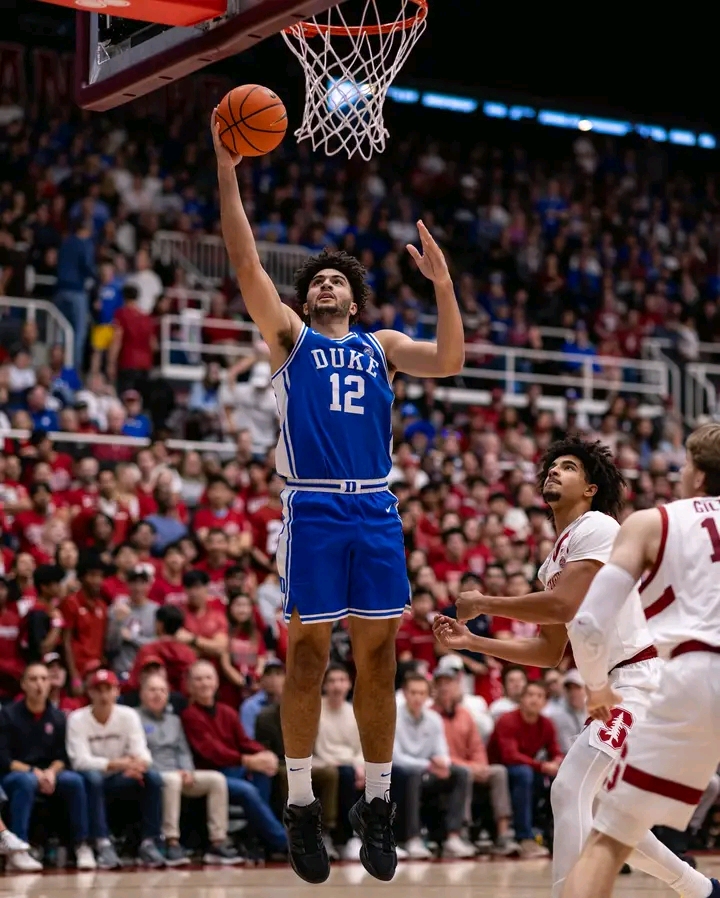
No. 6 Duke men’s basketball didn’t just close out its West Coast trip with a win — it delivered a performance that subtly answered several lingering questions.
After 20 minutes at Maples Pavilion, the Blue Devils held Stanford to just 19 points and carried a commanding 35–19 halftime lead. By the final horn, Duke had turned control into confirmation, showing balance, defensive sharpness, and renewed identity on both ends of the floor.
Here are five key observations from BOTH halves of Duke’s win over the Cardinal — and why the performance mattered beyond the box score.
1. The Starters Looked Like a Group That Knows Itself Again
After weeks of experimentation, Jon Scheyer appears to have found his footing.
Following recent lineup shuffles — including Maliq Brown’s insertion against SMU and Dame Sarr’s start at Cal — Scheyer stayed the course with the same starting five that handled the Golden Bears. Cameron Boozer, Isaiah Evans, and Caleb Foster anchored the group, joined by Patrick Ngongba II and Sarr.
That lineup has now become Duke’s most trusted configuration. Entering the Stanford game, the group was 9–0 with an average margin of victory exceeding 30 points — and the continuity showed early.
Duke opened the game with purpose. Boozer scored three straight layups as the Blue Devils attacked in transition and flowed smoothly into half-court sets. The ball moved crisply, spacing was deliberate, and players seemed to anticipate each other’s actions rather than react late.
Although Ngongba’s early substitution ended the lineup’s initial run around the 16-minute mark, the tone had already been set — and it carried into the second half. The same five returned with confidence, extending the lead and never allowing Stanford to regain belief.
The most telling sign? There was no frantic searching for answers in the final 20 minutes. Duke looked settled.
2. Duke’s Defense Didn’t Just Stop Stanford — It Created Offense
The Blue Devils’ defense has been a talking point for weeks, particularly after a midseason dip that forced Scheyer into experimentation.
Against Stanford, the defense didn’t merely reappear — it dictated the game.
In the first half, Duke forced eight steals and recorded a block, converting turnovers into easy points. Fifteen of its first-half points came directly off takeaways, allowing the Blue Devils to score without needing to grind through possessions.
Dame Sarr continued his rise as a defensive disruptor, punctuating the opening stretch with a clean block at the rim that energized the bench and triggered an early media timeout. Passing lanes were crowded. On-ball pressure was relentless. Stanford struggled just to initiate offense.
The second half followed the same script. Duke didn’t let up, continuing to jump passing lanes and rotate decisively. Stanford never found rhythm, rarely stringing together quality possessions. Even when Duke’s offense briefly slowed, its defense ensured the Cardinal never threatened the margin.
This wasn’t a defense playing desperate — it was a defense playing confident.
3. Duke Won Without Relying on the 3 — and That Might Matter Most
Perhaps the most intriguing development came offensively.
None of Duke’s first 10 made field goals came from beyond the arc. Instead, the Blue Devils committed to the paint — and punished Stanford for lacking size.
Entry passes into the post were intentional. Boozer was fed early and often. Ngongba and Brown carved out space. The Cardinal managed just eight points in the paint in the first half, compared to Duke’s 26.
Even in the second half, when Duke mixed in more perimeter attempts, the priority remained interior dominance. The few 3-pointers Duke took were largely clean, in-rhythm looks — often from the corners — rather than forced bailouts.
This balance is significant.
Shooting inconsistency has lingered as a minor concern for Duke, especially compared to last season. If the Blue Devils can continue scoring efficiently without depending on volume shooting from deep, it raises both their floor and ceiling.
The offense didn’t feel one-dimensional. It felt adaptable.
4. The Slow-Start Narrative Finally Took a Hit
One of Duke’s recurring issues this season has been sluggish openings, particularly on the road. Too often, the Blue Devils have allowed opponents to dictate early tempo, forcing themselves into unnecessary battles.
That didn’t happen at Maples Pavilion.
Duke jumped out early, building a double-digit lead behind disciplined offense and suffocating defense. At one point in the first half, the lead ballooned to 14, forcing Stanford to play catch-up far sooner than expected.
To the Cardinal’s credit, they showed fight, trimming the margin briefly before halftime. But every time momentum threatened to swing, Duke answered — either with a defensive stop or a paint touch that reestablished control.
In the second half, Duke did what it hasn’t always done this season: it extended its advantage instead of protecting it passively.
If this performance becomes a trend rather than an exception, it changes how dangerous this team can be in March.
5. Player of the Game: Cameron Boozer Set the Tone — and the Standard
There was little debate about who owned the night.
Cameron Boozer was dominant in every sense. The freshman forward overwhelmed Stanford inside, finishing through contact, controlling the glass, and setting the emotional tone for the group.
By halftime, Boozer already had 20 points and nine rebounds, flirting with a double-double before the break. He continued to impose his will in the second half, commanding double teams and opening opportunities for teammates.
Perhaps most encouraging was his perimeter confidence. Boozer calmly knocked down a wide-open 3-pointer from the left wing — Duke’s only long-range make for much of the game — reinforcing his value as a spacing big.
With players like Ngongba and Brown sharing the floor, Boozer’s ability to stretch defenses becomes invaluable. He doesn’t just score — he organizes Duke’s offense by where he draws defenders.
National Player of the Year talk follows him for a reason.
Final Thought
This wasn’t just a road win.
It was a performance that quietly suggested Duke may be finding its most sustainable identity — one built on defense, interior dominance, and lineup continuity rather than shooting variance.
The scoreline told one story. The habits told another.
And if those habits hold, the Blue Devils’ ceiling may still be rising.




