


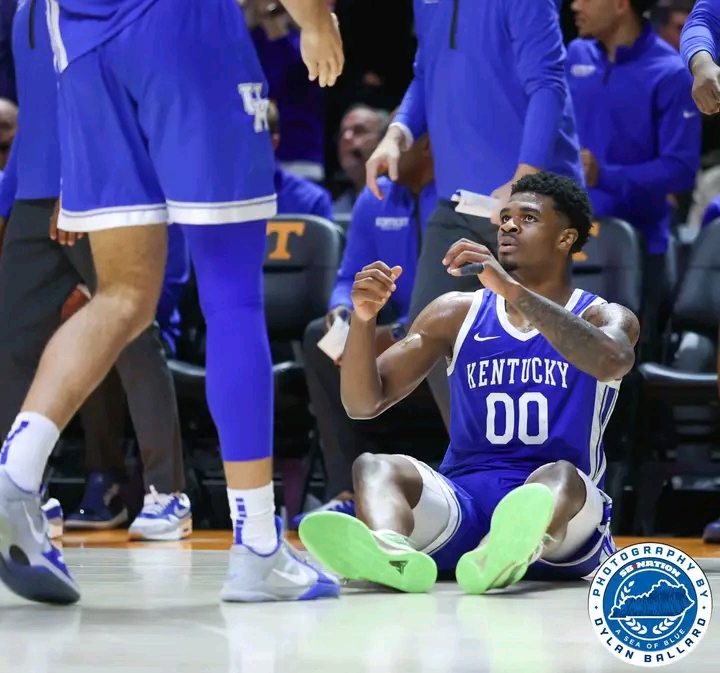
Kentucky didn’t just win a basketball game in Knoxville.
It survived one, endured one, and then walked straight into the kind of moment that only this rivalry, this arena, and this program seem capable of producing.
The final score — an 80–78 Kentucky victory over Tennessee — tells part of the story. The comeback from a 17-point deficit tells another. But what happened in the final seconds, and especially after the buzzer, is what has kept fans, media, and college basketball observers buzzing long after the nets stopped moving.
At the center of it all stood Otega Oweh.
He made the decisive play.
He delivered when Kentucky needed him most.
And then, in the emotional aftermath of a hostile road win, he became the focal point of a moment that turned a dramatic finish into full-blown chaos.
The Shot That Shifted Everything
For much of the night, Kentucky looked like a team searching for answers.
The Wildcats struggled early, fell behind by double digits, and absorbed the full force of a raucous Thompson-Boling Arena crowd. Tennessee dictated pace, controlled stretches of the game, and appeared well on its way to protecting home court.
But Kentucky kept hanging around.
And when the moment finally arrived — when the game tightened, the noise rose, and every possession felt heavy — Otega Oweh didn’t hesitate.
With under a minute to play and Kentucky still chasing, Oweh attacked the moment with confidence. The possession that mattered most ended with him finishing at the rim, giving the Wildcats a lead they would not relinquish.
It wasn’t flashy.
It wasn’t loud.
It was decisive.
In rivalry games like this, decisiveness is everything.
Why Oweh’s Performance Mattered More Than the Box Score
Oweh’s stat line was solid, but the numbers alone don’t explain his impact.
What separated his performance was timing.
Every critical contribution came when Kentucky’s margin for error was gone. Defensive pressure. Strong drives. Calm decision-making. Oweh didn’t force the issue — he answered it.
Kentucky has had nights this season where scoring came in bunches but disappeared late. This wasn’t one of them. When the Wildcats needed someone to make a play without blinking, Oweh stepped forward.
That confidence rippled outward. Teammates fed off it. The bench felt it. And suddenly, the building that had been roaring all night went quiet.
That silence mattered.
The Free Throw, the Miss, and the Moment That Followed
Tennessee still had a chance.
With the Wildcats clinging to a two-point lead late, the Vols went to the line. The first free throw went in. On the second, Tennessee intentionally missed — a last-ditch effort to extend the game.
That’s when everything broke loose.
Bodies collided under the basket. Players fought for position. The horn sounded. And what should have been the end of a dramatic comeback became the start of something else entirely.
Words were exchanged. Arms were raised. Emotions boiled over.
In the middle of it all stood Otega Oweh.
What Was Said — and Why It Became a Story
In the hours after the game, attention shifted from the comeback itself to what allegedly was said during the post-buzzer confrontation.
Clips circulated. Screenshots appeared. Social media filled the gaps with speculation and commentary. Various outlets reported that Oweh exchanged heated words with Tennessee forward Jaylen Carey during the scrum.
What matters here isn’t repeating unverified quotes.
What matters is understanding why the moment exploded the way it did.
This was not trash talk out of nowhere. It was the emotional release of a game that had swung violently, a rivalry steeped in tension, and a crowd that had gone from celebration to disbelief in a matter of seconds.
Players were exhausted. Adrenaline was high. The stakes were enormous.
In that environment, control is fragile.
Mark Pope Steps In
As tempers flared, Kentucky head coach Mark Pope moved quickly.
Video showed Pope physically restraining Oweh and Brandon Garrison, pulling both players away before the situation escalated further. It was a firm, immediate response — one that likely prevented the scene from becoming something far uglier.
That moment spoke volumes.
Not just about discipline, but about leadership.
Pope didn’t argue. He didn’t hesitate. He removed his players from danger — for themselves and for the program.
In rivalry games, how a team handles victory often matters as much as how it handles defeat.
The Fine Line Between Edge and Excess
Kentucky fans know this truth well: the program has always walked a fine line between intensity and excess.
The Wildcats are at their best when they play with edge — when emotion fuels execution rather than replaces it. Oweh’s performance embodied that edge for most of the night. His late-game composure was precisely what Kentucky needed.
But moments like the postgame scrum reveal how thin that line can be.
Oweh’s passion is not the problem. In fact, it’s part of what makes him effective. The challenge is ensuring that emotion stays channeled into performance, not reaction.
Kentucky’s staff understands that. Pope’s quick intervention made that clear.
Why Fans Are Split — and Why That’s Inevitable
The reaction from Big Blue Nation has been divided.
Some fans embraced Oweh’s fire, viewing it as a sign of competitiveness and refusal to back down in a hostile environment. Others expressed concern, worried that moments like this invite unnecessary scrutiny and risk.
Both reactions come from the same place: care for the program.
Kentucky fans demand toughness.
They also demand composure.
That tension is part of what makes this fan base so passionate — and so unforgiving.
The Bigger Picture: Kentucky’s Identity in 2026
This game wasn’t just about one shot or one exchange.
It was about who Kentucky is becoming.
A team that can rally from 17 points down on the road.
A team that has found late-game confidence.
A team that still, at times, flirts with emotional volatility.
Oweh’s night captured all of it.
He was clutch.
He was fearless.
And he was human.
Those qualities don’t cancel each other out.
Why This Moment Will Linger
College basketball thrives on moments.
This one had everything:
– A massive comeback
– A hostile rivalry setting
– A late lead change
– Postgame chaos
– And a player at the center of it all
Otega Oweh didn’t just make a shot. He made a statement — intentional or not — about Kentucky’s willingness to fight, to endure, and to embrace the ugliness that sometimes comes with winning in the SEC.
That’s why people are still talking.
Final Thought
Kentucky left Knoxville with a win that will matter in March.
But the image fans won’t forget isn’t just the scoreboard.
It’s Otega Oweh standing in the middle of chaos — having delivered the defining play, and then navigating the emotional fallout of a rivalry that never ends quietly.
It wasn’t just the shot.
It was the moment.
And moments like that are why Kentucky basketball is never just another game.




