


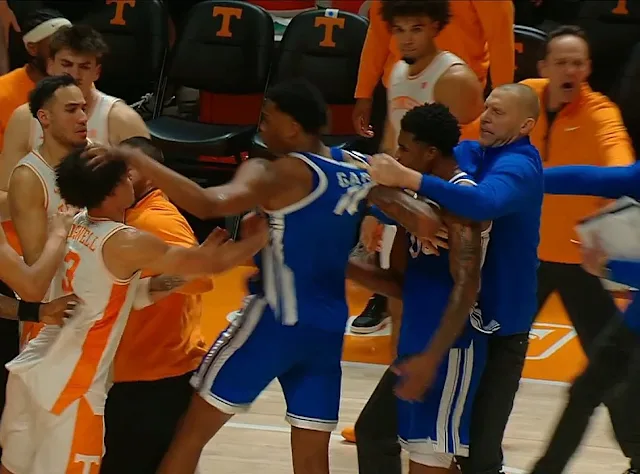
The final buzzer had already sounded. The scoreboard told one story — a stunning Kentucky comeback, another hostile SEC arena silenced — but something far more important was unfolding just a few feet away from the court. In the chaos of celebration, frustration, and raw emotion, Mark Pope saw danger before anyone else did. And in one instinctive, split-second decision, he may have done more than preserve a win in Knoxville. He may have protected Kentucky basketball from a moment that could have derailed an entire season.
The Win That Felt Bigger Than a Win
Kentucky’s 80–78 comeback victory over Tennessee will be remembered for the score, the resilience, and the way the Wildcats once again refused to fold after digging themselves a deep first-half hole. Down by double digits, struggling early, and facing a roaring crowd at Thompson-Boling Arena, Kentucky looked vulnerable yet again.
But just like they had against LSU, and just like they had in recent weeks, something flipped after halftime. The Wildcats tightened up defensively, played with renewed confidence, and chipped away possession by possession until the pressure shifted entirely onto Tennessee.
By the time the final buzzer sounded, Kentucky had completed another improbable rally. Players embraced. Coaches exhaled. Fans watching back home felt that familiar surge of pride and relief.
Yet while most eyes were locked on the scoreboard, Mark Pope’s attention snapped elsewhere.
A Moment That Nearly Changed Everything
As the teams began to separate after the game, cameras caught Kentucky guard Otega Oweh exchanging words with Tennessee forward Jaylen Carey. Trash talk is nothing new — especially in an SEC rivalry. In a heated environment like Knoxville, words fly all night long.
But this time, it didn’t stop at words.
Carey shoved Oweh.
In an instant, Brandon Garrison stepped in. The freshman big man didn’t hesitate. His reaction wasn’t calculated or cautious — it was instinctive. A teammate had been disrespected, and Garrison was ready to defend him.
This is where moments either fade away… or explode.
And this is where Mark Pope made his move.
Pope Didn’t Yell — He Acted
Before officials could fully intervene, Pope sprinted off the sideline and directly into the middle of the confrontation. He didn’t bark from a distance. He didn’t trust the situation to cool on its own.
He grabbed Oweh.
He grabbed Garrison.
And he physically pulled them away.
Television cameras captured Pope gripping both jerseys, holding on “for dear life,” determined not to let the moment spiral into something far uglier. Officials arrived seconds later, but by then the damage had already been prevented.
No punches.
No bench-clearing chaos.
No postgame suspensions.
Just a tense moment, quickly defused.
Why That Decision Mattered More Than the Win
At first glance, it looked like good coaching awareness. Hustle. Control. Discipline.
In reality, it was much bigger than that.
Because if that situation had escalated — even slightly — Kentucky could have been staring at serious consequences. The SEC does not take postgame incidents lightly. Suspensions, fines, and public scrutiny often follow when emotions boil over after the buzzer.
For a Kentucky team just beginning to regain confidence and momentum, losing a key player — or multiple players — to suspension would have been devastating.
Pope understood the stakes immediately.
This wasn’t about pride.
It wasn’t about trash talk.
It wasn’t about winning an argument.
It was about protecting the season.
Otega Oweh: The Edge Kentucky Needs — and Must Control
Otega Oweh has become one of the emotional leaders of this Kentucky team. He plays with confidence, fire, and a visible edge that fuels his game, especially in hostile environments. On the road, that edge often becomes sharper — and more dangerous.
Kentucky needs Oweh’s intensity. It’s part of what has fueled these comebacks. He attacks the rim aggressively, defends with purpose, and never looks rattled by pressure.
But intensity without control can cost you.
Pope’s reaction wasn’t a criticism of Oweh — it was an understanding of him. The coach knew that Oweh’s fire is an asset, but only if it’s protected from crossing a line that officials, conferences, and opponents are more than willing to exploit.
By pulling him away, Pope wasn’t silencing his leader — he was shielding him.
Brandon Garrison’s Instinct Revealed Something Important
Garrison’s role in the moment matters too.
Freshmen don’t always react that quickly. They hesitate. They look to the bench. They worry about consequences.
Garrison didn’t.
He stepped in immediately, ready to back his teammate. That instinct says a lot about Kentucky’s locker room. It speaks to chemistry, trust, and a sense of unity that isn’t always present on teams still searching for their identity.
Coaches want that loyalty.
They just don’t want the fallout.
Pope’s quick intervention allowed Garrison’s loyalty to shine without turning into a costly lesson.
A Pattern Emerging — And a Culture Forming
This wasn’t just another comeback. It was Kentucky’s third in recent games. Down big. Doubt creeping in. And yet, the Wildcats responded the same way each time.
They didn’t splinter.
They didn’t panic.
They believed.
That belief doesn’t come from speeches alone. It comes from trust — trust that teammates will respond, and trust that the coach will protect the group when things get chaotic.
Moments like the one in Knoxville are how cultures are built.
Not in the huddle.
Not in the film room.
But in the chaos, when instincts take over.
Mark Pope’s Leadership in Its Rawest Form
Coaching is often reduced to X’s and O’s, rotations, and adjustments. But the most important moments are often the ones you can’t draw up.
Pope didn’t have time to think.
He didn’t weigh optics.
He didn’t hesitate.
He acted.
That action sent a message louder than any postgame quote:
We win together
We don’t sabotage ourselves
We leave the floor clean
Those messages resonate deeply with players — especially in a season where confidence had been shaken earlier than expected.
How Close Kentucky Was to a Different Narrative
Imagine the alternative.
A punch thrown.
A bench-clearing scuffle.
SEC officials reviewing tape the next morning.
Key players suspended.
Suddenly, the conversation isn’t about resilience or growth. It’s about discipline problems. About control. About whether Kentucky can handle adversity.
Pope didn’t allow that narrative to exist.
He erased it before it was written.
The Season Didn’t Turn on a Shot — It Turned on a Choice
Kentucky’s resurgence won’t be traced back to a single three-pointer or a late defensive stop. It may very well be traced back to a coach sprinting into chaos and physically pulling his players out of harm’s way.
That’s the kind of moment players remember.
That’s the kind of moment teams rally around.
That’s the kind of moment seasons pivot on.
Three games ago, Kentucky looked lost. Confidence was fragile. Doubt was loud.
Now, there’s belief again.
There’s fight.
There’s control.
And sometimes, the most important plays happen after the buzzer — when a coach chooses the long view over the emotional one.
Mark Pope made that choice in Knoxville.
And it may have saved Kentucky’s season.




