


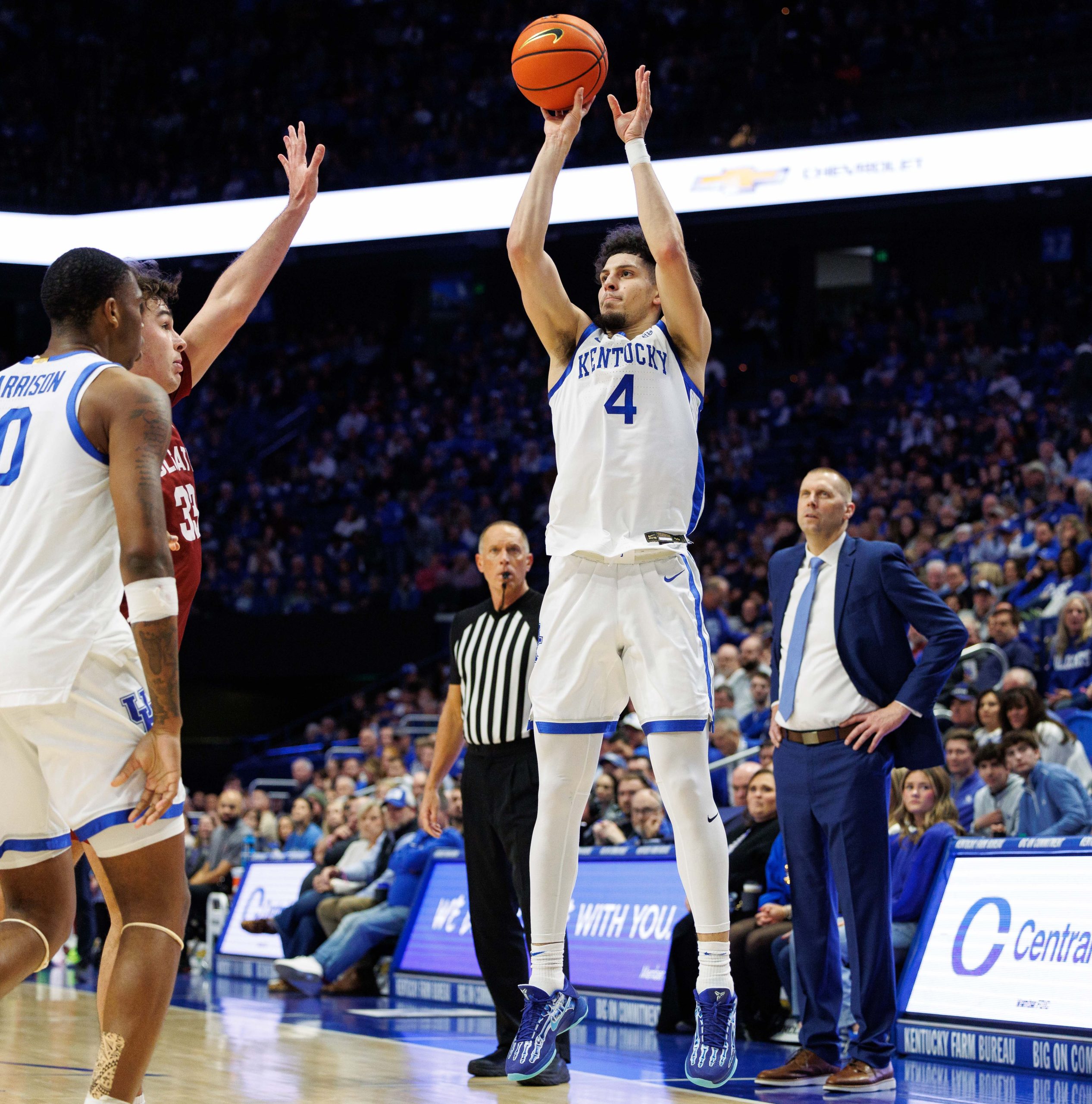
For weeks, Kentucky basketball lived on the NCAA Tournament bubble like an uncomfortable truth no one wanted to say out loud. Every win came with an asterisk. Every loss felt heavier than it should have. The Wildcats were hovering — not quite in danger, not quite safe — and the margin for error felt razor thin. Then, almost quietly, something changed. The wins started stacking. The résumé started breathing. And now, when the latest bracketology projections arrived, Kentucky wasn’t clinging anymore. It had climbed. Not dramatically. Not definitively. But enough to make one thing clear: this season has officially entered a different phase.
Winning ugly — and why it still matters
Let’s be honest: Kentucky’s recent stretch hasn’t been pretty.
The Wildcats didn’t suddenly morph into a flawless, dominant juggernaut. They didn’t blow teams out by 25 or cruise wire-to-wire against elite competition. Instead, they survived. They adjusted. They found ways.
Under first-year head coach Mark Pope, Kentucky has now put together three straight wins, including a statement victory over Tennessee, a ranked opponent that doesn’t hand out favors — especially on its home floor.
Those wins didn’t just boost confidence inside the locker room. They moved the needle nationally.
Kentucky picked up votes in the USA TODAY Sports Coaches Poll, a subtle but meaningful signal that the Wildcats are creeping back into the national conversation. More importantly, they moved up in ESPN’s latest bracketology projections from Joe Lunardi — and that movement matters.
From hanging on to climbing up
In Lunardi’s updated bracketology, Kentucky now sits as an eight seed.
That may not sound glamorous to a fan base accustomed to top-four seeds and Final Four chatter, but context is everything.
Just weeks ago, the Wildcats were projected as a ten seed, barely inside the field and dangerously close to slipping into First Four territory if things went sideways. The difference between an eight and a ten seed isn’t just cosmetic — it changes matchups, perception, and margin for error.
An eight seed means Kentucky is no longer being viewed as a fragile bubble team.
It means the Wildcats are starting to look like a team that belongs.
What the new bracket looks like for Kentucky
According to Lunardi’s projection, Kentucky would face Miami in the first round of the NCAA Tournament in the South Region.
On paper, that’s an intriguing matchup. Miami brings athleticism, pace, and shot-making — the kind of opponent that forces Kentucky to defend for 40 minutes. It’s not a guaranteed win, but it’s also not a nightmare draw.
And the rest of the region? It gets even more interesting.
The South Region would be headlined by Connecticut as the No. 1 seed — a powerhouse with championship pedigree and physicality. Behind them sit Nebraska, Iowa State, and BYU, each presenting very different stylistic challenges.
Then there’s the SEC flavor.
Both Texas A&M and the Texas Longhorns appear in the same region, along with St. John’s — coached by none other than Rick Pitino, setting the stage for a potential high-drama rematch that would dominate headlines and TV ratings.
Is this the bracket Kentucky will actually get? Almost certainly not.
But it offers a snapshot — and a telling one.
Why this move up matters more than it seems
Bracketology isn’t destiny. Everyone knows that.
But it is a reflection of how teams are perceived right now. And perception shapes reality in March.
By moving from a ten seed to an eight, Kentucky has:
Reduced immediate pressure to “steal” wins
Created more cushion for future losses
Improved the quality of potential first-round matchups
Signaled upward momentum to the committee
Perhaps most importantly, Kentucky is no longer viewed as a team scrambling to survive.
It’s viewed as a team trending upward.
The Tennessee win changed everything
If there’s a single moment that flipped Kentucky’s trajectory, it’s the road win over Tennessee.
That wasn’t just another tally in the win column — it was a résumé anchor. A Quad 1 victory. A proof-of-concept moment.
Coming back from a 17-point deficit against one of the SEC’s most physical, disciplined teams showed resilience that metrics care about. It also demonstrated something Kentucky hadn’t consistently shown earlier in the season: composure under pressure.
That win pushed Kentucky to 3–5 in Quad 1 games, a number that suddenly looks respectable rather than alarming.
And once you get into the conversation, climbing becomes easier than clawing.
Mark Pope’s fingerprints are starting to show
This is where the story gets more interesting.
Mark Pope inherited a roster with talent but uncertainty. He also inherited expectations that rarely allow patience. The early portion of the season reflected that tension — flashes of promise followed by frustrating breakdowns.
But over the last few weeks, Pope’s influence has become clearer.
Kentucky is:
Playing with better spacing
Making quicker decisions offensively
Trusting role definition rather than forcing hierarchy
Leaning into matchup-based rotations
The Wildcats haven’t become perfect. They’ve become adaptable.
And adaptability wins in March.
Winning despite the chaos
One of the most impressive parts of Kentucky’s recent climb is how it has happened.
The Wildcats have dealt with:
Injuries
Rotation uncertainty
Frontcourt shuffling
Slow starts
Road adversity
Yet instead of folding, they’ve learned how to survive uncomfortable games.
That matters.
The NCAA Tournament is built on discomfort. Neutral courts. Unfamiliar opponents. Tight whistles. Momentum swings.
Teams that require everything to go right don’t last long.
Teams that can win ugly stick around.
The frontcourt-by-committee effect
Kentucky’s frontcourt has been anything but traditional.
Rather than leaning on one established star, Pope has deployed a by-committee approach, rotating based on matchup, feel, and flow. Players like Mouhamed Dioubate, Kam Williams, Andrija Jelavic, Malachi Moreno, and Brandon Garrison have all played meaningful roles.
There’s no set script — and that unpredictability is becoming a strength.
Opponents can’t key in on one look. Kentucky can adjust defensively without sacrificing spacing offensively.
It’s not flashy.
But it’s effective.
The shooting shift that changed the math
Earlier in the season, Kentucky’s three-point shooting was a liability.
Now, it’s a weapon.
Over the past several games, the Wildcats have quietly become one of the better three-point shooting teams in the SEC, thanks to improved shot selection and ball movement.
Guards like Denzel Aberdeen and Jasper Johnson have stepped into larger roles with confidence. Otega Oweh continues to pressure defenses downhill, creating kick-out opportunities that didn’t exist before.
That shooting improvement has changed how opponents defend Kentucky — and that ripple effect is huge.
Suddenly, driving lanes open. Offensive rebounding improves. Transition defense gets cleaner.
The team looks more connected.
Why the eight seed feels different
An eight seed doesn’t guarantee safety — but it offers opportunity.
It means Kentucky isn’t staring down a top-two seed in the second round by default. It means the Wildcats can realistically envision surviving the opening weekend if they play well.
More importantly, it reframes the season.
This is no longer a story about making the tournament.
It’s becoming a story about what Kentucky could do once it’s there.
Plenty still to prove
None of this means Kentucky has arrived.
The Wildcats still have:
Inconsistent starts
Rebounding lapses
Defensive stretches that invite trouble
Games ahead that could swing momentum quickly
SEC play doesn’t offer mercy. One bad week can undo a month of progress.
But the difference now is margin.
Kentucky has created breathing room.
Why “interesting” is the right word
This isn’t the Kentucky team fans envisioned in November.
It’s also not the team critics dismissed in December.
It’s something in between — a group discovering its identity while the stakes rise.
Bracketology movement reflects that uncertainty.
Kentucky isn’t locked into a seed. It’s climbing toward one.
And that climb makes every upcoming game matter just a little more.
The bigger picture
As the season unfolds, bracket projections will shift dozens of times. Seeds will rise and fall. Matchups will shuffle.
But momentum is harder to fake.
Right now, Kentucky has it.
Not because everything is perfect — but because progress is real.
That’s why this bracketology update matters.
It’s not about being an eight seed.
It’s about no longer feeling like a ten.
And in March, that difference can change everything.




