


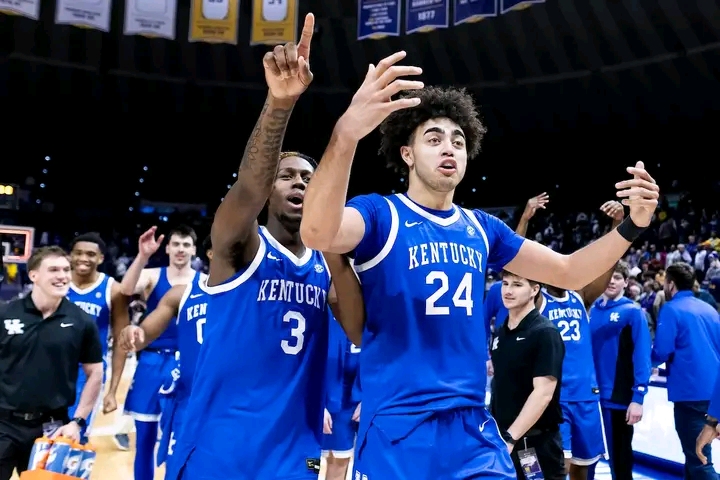
For much of the season, Kentucky basketball has felt like a contradiction. The talent was obvious, the expectations enormous, yet the results didn’t always line up with what Big Blue Nation believed it should be seeing. There were nights when the Wildcats looked dominant, and others when they looked unfinished. That tension — between what Kentucky is supposed to be and what it was becoming — lingered in the background of every game. Then, quietly and without theatrics, Mark Pope offered a parable that may explain everything. Not an excuse. Not a slogan. But a picture of growth that, for the first time, makes this season start to make sense.
A Parable That Caught Attention
When Pope referenced the currant bush, it didn’t sound like typical postgame coach-speak. There were no clichés about “trusting the process” or “getting better every day.” Instead, he described something slower, more uncomfortable, and more honest.
A currant bush, Pope explained, doesn’t thrive immediately. Early on, it can look underwhelming. It must be cut back. Pruned. Put under stress. Only through that difficult phase does it eventually produce meaningful fruit.
For a program like Kentucky — one that expects harvests every season — that metaphor landed differently.
It wasn’t a message about patience for patience’s sake. It was a statement about why the struggle has mattered.
Why This Season Has Felt So Uneasy
Kentucky entered the year carrying the weight of transition. New leadership under Pope. New voices in the locker room. New roles for players still figuring out how they fit together under intense scrutiny.
In Lexington, transition is rarely afforded grace. The program’s history doesn’t allow it. Kentucky isn’t supposed to grow slowly — it’s supposed to dominate.
But growth doesn’t always obey expectations.
The early months of the season revealed a team searching for identity. There were slow starts that frustrated fans. There were defensive lapses that raised alarms. There were games that felt closer than they should have — and losses that stung more deeply because of what Kentucky represents.
To some, it looked like stagnation.
To Pope, it looked like pruning.
The Necessary Discomfort of Pruning
Pruning isn’t pleasant. It looks destructive before it looks productive. Pieces are cut away. Habits are challenged. Comfort is removed.
Kentucky experienced that discomfort in real time.
Rotations changed. Roles shifted. Some players were asked to do less; others were asked to do more. Mistakes were exposed publicly. Confidence was tested. And through it all, criticism followed — loudly.
This was the phase where teams either fracture or form.
Pope’s parable suggests that what fans were witnessing wasn’t failure, but reshaping.
Signs the Growth Is Becoming Visible
In recent weeks, something has changed.
Kentucky hasn’t become perfect — far from it. But it has become tougher. More resilient. More connected.
The Wildcats have shown an ability to survive adversity that simply wasn’t there earlier in the season. Double-digit deficits on the road no longer spell collapse. Close games no longer feel like coin flips. Players appear more confident in each other, more willing to make the extra pass, more composed when momentum swings.
Those aren’t accidents. They’re signs of growth.
And they align perfectly with Pope’s metaphor.
Road Wins as Proof of Maturity
Few things reveal growth like road games in the SEC.
Hostile environments expose weaknesses. They punish hesitation. They magnify mistakes. Kentucky’s recent road performances — especially comeback wins — speak louder than any quote ever could.
Coming back from large deficits against LSU and Tennessee required more than talent. It required belief. Trust. Communication. And emotional control.
Those qualities don’t show up overnight. They are cultivated.
Like fruit on a currant bush, they appear only after the hard work is done.
Players Growing Into Themselves
Individual growth has mirrored the team’s evolution.
Players who once looked tentative now look decisive. Others who struggled early have begun to contribute in meaningful moments. The confidence to take — and make — big shots has spread beyond one or two names.
Otega Oweh’s emergence as a reliable scoring presence is part of that story. So is Collin Chandler’s willingness to step into pressure moments. So is the collective defensive effort that has tightened late in games.
These aren’t isolated developments. They are interconnected.
Growth, Pope would argue, is shared.
Why This Message Matters to Big Blue Nation
Kentucky fans are not wrong for expecting excellence. The program’s history demands it. But Pope’s parable gently challenges the idea that excellence always arrives fully formed.
Sometimes, excellence is built.
The currant bush analogy reframes the frustration many fans have felt. It suggests that the unevenness wasn’t wasted time — it was preparation. That the mistakes weren’t meaningless — they were instructive.
And perhaps most importantly, it suggests that the best version of this team may still be ahead.
A Coach Defining His Philosophy
This moment also revealed something important about Mark Pope.
He isn’t trying to rush Kentucky into being something it isn’t yet. He isn’t masking struggle with optimism. He’s acknowledging the difficulty — and explaining its purpose.
That honesty matters at Kentucky.
Fans can accept growth if they understand it. They can support patience if they believe it leads somewhere. Pope’s parable gives shape to what has felt like chaos.
It tells fans: this isn’t random.
Growth Without Guarantees
Of course, growth doesn’t guarantee championships. A currant bush can still face storms. Injuries happen. Bad nights still exist.
But growth increases margin for error. It creates teams that don’t panic when plans fall apart. It produces players who trust preparation over emotion.
Kentucky is beginning to show those traits.
And that’s why Pope’s words resonate now more than they would have earlier in the season.
The Timing of the Message
Pope didn’t share this parable after a loss. He didn’t use it as a shield against criticism. He spoke from a position of emerging proof.
That matters.
Growth is easiest to believe when you can see it.
Kentucky fans are starting to see it — in body language, in execution, in late-game poise.
The currant bush is no longer just being pruned.
It’s beginning to bear fruit.
What Comes Next
The season is far from finished. Harder games remain. The SEC offers no rest. March looms with its own pressures.
But Kentucky enters that stretch more prepared than it was weeks ago.
More grounded.
More unified.
More resilient.
Those qualities don’t guarantee banners — but they make belief reasonable.
And belief, at Kentucky, is everything.
Final Thought: Growth Worth Remembering
Not every Kentucky season is remembered for how it began. Some are remembered for how they became.
If this team continues on its current path, Pope’s currant bush parable may one day feel prophetic — a simple explanation offered before the results fully arrived.
For now, it offers clarity.
This season was never meant to be easy.
It was meant to grow.
And finally, the growth is starting to show.




