


The gap didn’t appear overnight it quietly widened
At first, it felt like just another week in a season overflowing with freshman brilliance. Another box score, another double-double, another headline-worthy performance. But somewhere between Cameron Boozer muscling through ACC defenses, piling up numbers with surgical efficiency, and collecting his third Freshman of the Week honor, a subtle shift occurred. This stopped being a conversation about who belongs in the mix. It became a conversation about who everyone else is chasing. College basketball’s freshman race isn’t thinning out it’s being stretched, and Boozer is the one pulling it apart.
What we’re witnessing isn’t merely a hot stretch or a favorable matchup run. It’s the early formation of hierarchy. And right now, Duke’s Cameron Boozer sits unmistakably at the top.
A freshman class loaded with promise and pressure
The 2025–26 freshman class arrived with rare anticipation. Scouts, coaches, and fans alike entered the season knowing this group could define college basketball for years and shape the 2026 NBA Draft in dramatic fashion. Names like AJ Dybantsa, Koa Peat, Mikel Brown Jr., and Darius Acuff Jr. carried the weight of hype before ever stepping onto a college floor.
But hype is fragile. Production is not.
As the season has unfolded, one truth has become clearer by the week: while many freshmen have flashed brilliance, very few have paired consistency with dominance. Fewer still have done it against elite competition, under national spotlight, and with the burden of expectations that come with wearing Duke blue.
Cameron Boozer has done all of it and made it look sustainable.
The numbers tell one story the efficiency tells another
Let’s start with the surface-level dominance:
23.2 points per game (Top 3 nationally among all Division I players)
9.9 rebounds per game (Top 20 nationally)
4.1 assists per game
Multiple 30-point performances
Nine double-doubles already this season
Those numbers alone place Boozer in elite company — not just among freshmen, but across the entire college basketball landscape.
But the real separator? Efficiency.
Boozer isn’t piling up points through volume alone. He’s converting at an extraordinary rate, routinely shooting above 60% from the field, and on five separate occasions, eclipsing 70% shooting on double-digit attempts. That level of efficiency, combined with usage, is exceedingly rare especially for a freshman tasked with carrying offensive responsibility.
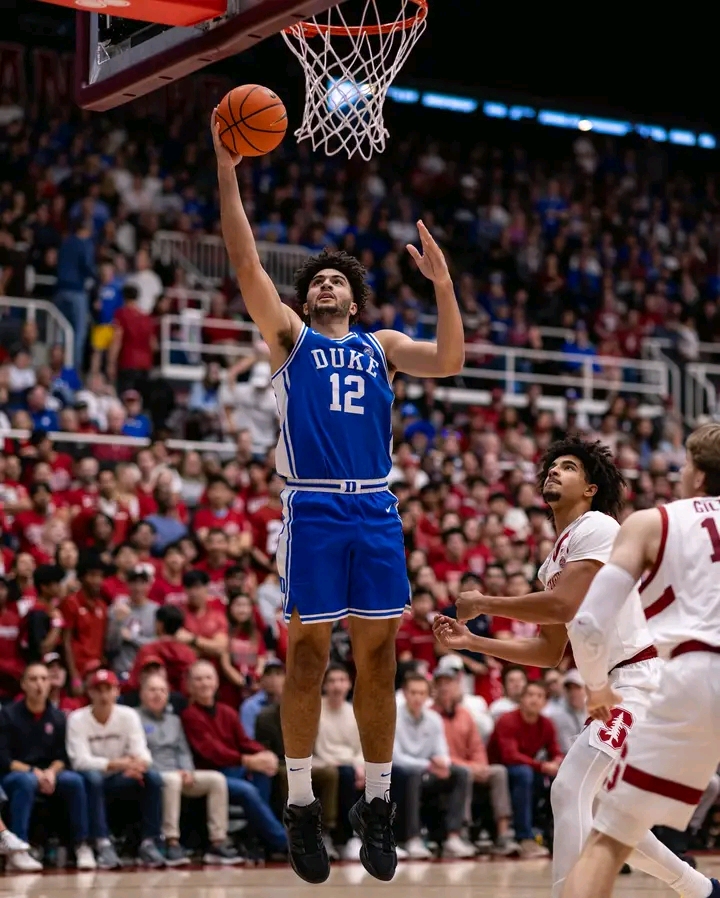
Against Stanford, Boozer delivered a masterpiece:
30 points
14 rebounds
3 assists
3 steals
1 block
70.6% shooting
It wasn’t just dominant it was effortless. Stanford threw bodies at him. Duke kept feeding him. And nothing changed.
Freshman of the Week again and why it matters
Winning Freshman of the Week once signals arrival.
Winning it twice suggests consistency.
Winning it three times before midseason? That signals separation.
Boozer now joins a very short list of freshmen nationally who have commanded sustained weekly recognition. And it’s not happening in a vacuum. This isn’t mid-major stat padding or quiet production. These performances are coming in ACC play, under national television lights, against defensive game plans built specifically to slow him down.
CBS Sports and the USBWA’s Frosh Watch has taken notice and so has everyone else.
The award isn’t just a weekly pat on the back. It’s a reflection of dominance relative to peers. And week after week, Boozer isn’t just winning he’s winning convincingly.
Duke’s lineage and the weight of history
At Duke, excellence isn’t surprising it’s expected. That reality cuts both ways.
Cameron Boozer arrived in Durham not merely as a five-star prospect, but as a name already heavy with legacy. Comparisons were inevitable. Expectations were relentless. And the margin for patience was slim.
Yet Boozer has navigated that pressure with remarkable composure.
If he were to go on and win National Player of the Year, he would become the 10th Duke player to do so joining a lineage that includes Shane Battier, Jason Williams, JJ Redick, Zion Williamson, and most recently, Cooper Flagg, who captured the award last season.
The last time a program produced back-to-back National Players of the Year? Duke in the early 2000s.
History is not repeating itself yet. But it’s no longer a far-fetched discussion.
Why Boozer is different from the rest of the freshman field
There are other outstanding freshmen. Let’s be clear.
AJ Dybantsa flashes elite athleticism and shot creation.
Koa Peat brings physicality and two-way impact.
Mikel Brown Jr. controls tempo like a seasoned veteran.
Darius Acuff Jr. has shown scoring bursts that can swing games.
But here’s the difference: Boozer affects every possession even when he’s not scoring.
He rebounds in traffic.
He initiates offense.
He reads double teams.
He anchors Duke’s interior defense.
He makes teammates better.
That all-around impact is why opposing coaches don’t just scheme for him they build entire game plans around limiting damage. And yet, the damage still arrives.
Duke’s winning streak and Boozer at the center of it
Since Duke’s lone setback against Texas Tech, the Blue Devils have ripped off six consecutive wins all fueled by Boozer’s steady brilliance.
In that stretch, Boozer hasn’t dipped below 20 points. He hasn’t disappeared in any half. He hasn’t needed to be “found” offensively.
When Duke needs stability, he provides it.
When Duke needs a run-stopper, he becomes it.
When Duke needs a closer, he delivers.
That reliability is rare in freshmen — and priceless for contenders.
The mental side where freshmen usually falter
What often separates elite freshmen from great ones isn’t skill it’s mental stamina.
The college season is unforgiving. Scouting intensifies. Legs get heavy. Expectations compound. Many freshmen hit walls.
So far, Boozer has shown no cracks.
His shot selection remains disciplined. His defensive positioning has improved as the season progresses. His body language even after physical games reflects confidence rather than fatigue.
That’s often the clearest indicator of future greatness: not how high a player peaks, but how steady they remain while carrying the load.
Frosh Watch Top 10 and the view from No. 1
1. Cameron Boozer | F | Duke
Stats: 23.2 PPG | 9.9 RPG | 4.1 APG
There’s no longer debate about who sits atop the freshman rankings. The only question is how wide the gap becomes by March.
Boozer isn’t just leading freshmen he’s forcing conversations about All-America teams, National Player of the Year ballots, and Duke’s ceiling in the postseason.
And we’re only halfway through the season.
What comes next and why the separation may grow
As conference play deepens, the pressure increases. Matchups tighten. Scouting sharpens.
That’s where stars either plateau or ascend.
Boozer’s game is built for the grind. His scoring doesn’t rely solely on jump shots. His rebounding travels. His feel for the game only improves with repetition.
If anything, the second half of the season may widen the gap further.
Because while others are still learning how to impose themselves consistently, Boozer already knows who he is and so does everyone else.
Final thought: this isn’t hype it’s hierarchy
Freshman rankings are usually fluid. Volatile. Subject to nightly swings.
This one feels different.
Cameron Boozer isn’t just leading the class. He’s defining it. And with every dominant outing, every weekly honor, every efficient masterpiece, the conversation shifts a little more away from who might catch him, and toward how far ahead he can go.
The pack is still talented.
The season is still young.
But the separation?
That’s already happening.




