


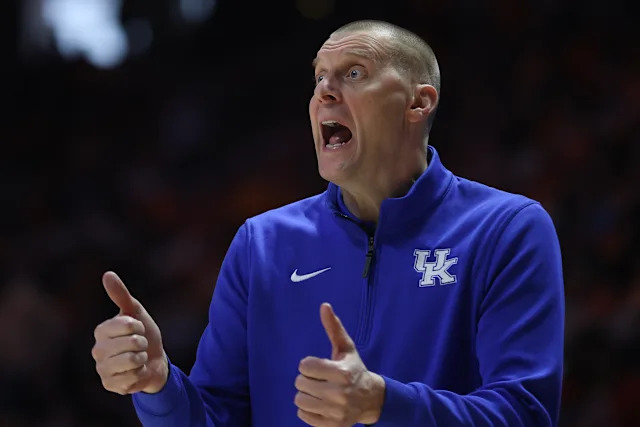
It keeps happening so early that fans barely have time to settle into their seats before the concern creeps in. A missed rotation. A rushed shot. A quick glance at the scoreboard — and suddenly Kentucky is down double digits again. The Wildcats keep finding ways to escape, to rally, to turn chaos into thrilling wins. But beneath the excitement sits an uncomfortable truth Mark Pope can no longer ignore: this season may not be undone in March, or even in February — it might be getting endangered in the first five minutes of every game.
This isn’t a one-off issue. It’s not a matchup quirk or a bad shooting night. It’s a pattern — one that has shown up too often, too early, and too consistently for Mark Pope to ignore.
The Wildcats’ slow starts are no longer just an annoyance. They are the single biggest threat to Kentucky’s season.
A Problem That Keeps Repeating Itself
Kentucky has now built a reputation for digging itself into deep holes — especially on the road — and then spending the rest of the game clawing back to even footing. In the past two games alone, the Wildcats trailed LSU by 18 points and Tennessee by 17. Both games ended in dramatic Kentucky victories, showcasing resilience and talent.
But those comebacks also masked the deeper issue.
You cannot rely on miracles every night.
Sooner or later, even the most talented roster will run out of margin for error. The SEC doesn’t forgive sluggish starts. March doesn’t forgive them either.
And Kentucky hasn’t yet played a full 40 minutes of connected, focused basketball against a Power Five opponent this season.
There have been stretches — impressive ones. There have been halves, even quarters, where the Wildcats look dominant. But there hasn’t been a complete game where everything clicks from the opening tip to the final buzzer.
That absence matters.
“I Don’t Really Have an Answer”
Perhaps the most telling moment came not from a coach, but from a player.
When newly inserted starter Andrija Jelavic was asked why Kentucky keeps starting games slowly, his response was honest — and alarming.
“I don’t really have an answer to that, I’m not going to lie,” Jelavic said. “I don’t really have an answer to that.”
It wasn’t deflection. It wasn’t frustration. It was genuine uncertainty.
And that’s what makes this issue so difficult to solve.
Kentucky isn’t coming out flat because of effort alone. It’s not a simple case of players not caring or not being ready. The slow starts are happening despite lineup changes, despite veteran leadership, and despite repeated reminders.
Which means the solution has to go deeper.
Mark Pope Knows It Can’t Continue
The good news for Kentucky fans is that Mark Pope isn’t pretending this problem will magically resolve itself.
He’s not brushing it off as “part of the season” or chalking it up to youthful inconsistency. He’s openly acknowledging that what Kentucky is doing before games — mentally and physically — isn’t working.
“We’ve actually talked to the team about changing the way we do our 40 minutes before tip,” Pope told reporters this week.
That sentence matters more than it might seem.
Pope didn’t reveal specifics. He didn’t outline a checklist of changes or describe a dramatic overhaul. But he admitted something crucial: the current routine is producing the same flawed results.
When a coach is willing to adjust the pregame process — not just the in-game rotations or play calls — it signals urgency.
Why Slow Starts Are So Damaging
Slow starts don’t just put points on the scoreboard. They shape the entire flow of a game.
When Kentucky falls behind early, several things happen simultaneously:
The offense starts pressing.
Shot selection becomes rushed.
Defensive discipline loosens as players try to make up ground.
Opponents gain confidence and freedom.
Rotations tighten sooner than planned.
Instead of playing from strength, Kentucky is constantly playing from urgency.
Even when the Wildcats rally, the emotional and physical toll is real. Comebacks require more energy, more focus, and more perfect execution than games played from ahead.
Against LSU and Tennessee, Kentucky had enough to overcome those deficits. Against elite SEC teams — or in the NCAA Tournament — that margin may not exist.
The Auburn Comparison Fans Keep Making
Many fans have pointed back to last season’s matchup with Auburn as a reference point. Not because of the result, but because of the contrast in approach.
Bruce Pearl’s pregame speeches are fiery, emotional, and aggressive. Mark Pope’s style is far more cerebral — deliberate, thoughtful, measured.
Pope has openly acknowledged that he doesn’t believe in burning “white hot” all the time. He prefers controlled intensity, believing that emotional peaks must be timed carefully over a long season.
And that philosophy has merit.
But the question now is whether this particular Kentucky team needs a different spark early.
Intensity doesn’t have to mean yelling. But it does require clarity, urgency, and edge — especially in the opening minutes.
What Pope Might Be Changing
Pope hasn’t detailed the adjustments, but there are several areas that could be under review:
Warm-up structure: Are drills engaging players mentally, or simply going through routine?
Locker room messaging: Is the emphasis on execution outweighing urgency?
Arrival timing: Are players coming out too relaxed, too comfortable?
Starting lineups: Is the group best suited to absorb early pressure?
Any of these could be part of the solution — or part of the problem.
What’s clear is that Pope understands the danger of waiting too long to fix it.
The Irony of Kentucky’s Resilience
Here’s the paradox: Kentucky’s ability to fight back has become both its strength and its crutch.
The Wildcats know they can rally. They’ve proven it. That confidence can be empowering — but it can also breed complacency. When players believe they can always recover, urgency at the opening tip can slip.
That’s not a character flaw. It’s human nature.
The challenge for Pope is to harness that resilience without letting it excuse poor starts.
Why This Matters Right Now
Mid-January is the danger zone for teams like Kentucky.
This is when habits solidify. This is when routines become comfortable. This is when flaws either get fixed — or get exposed later under brighter lights.
Kentucky can’t afford to keep spotting opponents double-digit leads, especially with the SEC schedule tightening and March looming.
If the Wildcats want to turn this season into something meaningful — not just entertaining — they must learn how to start games with the same force they finish them.
The Texas Test
Wednesday night’s matchup against Texas presents an immediate measuring stick.
Texas is physical. Texas rebounds well. Texas thrives on opponents that lose focus early.
If Kentucky comes out slow again, the hole may be too deep to escape. If the Wildcats show improved energy, sharper execution, and clearer purpose in the opening minutes, it could be a sign that Pope’s adjustments are working.
Either way, eyes will be watching closely — not just the final score, but the first five minutes.
The Season Isn’t Broken — Yet
This isn’t a panic moment. Kentucky is winning games. The talent is obvious. The resilience is real.
But unresolved problems have a way of growing teeth in February and March.
Mark Pope knows that. That’s why he’s scrambling — not because the season is lost, but because it’s still salvageable.
Fix the starts, and Kentucky becomes dangerous from tip to buzzer.
Ignore them, and the Wildcats may find that one night, the comeback never comes.




