At first, it didn’t sound like a basketball story at all. No talk of shooting percentages, defensive rotations, or late-game execution. No mention of rankings, bracketology, or national perception. Instead, it was about a bush. A gardener. And the painful necessity of being cut back before becoming something better. But as Kentucky basketball keeps climbing out of early-season turbulence — often the hard way, often late, often against the odds — the metaphor has begun to feel less abstract and more uncomfortably precise. What started as a quiet conversation rooted in faith has become an unexpectedly fitting lens through which to view a season defined not by dominance, but by survival, resilience, and growth.
A parable finds its moment
Ahead of Kentucky’s dramatic comeback victory over Tennessee, guard Collin Chandler approached head coach Mark Pope with a story that had resonated deeply with him for years: the parable of the currant bush, authored more than five decades ago by Hugh B. Brown, a longtime leader in the Church of Jesus Christ of Latter-day Saints. Both Chandler and Pope are members of the LDS Church, but the power of the parable, Pope insists, extends well beyond faith.
At its core, the story is simple. A gardener prunes an overgrown currant bush — cutting it down drastically — not to punish it, but to help it bear fruit. The bush, anthropomorphized, mourns what it believes is progress lost. The gardener responds with quiet certainty: I know what I want you to become.
For Pope, the resonance was immediate.
“Which is so — it so exactly hits our team,” Pope said after the Tennessee win. “Exactly about what we are about. Getting cut down and growing back better.”
Why it fits this Kentucky team
Few Kentucky teams in recent memory have experienced such a sharp contrast between expectation and reality. Entering the season, Pope’s second in Lexington, optimism was not only high — it was loud. After a 24-12 campaign in his debut year, Pope had aggressively reshaped the roster. Kentucky landed high-profile transfers, welcomed elite recruits, and returned key contributors like Otega Oweh, who was expected to take a leap from star to leader.
When Kentucky defeated preseason No. 1 Purdue by double digits in its first true exhibition, the whispers became declarations. SEC title. Final Four ceiling. Maybe more.
Then the pruning began.
Losses piled up against ranked opponents. Close games slipped away. The Wildcats dropped five of six contests against top-tier competition, including painful defeats to Louisville, North Carolina, and Gonzaga. Conference play opened with losses at Alabama and at home to Missouri. Rupp Arena, long considered sacred ground, grew restless. Booing followed. Confidence wavered.
Kentucky wasn’t just losing — it was being cut back.
Adversity without a shortcut
Pope never pretended otherwise. After a brutal December stretch, he openly acknowledged that the criticism from fans was deserved. He called certain performances “uncharacteristic” and admitted the team was underachieving by its own standards. At one point, he even joked — controversially — about the emotional toll of the losses, a comment that underscored just how heavy the moment felt.
But through it all, Pope resisted the temptation to redefine success prematurely.
“There’s no time for indulging in feeling terrible,” he said at one point. “The next thing you do rewrites what happened before.”
That philosophy aligns seamlessly with the parable Chandler shared. Growth, in this framing, is not linear. It is disruptive. Painful. Often misunderstood while it’s happening.
Two comebacks, one message
Kentucky’s recent stretch of play has mirrored that idea almost perfectly.
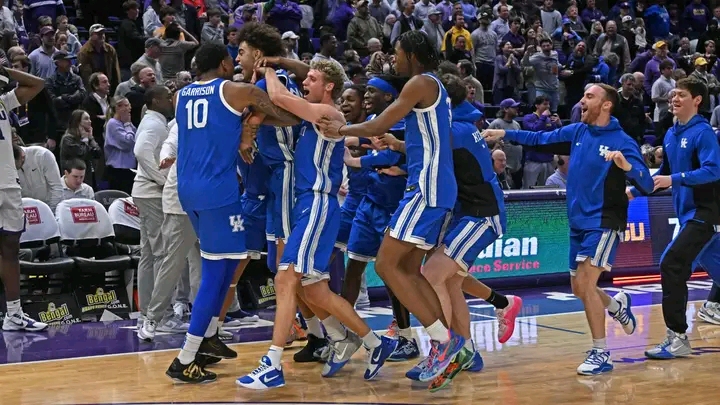
Against LSU, the Wildcats entered halftime trailing 38–22 — lifeless, disjointed, and on the brink of a season-derailing loss. What followed was the largest comeback of the Mark Pope era, capped by Malachi Moreno’s buzzer-beater.
Days later, at Tennessee, Kentucky did it again. Down big. Written off again. Victorious again.
According to ESPN, Kentucky became the first program since 2017 to win consecutive games after trailing by at least 15 points. The statistic mattered, but the manner mattered more. There was no panic. No finger-pointing. Only belief.
“Our team knows how to respond,” Chandler said afterward. “We’re never too low.”
Faith, stripped of exclusivity
While the currant bush parable originates within LDS teachings, Pope has been careful not to frame it as religious instruction for his team. Most of his players are not members of the Church. That, he says, doesn’t matter.
“On a purely athletic level, this is the way it works,” Pope explained. “We go into the weight room to literally tear down muscle so it grows back stronger.”
The metaphor lands because it’s universal. Every athlete understands soreness. Every competitor understands setback. Every human understands disappointment.
Local LDS leader Drew Millar emphasized that while not all church members may even recognize the parable by name, the idea behind it — growing through challenge — is deeply ingrained.
“You grow more from defeat than from victory,” Millar said.
A roster built for pressure — and patience
Kentucky’s struggles have not been tied to a lack of talent. Pope assembled one of the more intriguing rosters in the country: Jaland Lowe, Jayden Quaintance, Denzel Aberdeen, Jasper Johnson, Malachi Moreno. The pieces are there.
But injuries disrupted continuity. Lowe and Quaintance both battled health issues. Rotations changed. Chemistry lagged.
This wasn’t a team that needed more ability. It needed time — something Kentucky fans rarely want to hear.
And yet, slowly, signs of growth emerged. Otega Oweh evolved into a steadying presence. Younger players embraced roles. Defensive effort improved. Composure followed.
The bush, though pruned, was beginning to bud.
Kentucky basketball and collective identity
John Pelphrey once described Kentucky basketball as something that simply exists in the hearts of its fans — not taught, not explained, just felt. For many in Big Blue Nation, wins and losses don’t just affect mood; they affect rhythm of life.
Pope understands that weight.
When fans booed, he didn’t bristle. He empathized. When expectations crushed early confidence, he didn’t deflect. He absorbed it.
“I understand why people are frustrated,” he said. “They care.”
In that way, the currant bush parable extends beyond the locker room. Fans, too, have been pruned — forced to sit with uncertainty instead of entitlement.
Not the end of the story
The most powerful aspect of the parable is not the pruning itself, but the assurance that pruning is not the final chapter.
“I believe that when we’re facing adversity, it’s not the end of the story,” Pope said. “It’s a necessary part of the process for us to actually become something great.”
That belief doesn’t guarantee banners or championships. It guarantees perspective.
Kentucky may still stumble. The ceiling remains unclear. The SEC remains unforgiving. But what this team has shown — repeatedly — is an ability to absorb punishment without breaking.
That matters in March.
Why this season may age well
Not every Kentucky season is remembered fondly. Some fade quietly. Others grow more meaningful with time.
This one, messy as it’s been, carries the fingerprints of transformation.
A team that was doubted learned to respond. A coach under scrutiny leaned into patience. A fan base forced to wait discovered something else to watch for: growth.
“Don’t miss it,” Pope urged. “Because it’s a tribute to these guys.”
The quiet power of becoming
The currant bush never knew what it could become until it was cut down. Kentucky basketball, in its own way, may be discovering the same truth.
This season is not about perfection. It’s about resilience. About refusing to confuse pruning with failure. About understanding that growth often feels like loss before it feels like progress.
And maybe that’s why the story sticks — not because it promises triumph, but because it dignifies the struggle.
We find joy in growing.
Sometimes, that’s enough.