


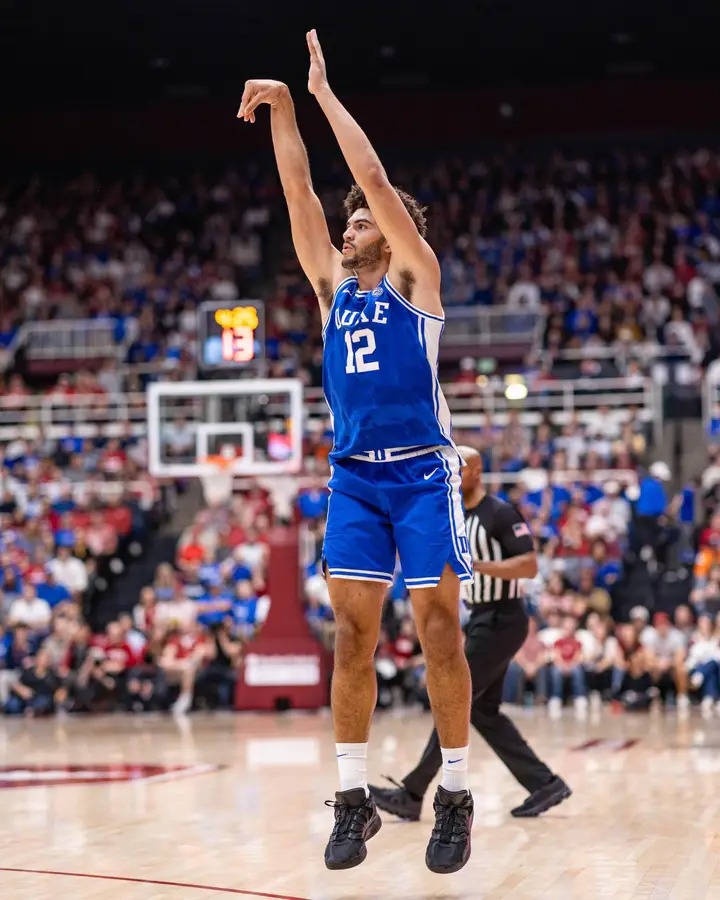
What unfolded Saturday night in Palo Alto went far beyond a routine conference win or a simple West Coast road result. Duke’s 80–50 dismantling of Stanford was the kind of performance that reshapes perception, resets narratives, and quietly reasserts hierarchy inside the Atlantic Coast Conference.
While other traditional powers from Tobacco Road stumbled during their California trips, Duke Blue Devils didn’t just survive the swing — they owned it. By becoming the first ACC team to complete a California sweep, Duke sent a clear, unmistakable message: this program still defines the league’s standard, regardless of venue, time zone, or opponent.
A Game That Was Over Before It Felt Close
From the opening tip, the tone was unmistakable. Duke played with precision, physicality, and composure, building an early cushion and never allowing Stanford to believe momentum might swing. By halftime, the gap already felt significant. By the middle of the second half, it felt inevitable.
Stanford simply had no answers — not for Duke’s spacing, not for their defensive rotations, and certainly not for the star power headlining the floor.
Cameron Boozer’s Star Turn Becomes a Statement
At the center of it all was Cameron Boozer, who delivered another performance that looked less like a freshman breakout and more like a superstar asserting dominance. Boozer finished with 30 points and 14 rebounds, scoring efficiently, rebounding through contact, and dictating tempo whenever Duke needed a steady hand.
It wasn’t just the numbers — it was the ease. Boozer never forced the game. He let it come to him, punished mismatches, and controlled the paint on both ends. Each possession reinforced the same reality: Duke doesn’t just have talent — it has a centerpiece capable of carrying games on the road against high-level competition.
Depth, Balance, and Control
Boozer wasn’t alone. Isaiah Evans added 15 points with timely shot-making, while Pat Ngongba chipped in 13, continuing to give Duke reliable interior production and defensive toughness.
But perhaps the most telling contribution didn’t show up fully in the box score.
The Defensive Moment That Changed Everything
Stanford entered the night with confidence built around freshman sensation Ebuka Okorie, who averages 23 points per game and was coming off a jaw-dropping 36-point, nine-assist performance earlier in the week. Duke made stopping him a priority — and executed the plan to perfection.
Dame Sarr drew the primary assignment, and the result was decisive. Okorie was hounded into difficult shots, denied clean driving lanes, and visibly frustrated as the night wore on. He finished with just nine points, a stunning contrast to his recent output and a testament to Duke’s discipline and defensive buy-in.
It was the kind of individual defensive effort that swings games quietly — the kind that championship-level teams rely on when stars on the other side threaten to take over.
More Than One Win — A Conference Warning
By the final horn, the 30-point margin told the story plainly, but the implications went deeper. Duke didn’t just beat Stanford — they dominated them in every phase: execution, effort, physicality, and poise.
With a week off before returning home to face Wake Forest Demon Deacons, Duke now sits in an enviable position. Healthy, confident, and battle-tested, the Blue Devils look increasingly like a team rounding into form at exactly the right time.
For the rest of the ACC, Saturday night served as a reminder: while the league continues to evolve, while challengers rise and narratives shift, Duke remains the measuring stick.
And on a quiet night in California, they made sure everyone noticed.




