


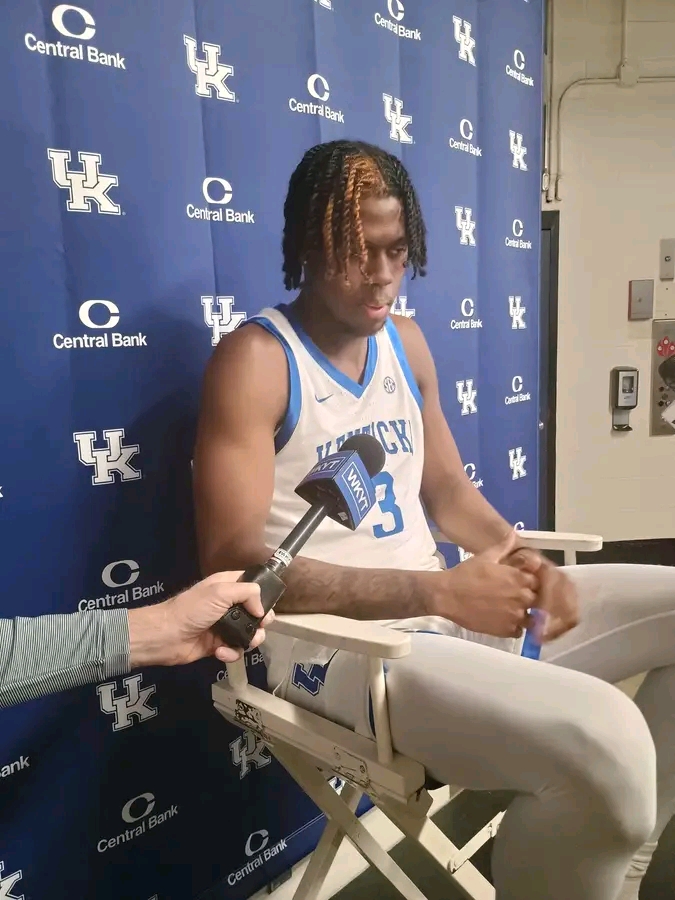
For a moment, the roar inside Rupp Arena softened—not because Kentucky was losing, but because everyone sensed something had gone wrong. A limping Wildcat, a quiet bench, and a game that suddenly felt secondary. Kentucky would go on to beat Texas, but the most lasting image from Wednesday night wasn’t a clutch basket or a late stop—it was Kam Williams heading toward the locker room, unknowingly carrying news that would reshape Kentucky’s season.
A win that came with a cost
Kentucky’s 85–80 victory over Texas should have been celebrated without reservation. The Wildcats defended home court, overcame late-game pressure, and continued a midseason surge that has quietly stabilized a once-uneven campaign. Instead, the immediate postgame conversation turned somber.
Head coach Mark Pope didn’t dance around the news.
“Kam’s foot’s broken, so he’ll be out,” Pope said. “He’s just a beautiful kid. I thought he actually made some special plays tonight… we’re gonna get him back healthy as soon as we possibly can, but he’ll be out for a while. And it’s certainly a blow to us.”
Those words—a blow to us—carried weight. Not because Kentucky lacks talent or depth, but because Williams had begun to matter in ways that don’t always show up cleanly in box scores.
How the injury unfolded
Williams exited the game with 18:11 remaining in the second half after coming down awkwardly on a play near the lane. There was no dramatic collision, no immediate stoppage that screamed disaster. Instead, it was the quiet kind of injury—the kind players try to shake off before realizing something isn’t right.
He didn’t return.
At the time, Kentucky was in control but far from comfortable. Texas is too physical, too athletic, and too experienced to allow any lapse in focus. The Wildcats could have unraveled emotionally. Instead, something else happened.
They rallied.
“Connectivity came in”
Pope described the moment Williams left the floor as a test of emotional maturity.
“We all watched Kam walk off the floor, and that’s a gut punch,” Pope said. “J-Lowe’s out, JQ’s out, Kam’s limping off the floor… that was a moment where connectivity came in. Our guys were like, ‘Okay, the only thing we can do for Kam right now is go play.’”
That response mattered.
Kentucky has not always responded well to adversity this season. Early losses, inconsistent starts, and roster disruptions have challenged continuity. But this group—shorthanded, tested, and emotionally shaken—found resolve.
The Wildcats turned frustration into focus.
Collin Chandler steps forward
No one embodied that response more than Collin Chandler.
Chandler scored 18 points on the night, but the distribution told the real story: 14 of those points came in the second half, after Williams’ injury. Each basket felt heavier, more intentional—like a message to a fallen teammate.
Chandler attacked gaps, finished through contact, and played with a quiet edge that Kentucky desperately needed as Texas mounted a late push. When the Longhorns cut the lead to two with under a minute remaining, Chandler’s composure helped steady the moment.
This was not coincidence. It was leadership emerging in real time.
The role Kam Williams was carving out
Williams wasn’t the most talked-about Wildcat this season. He wasn’t the leading scorer, nor was he the centerpiece of scouting reports. But internally, his role was growing—and it was growing fast.
At 6-foot-8, Williams provided lineup flexibility that allowed Pope to toggle between speed and size. He could score from the mid-post, stretch the floor just enough to keep defenses honest, and defend multiple positions without fouling. More importantly, he played within himself.
In a season where Kentucky has often struggled with slow starts and rhythm, Williams was becoming a stabilizer.
He didn’t force shots.
He didn’t hijack possessions.
He simply played winning basketball.
And that’s why the loss stings.
A season already tested by injuries
Williams’ injury doesn’t exist in isolation. Kentucky has already been navigating a growing list of unavailable or limited players.
Jaland Lowe has been ruled out for the season.
Jayden Quaintance remains sidelined with an uncertain return timeline.
Now Kam Williams joins that list.
Each injury forces another adjustment. Each absence chips away at lineup continuity. Each change asks more of the remaining players—not just physically, but mentally.
And yet, Kentucky keeps winning.
That paradox defines this season.
Depth will be tested—and trusted
If there is one reason Kentucky can survive this stretch, it’s depth.
Pope still has options:
Brandon Garrison brings interior strength and rebounding.
Mo Dioubate offers energy, length, and defensive versatility.
Andrija Jelavic continues to grow into a more consistent contributor.
Malachi Moreno provides size and physicality in the paint.
The challenge won’t be replacing Williams with one player—it will be replacing what he allowed everyone else to do. His presence made rotations cleaner. His minutes reduced strain on others. His versatility smoothed lineup decisions.
Now, Pope must recalibrate.
Mark Pope’s calm approach faces a new test
Pope has never been a sideline screamer. He’s deliberate, thoughtful, and measured. Earlier this season, he acknowledged that Kentucky’s slow starts were becoming a real issue—and admitted changes were needed.
“We’ve talked to the team about changing the way we do our 40 minutes before tip,” Pope said recently.
Williams’ injury adds another variable to that equation. Preparation, mentality, rotation management—everything becomes more fragile when margin for error shrinks.
Pope knows this.
That’s why his postgame tone wasn’t panicked—but it was honest.
This one hurt.
The emotional weight inside the locker room
The most revealing moment of the night didn’t happen on the court. It happened in the way Pope described the locker room afterward.
“Go play,” the team told itself. “Then we can cry with Kam after.”
That line matters.
It suggests this team is connected in ways that weren’t always visible earlier in the season. It suggests shared accountability. It suggests trust.
Winning teams aren’t defined by how they look when everything goes right—but by how they respond when something goes wrong.
Wednesday night showed growth.
What this means going forward
Williams will be out “for a while.” That phrase is intentionally vague, but in January, “a while” can feel like an eternity. SEC play doesn’t slow down. Physical matchups don’t ease up. And fatigue accumulates quickly.
Kentucky will need:
Cleaner starts
Smarter shot selection
More consistent defensive focus
Leadership from veterans and young stars alike
The Wildcats can’t afford emotional hangovers. They can’t wait for reinforcements. They have to be who they are—right now.
A win that revealed something deeper
Kentucky beat Texas. That’s the headline on the scoreboard.
But the real story lives underneath.
It’s a team learning how to absorb pain without folding. A coach acknowledging reality without losing belief. A group of players deciding—together—that adversity won’t define them.
Kam Williams will be missed. His injury changes things. There’s no denying that.
But if Wednesday night proved anything, it’s this:
Kentucky didn’t just survive a blow it didn’t see coming.
It revealed a resilience it may not have known it had.
And in January, that might matter just as much as any win.




