


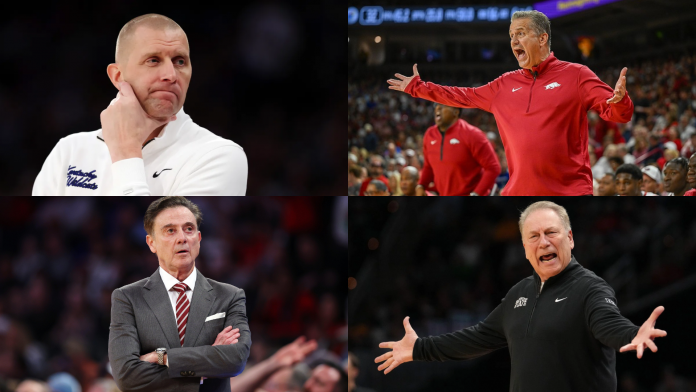
At first glance, it sounds almost unbelievable — even a little ironic. Kentucky basketball, a program built on tradition, recruiting pipelines, and an unwritten code of how the college game should operate, is now reportedly considering a move that could shake the sport’s moral fault lines. After months of injuries, instability, and survival-mode basketball, Mark Pope’s Wildcats may be ready to cross into territory that some of the most powerful voices in college basketball have openly criticized. And if the reports are accurate, the ripple effects could extend far beyond Lexington — straight into the long-standing philosophies of coaches like John Calipari, Tom Izzo, Rick Pitino, Mark Few, and Matt Painter.
This isn’t just about adding a player. It’s about desperation, evolution, and a sport still struggling to define its own boundaries.
Kentucky’s Season: Better Than It Looks, Worse Than It Feels
Kentucky currently sits fifth in the SEC with a 13–6 record, a mark that, on paper, appears underwhelming for one of college basketball’s bluebloods. For a fanbase accustomed to dominance, deep tournament runs, and national relevance, that record hardly inspires confidence.
But context matters — and this season, context might be everything.
Considering how the year began and how relentlessly it has tested Mark Pope’s roster, Kentucky’s position in the SEC standings is arguably impressive. The Wildcats have weathered turbulence, absorbed blow after blow, and somehow emerged on a four-game winning streak, signaling resilience rather than collapse.
Yet just when it seems Kentucky might be turning a corner, the injury report refuses to quiet down.
A Crisis of Availability, Not Effort
Mark Pope’s biggest challenge this season hasn’t been scheme, motivation, or buy-in — it’s been simply having healthy bodies available.
Kentucky has been battered by injuries across nearly every position group, forcing constant rotation changes, emergency minutes, and lineup instability. The list of injured Wildcats over the past season and a half reads more like a medical chart than a depth chart.
Among those affected:
Denzel Aberdeen – missed time
Trent Noah – sidelined multiple games
Mo Dioubate – out several contests
Jaland Lowe – season-ending injury
Jayden Quaintance – extended absence
Kam Williams – potentially out for the season
And those are just the most recent names.
In total, Kentucky has lost 13 players to injuries in less than two years, an almost unbelievable statistic for a program expected to contend annually.
The Full Injury Toll Under Mark Pope
Over the past season and a half, Pope has managed injuries to:
Lamont Butler (missed most of the season)
Kerr Kriisa (out for the season)
Andrew Carr (in-and-out all year)
Brandon Garrison (missed time)
Jason Robinson (out for the season)
Otega Oweh (missed summer workouts)
Jaland Lowe (out for the season)
Denzel Aberdeen
Trent Noah
Mo Dioubate
Jayden Quaintance
Kam Williams (status uncertain)
The cumulative effect? A roster that has rarely looked the same from week to week, let alone game to game.
Why Kentucky Is Now Exploring an Uncomfortable Option
With depth depleted and reinforcements limited, Kentucky appears to be exploring a move few expected — reaching out to G-League guard Dink Pate.
The decision, while practical on the surface, carries enormous philosophical weight.
For years, several prominent college coaches — including John Calipari, Tom Izzo, Rick Pitino, Mark Few, and Matt Painter — have voiced strong opposition to allowing former G-League or NBA-affiliated players to return to college basketball. Their argument centers on fairness: that college programs should not be able to sign players who bypassed college, entered professional systems, and then returned once those paths stalled.
From their perspective, such moves threaten the competitive balance and undermine high school athletes who choose the traditional college route.
And yet — here stands Kentucky.
Dink Pate: The Gray-Area Prospect
Dink Pate is not a typical transfer.
At just 19 years old, Pate opted out of college entirely, choosing instead to play professionally for the G-League Ignite, a developmental system designed as an alternative path to the NBA. Under head coach Jason Hart, Pate spent two seasons competing against older, more physically developed professionals.
He later went undrafted, placing him in a unique limbo — no longer an NBA prospect, but also not a traditional college recruit.
This is where the controversy intensifies.
Unlike players who declared for the NBA Draft after college and returned, Pate never enrolled in college at all. That distinction places him in a regulatory gray area, one that may technically allow his eligibility — even if it contradicts the spirit of what many coaches believe the system should be.
Why This Reported Move Could Rattle College Basketball’s Old Guard
Coaches like Calipari, Izzo, and Pitino have built careers defending the structure of college basketball, even as they’ve adapted to NIL, transfers, and one-and-done culture.
But a G-League-to-college pipeline crosses a line for many of them.
If Kentucky proceeds — and succeeds — it could open the door for other programs to do the same, effectively reshaping roster construction nationwide. The concern isn’t just about one player; it’s about precedent.
What happens when struggling teams start viewing the G-League as a secondary transfer portal?
Kentucky’s Reality: Idealism vs Survival
From Kentucky’s perspective, however, ideology doesn’t win games — healthy players do.
Mark Pope is navigating a season defined by attrition. With limited scholarship flexibility, mounting injuries, and the pressure of SEC competition, his options are shrinking by the week.
The reported interest in Dink Pate feels less like a statement and more like a necessity.
This isn’t Kentucky chasing an edge. It’s Kentucky trying to stay afloat.
A Fanbase Divided, But Understanding
Reaction among Kentucky fans has been mixed — but largely pragmatic.
Some see the move as a slippery slope, fearing it undermines what college basketball represents. Others view it as a smart, forward-thinking adaptation to a rapidly changing landscape.
One thing is clear: few blame Mark Pope.
The injury toll has earned him empathy, and the four-game winning streak suggests the team has responded to adversity rather than folded under it.
What This Means for the Future of College Basketball
If Dink Pate suits up in Lexington, the conversation won’t end there.
It will reignite debates about:
NCAA eligibility rules
Professional alternatives for young players
Competitive balance
The definition of “amateurism” in a post-NIL world
Kentucky may not be trying to lead a revolution — but revolutions often begin with survival decisions made under pressure.
Final Thoughts: A Decision Born From Crisis
Kentucky basketball is not broken — but it is bruised.
At 13–6, riding a four-game win streak, and clinging to relevance in a brutal SEC, the Wildcats are fighting forward despite relentless setbacks. Injuries have reshaped their season, forced uncomfortable choices, and now pushed them toward a decision that could reverberate across the sport.
Whether Dink Pate ultimately joins the program or not, the mere possibility highlights how much college basketball has changed — and how much more change may be coming.
For Mark Pope, this isn’t about upsetting legends or challenging tradition.
It’s about keeping Kentucky alive.
And sometimes, survival demands decisions that make the entire sport uncomfortable.




