


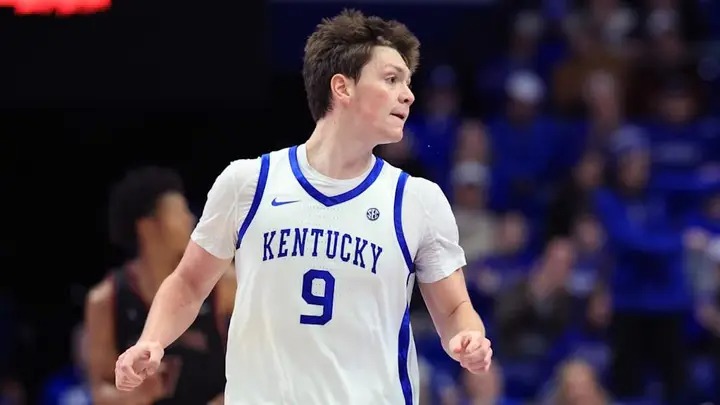
The debate has been simmering for weeks, quietly at first, then louder with every rotation decision and every close game. Now it’s unavoidable. Trent Noah has become the most polarizing figure inside Big Blue Nation — not because of something he said, but because of what he represents.
Walk into a Lexington sports bar, scroll through X, or listen closely inside Rupp Arena, and you’ll hear two very different conversations happening at the same time.
On one side are the believers.
They see a guard who understands spacing, who makes the extra pass, who rarely hijacks possessions and often stabilizes them. They point to his off-ball movement, his willingness to screen, rotate, and defend without demanding touches. To them, Noah is a connective piece — the kind of player coaches trust and teammates rely on when games tighten and chaos creeps in.
On the other side are the skeptics.
They argue his minutes are driven more by narrative than necessity. They whisper — sometimes loudly — that if he didn’t come from the mountains, if his story wasn’t so Kentucky-coded, he’d be glued to the bench. They question whether his production matches his opportunity, whether sentimentality has crept into a program that prides itself on ruthless excellence.
And sitting quietly between those two camps is the truth — one that’s about to come into focus.
Why the Divide Exists
The tension around Noah isn’t accidental. This Kentucky Wildcats roster is young, uneven, and still searching for a consistent identity. When results swing wildly from half to half, fans look for reasons — and often, for faces to attach those reasons to.
Noah doesn’t dominate the box score. He doesn’t explode for 20. His highlights don’t flood timelines. In today’s college basketball culture, where NIL value and perception often intertwine with production, that makes him an easy target.
But basketball isn’t played on spreadsheets alone.
What Noah does well — quick decisions, defensive discipline, floor balance — rarely screams for attention. It whispers. And unless you’re watching closely, you miss it.
What the Coaches See
Inside the program, the conversation sounds very different.
Head coach Mark Pope has been consistent in his messaging, even when he avoids naming names. He talks about trust. About players who “don’t speed the game up when it doesn’t need to be fast.” About guys who understand when to take a shot — and when not to.
Those descriptions keep lining up with Noah.
In film sessions, his clips often come with fewer pauses and fewer corrections. Not because he’s perfect, but because he’s predictable in the best way. Coaches know where he’ll be. Teammates know what pass is coming. In a season where volatility has been Kentucky’s biggest enemy, that matters more than fans might want to admit.
The Moment That’s Coming
Here’s where the story turns.
With rotations tightening and pressure rising, roles are being defined — not by reputation, but by reliability. And in those moments, players like Noah are no longer invisible. They’re tested.
Not with words. With minutes.
One side of this debate is about to get clarity. Either Noah’s calm, team-first approach will translate into tangible impact when the margins are thin — or the skeptics will feel validated as opportunities shrink and the rotation hardens.
There’s no middle ground left.
More Than a Player
This isn’t just about Trent Noah. It’s about what Kentucky values right now.
Is this a team still searching for stars to save it? Or one learning that cohesion, discipline, and trust might be the only way through an unforgiving SEC stretch?
Noah has become the symbol of that question — fairly or not.
And very soon, Big Blue Nation won’t have to argue anymore.
The floor will decide.




