


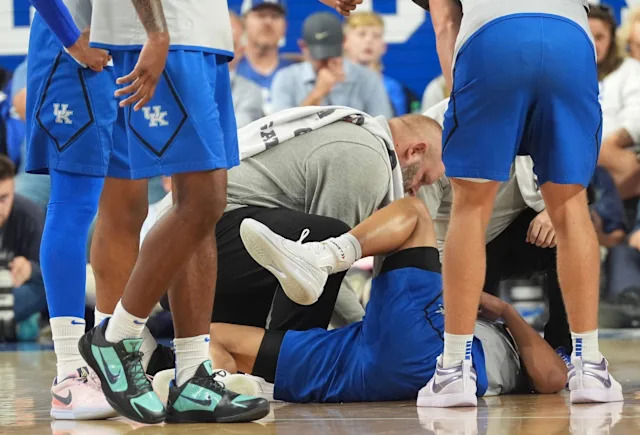
There are seasons when adversity strikes once or twice and forces a team to adapt. Then there are seasons where adversity refuses to leave, no matter how many adjustments are made. Kentucky basketball appears to be living in the latter reality. Every time the Wildcats seem poised to turn a corner—every time momentum builds, confidence rises, and answers begin to emerge—another name quietly slides onto the injury report. At some point, coincidence begins to feel like something more. And now, as the list keeps growing under Mark Pope, fans aren’t just frustrated anymore—they’re starting to ask the uncomfortable question: Is Kentucky basketball cursed?
Winning Through Chaos — Somehow
What makes Kentucky’s injury situation even more jarring is that the Wildcats are still winning.
Mark Pope has already collected 11 wins against top-30 NET opponents—a feat no other coach hired in 2024 can claim. On paper, that should be the story. A first-year head coach exceeding expectations. A team proving resilient. A program stabilizing after transition.
Instead, the dominant narrative surrounding Kentucky basketball has been survival.
The Wildcats are winning games while barely resembling the roster they envisioned during the preseason. Rotations have been reshuffled, lineups rewritten, and responsibilities reassigned—often with little warning. The constant question isn’t about matchups or tactics anymore. It’s about availability.
Who’s healthy?
Who’s next?
And how long can this keep going?
This Didn’t Start With Mark Pope
As tempting as it might be to pin the injury crisis on the new regime, the truth is far more complicated. Kentucky’s injury issues didn’t begin when Mark Pope arrived in Lexington. They’ve been quietly accumulating for more than a year, snowballing into what now feels like a full-blown epidemic.
Last season, the Wildcats’ training staff worked overtime just to keep lineups functional. Even then, the hits kept coming.
A History of Hurt: Last Season’s Breakdown
The 2024 campaign was less about rotations and more about rehabilitation schedules.
Kerr Kriisa fractured his foot and was lost for the season entirely, a devastating blow to depth and experience.
Andrew Carr battled persistent back issues that flared up repeatedly. Some weeks, he couldn’t even practice, let alone play at full speed.
Lamont Butler spent most of the year compromised by a shoulder injury, then added an ankle sprain that sidelined him for multiple games.
Brandon Garrison missed time due to nagging injuries that disrupted continuity.
Jaxson Robinson saw his season end abruptly when his wrist finally gave out late in the year.
Travis Perry sprained his wrist during the SEC Tournament, missing critical postseason games against Illinois and Tennessee.
By the time the season ended, Kentucky wasn’t just short-handed—it was stitched together.
The hope was that an offseason reset would finally clear the slate.
That hope didn’t last long.
The Summer That Changed Nothing
If summer is supposed to be a period of recovery, Kentucky never really got one.
Before the current season even reached opening night, injuries had already begun to shape the narrative.
Otega Oweh missed nearly the entire summer with a toe injury, limiting his preparation and conditioning.
Jaland Lowe entered the season with a compromised shoulder, which was eventually separated again—forcing Kentucky to shut him down completely.
By the time fans realized this wasn’t just “bad luck,” the injury list had already grown uncomfortably long.
The Current MASH Unit
What Kentucky is dealing with now doesn’t resemble a normal injury report. It resembles a medical ward.
Trent Noah missed time with an ankle injury.
Mo Dioubate was sidelined during a crucial stretch of games.
Jayden Quaintance returned briefly, only to see knee swelling force him back out—missing the last four games.
Kam Williams, the latest blow, broke his foot against Texas and is likely done for the year.
At this point, the Wildcats aren’t managing injuries—they’re managing attrition.
This isn’t a short-term problem. It’s a structural one.
When Depth Becomes a Myth
Every program talks about depth. Kentucky recruits it, develops it, and relies on it.
But depth assumes availability.
When injuries pile up at this rate, depth stops being a strength and starts becoming a myth. Lineups shrink. Minutes spike. Players are asked to do more, more often, with less recovery time.
That creates a vicious cycle:
Increased workload
Heightened fatigue
Elevated injury risk
Kentucky is now trapped in that loop.
Is It Just Bad Luck?
This is where the conversation gets uncomfortable.
Fans can accept bad luck—for a while. A freak injury here. An awkward landing there. But when injuries span multiple seasons, multiple rosters, and multiple body parts, coincidence starts to lose credibility.
Is it:
Training load?
Conditioning philosophy?
Recovery protocols?
Practice intensity?
Or simply extraordinary misfortune?
There’s no easy answer, and no obvious smoking gun. But elite programs don’t ignore patterns—they investigate them.
At some point, Kentucky has to ask whether something systemic needs to change.
The Psychological Toll
Injuries don’t just affect rotations—they affect confidence.
Players begin to play cautiously.
Coaches hesitate to push.
Fans brace for the next announcement.
Even victories come with a sense of dread. Every hard fall triggers concern. Every grimace sends a ripple through the arena.
That emotional tax is real, and it accumulates.
Mark Pope’s Greatest Test
Ironically, this injury crisis may become Mark Pope’s defining challenge—not strategy, not recruiting, not culture-building.
Leadership in chaos is different.
Pope has already proven he can coach. The wins against elite competition speak for themselves. But managing morale, health, and belief through sustained adversity is a different test entirely.
So far, Kentucky has responded with toughness.
But toughness isn’t infinite.
Can Kentucky Fix This?
The uncomfortable truth is that not all injuries are preventable. Basketball is violent, fast, and unforgiving.
But when injury trends stretch across seasons, smart programs ask hard questions:
Are workloads optimized?
Are recovery windows respected?
Are players returning too quickly?
Is preventative care prioritized enough?
Kentucky doesn’t need panic. But it does need answers.
A Fanbase Running Out of Patience — and Explanations
Kentucky fans are knowledgeable. Passionate. Demanding.
They understand adversity. They respect resilience.
What they’re struggling with now is repetition.
Every update feels familiar. Every press release reads the same. Every injury compounds frustration.
At some point, “bad luck” stops being satisfying.
Final Thoughts: Curse or Crisis?
Is Kentucky basketball cursed?
Probably not.
But something is undeniably broken.
Whether it’s misfortune, mismanagement, or an unsolved puzzle of modern college basketball demands, the result is the same: a program forced to fight uphill, again and again, against something it can’t game-plan for.
And until that changes, every win will feel fragile—and every season will feel like it’s one awkward landing away from unraveling.
Now it’s your turn.
Is this truly just bad luck?
Or does Kentucky need to confront a deeper issue before the injury report grows even longer?
Let the debate begin.




