


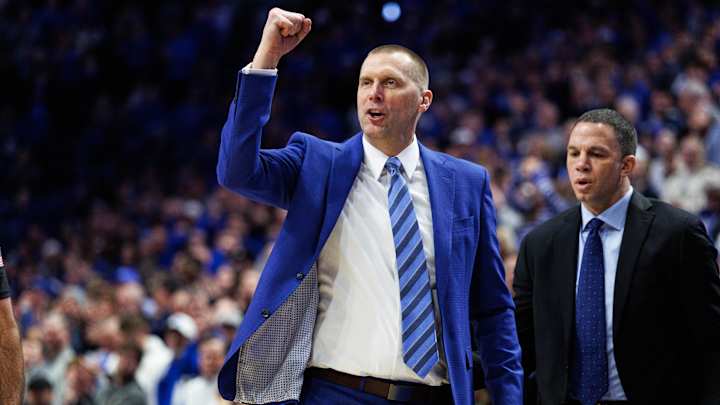
At some point during Kentucky’s gritty, nerve-rattling win over Ole Miss, a strange realization began to settle in around Rupp Arena — and among fans watching from home. This wasn’t beautiful basketball. It wasn’t fluid. It wasn’t the kind of game you clip for highlights or replay on loop. And yet, as the clock wound down and the margin stayed uncomfortably tight, there was a quiet sense that Kentucky was still in control. Not because they were dominating — but because they knew how to survive. That feeling, subtle but undeniable, is new. And it might be the most important development of Kentucky’s season.
For weeks now, the Wildcats have made a habit of winning games they don’t “deserve” on the stat sheet. They’ve won while shooting poorly. They’ve won while short-handed. They’ve won games that felt like coin flips. And increasingly, those flips keep landing in Kentucky’s favor. Not by accident. Not by luck. But because something fundamental has shifted in how this team understands winning.
Winning Ugly Has Become the Point
Kentucky’s 72–63 victory over Ole Miss was not an aesthetic triumph. The first half alone was a masterclass in offensive frustration, with both teams combining to shoot 15-for-53 from the field. Shots clanged. Possessions stalled. Rhythm never arrived.
But while Ole Miss seemed stuck searching for answers, Kentucky simply leaned into the discomfort.
This is where the shift becomes clear. Earlier in the season, ugly basketball rattled the Wildcats. Missed shots led to rushed possessions. Defensive lapses followed frustration. Momentum slipped away quickly. Now? Ugly basketball feels like home.
Mark Pope’s team no longer needs games to look good to feel good. They need them to be winnable. And those are two very different things.
Kentucky held the lead for the entire second half against Ole Miss, but never by more than a few possessions. Every time the Wildcats stretched it to six, the Rebels answered. Every time it felt like Kentucky might finally pull away, Ole Miss dragged them back into the mud.
And Kentucky didn’t panic once.
Falling in Love With the Work That Doesn’t Show Up
After the game, Pope put words to something fans have been sensing for weeks.
“We have guys that are falling in love with making the dirty, non-scoring, massively important winning plays of the game,” he said.
That sentence explains almost everything about this stretch of basketball.
This Kentucky team is no longer defined by who scores the most points. It’s defined by who saves possessions. Who dives on the floor. Who rotates early. Who takes the charge instead of going for the block. Who rebounds out of their area. Who makes the extra pass even when their own shot hasn’t been falling.
Against Ole Miss, those plays came from everywhere.
Denzel Aberdeen — the smallest player on the floor — ripped down one of the biggest defensive rebounds of the game. Mouhamed Dioubate sprinted across the court to contest a play that looked insignificant in real time but loomed massive in hindsight. Collin Chandler absorbed contact on defense, took charges, and then buried the three-pointer that finally gave Kentucky breathing room late.
None of those moments will dominate highlight reels. All of them decided the game.
Collin Chandler and the Moment That Explained Everything
With just over a minute remaining, Kentucky clung to a narrow lead. Malachi Moreno stepped to the line and made the first free throw, pushing the margin to three. He missed the second.
That miss could have changed everything.
Instead, Dioubate fought for the rebound, forcing a jump ball and keeping possession with Kentucky. On the ensuing play, Denzel Aberdeen found Chandler. Chandler rose. Chandler fired. Chandler hit.
A six-point game instantly became a two-possession cushion.
That sequence — not the shot alone, but everything surrounding it — is Kentucky’s season in miniature. Misses didn’t spiral into mistakes. Mistakes didn’t lead to panic. One player covered for another. Then another stepped forward.
Chandler, still early in his Kentucky career, has developed a reputation for wanting those moments. Pope made that clear afterward.
“He loves the moment. He wants it,” Pope said. “You have to be wired a little different to do that.”
Kentucky didn’t always have players who wanted these moments. Now, they do — and they trust one another to survive them.
Nine Players, One Purpose
Perhaps the most striking statistic from the Ole Miss game wasn’t a shooting percentage or a turnover count. It was this: every available Kentucky player played double-digit minutes.
With Kam Williams sidelined after foot surgery. With Jayden Quaintance still out. With Jaland Lowe lost for the season. With injuries stacking up faster than answers, Kentucky has had no choice but to embrace collective responsibility.
And they have.
Otega Oweh scored 20 points in the second half alone, finishing with 23. But he spent much of his postgame interview praising teammates — not himself. Jasper Johnson gave Kentucky its offensive spark in the first half, rattling off eight points in under two minutes to erase an early deficit. Trent Noah came off the bench and made immediate defensive noise, collecting three steals and hitting a crucial three.
Malachi Moreno battled inside. Andrija Jelavic did a bit of everything. Brandon Garrison fought on the glass. Aberdeen orchestrated. Dioubate brought physicality.
Kentucky isn’t deep anymore. But it is connected.
“We don’t have that many guys,” Pope said bluntly. “So we’re kind of using everybody we have.”
And somehow, that limitation has sharpened the team’s focus rather than dulling it.
The Simplification That Saved the Season
Two weeks ago, after a home loss to Missouri, Pope admitted something that could have rattled a young roster: the staff had to “dumb it down” offensively.
Instead of taking offense, the Wildcats took clarity.
Since then, Kentucky has stopped chasing perfection. Sets are simpler. Reads are clearer. Roles are better defined. And perhaps most importantly, players look comfortable making decisions — even imperfect ones.
“I think the guys are a little more comfortable with each other,” Pope said. “We’re staying as simple as we possibly can.”
That simplicity has translated directly to late-game execution. Kentucky knows what it wants to do. They know where shots are supposed to come from. They know who they trust with the ball.
That confidence matters when the game tightens and every possession feels heavier than the last.
Close Games Aren’t a Fluke Anymore
Five straight wins. Multiple one-possession games. Comebacks. Stands. Stops.
At some point, this stops being coincidence.
Kentucky has turned close games into a proving ground — not a pressure cooker. They don’t need separation early. They don’t need fireworks. They need the game to remain within reach long enough for their habits to matter.
And those habits are finally strong.
This is not the most talented version of Kentucky basketball fans have ever seen. It might not even be the most confident. But it is becoming one of the most resilient.
What This Means Going Forward
Injuries aren’t going away. The schedule won’t get easier. And there will be nights when Kentucky’s offense looks every bit as stuck as it did in the first half against Ole Miss.
But here’s the difference now: Kentucky doesn’t need the game to break perfectly.
They just need it to break late.
They’ve learned how to stay present. How to grind. How to make one more play than the opponent. And in college basketball — especially in March — that skill matters more than shooting percentages or preseason expectations.
They’re not playing prettier.
But they’re playing smarter.
They’re playing tougher.
And most importantly, they’re playing to win the moments that decide games.
That’s why close games keep breaking Kentucky’s way.
And if this shift holds, it might end up defining their season.




