


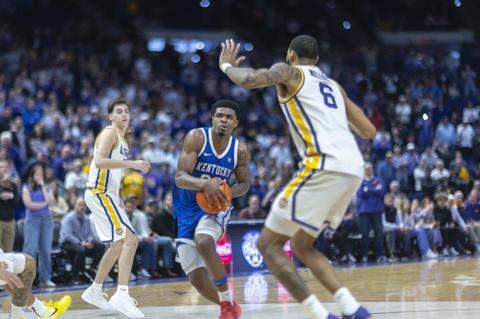
There are stars who announce themselves loudly — with chest-pounding dunks, viral highlights, and nightly box scores that scream for attention. And then there are players whose greatness creeps up on you, possession by possession, night after night, until one day you look up and realize something rare has been happening right in front of you the entire time.
Otega Oweh belongs firmly in the second category.
No grand declarations. No dramatic arcs. Just an unbroken rhythm of production, toughness, and reliability that has quietly become the backbone of Kentucky basketball. While the Wildcats have weathered injuries, roster upheaval, and the emotional volatility of a season full of pressure, Oweh has been the constant — the one presence Mark Pope can pencil in without hesitation.
He brings it every game.
That phrase, uttered almost casually by Pope after a comeback win at Tennessee, now feels like the simplest explanation for something far more significant. Because beneath the surface of Oweh’s nightly scoring totals lies a streak — one that is shaping his Kentucky legacy in ways that won’t be fully appreciated until it’s gone.
Consistency in a Program Built on Volatility
Kentucky basketball is not a place that rewards subtlety.
The program’s modern identity has been shaped by one-and-done stars, NBA lottery picks, and seasons that burn hot and fast. Players flash brilliance, leave early, and are remembered in highlight reels. Consistency — especially multi-year consistency — is harder to come by.
That’s what makes Oweh’s run so striking.
In a system that has churned through rosters and redefined roles, Oweh has been immovable. He has scored in double figures in 53 of his 56 games as a Wildcat. Including the end of last season, he has now produced 23 consecutive games with at least 10 points — a mark that places him among a tiny group of players nationally.
It’s not just impressive by Kentucky standards. It’s historic by modern college basketball standards.
Entering the week, only 19 players in all of Division I had scored in double figures in every game of their season. Oweh is one of them. And if he continues on this pace, he would become the first Kentucky player since Malik Monk in 2016–17 to score 10 or more points in 30 consecutive games.
That’s elite company. And it’s happening without noise.
The Evolution Mark Pope Keeps Pointing To
Ask Mark Pope about Oweh, and the answer always starts in the same place: maturity.
Not skill. Not athleticism. Maturity.
“I hear his voice more,” Pope said. “He speaks up more. He speaks up in film. He’ll speak up on the court.”
That growth matters more than any box score. Because leadership at Kentucky is not granted — it’s earned. And Oweh has earned it through the moments when things go wrong.
Pope often points to Oweh’s body language as the clearest indicator of his development. When a play breaks down. When a call doesn’t go Kentucky’s way. When a possession collapses into frustration. That’s when Oweh resets.
“He’s able to turn immediately to the next possession,” Pope said. “That’s huge.”
In a season where Kentucky has trailed early in games, battled through ugly stretches, and leaned heavily on resilience, Oweh’s emotional steadiness has become contagious. Younger players follow his cues. Veterans trust him. And in tight moments, the ball naturally finds its way into his hands.
Carrying the Load When the Roster Fell Apart
The timing of Oweh’s best stretch this season is no coincidence.
As Kentucky has lost key pieces — Jaland Lowe, Jayden Quaintance, Kam Williams the Wildcats have needed someone to shoulder the scoring burden without forcing the offense into chaos.
Oweh answered.
During Kentucky’s current five-game winning streak, he has averaged 19.2 points per game, including a game-high 23 points against Ole Miss while battling foul trouble early. He hasn’t done it with reckless shot selection or hero ball. He’s done it by reading the game — attacking when needed, spacing when necessary, defending with urgency.
“He’s the leader of this team,” Pope said. “He’s the energy leader. The guy everybody trusts.”
That trust is everything.
Because Kentucky’s offense hasn’t always been pretty. Wins have been gritty. Possessions have been chaotic. But when the game tightens late, Oweh’s presence stabilizes everything.
The LSU Game That Changed the Season
Every season has a moment that shifts belief internally.
For Kentucky, that moment came in Baton Rouge.
On Jan. 14, the Wildcats trailed LSU by 18 points. Oweh was sick — so sick he missed pregame shootaround. He could have played limited minutes. He could have conserved energy.
Instead, he played 37 minutes, logged all 20 minutes of the second half, and fueled one of the most improbable comebacks of the season. He scored 15 points after halftime, drilled three 3-pointers, and never once looked like a player conserving himself.
Freshman center Malachi Moreno saw it clearly.
“If he’s willing to do that,” Moreno said, “then we need to be willing to give more.”
That game reset the standard.
It wasn’t just a win. It was proof that Oweh’s consistency isn’t situational. It’s intrinsic.
Scoring Without Needing the Spotlight
What separates Oweh from so many high-volume scorers is how adaptable his scoring is.
He doesn’t need isolation sets.
He doesn’t need usage dominance.
He doesn’t need a perfect matchup.
Sometimes his points come in transition. Sometimes they come on backdoor cuts. Sometimes they come when Kentucky desperately needs a bucket with the shot clock dying.
That versatility showed itself again at Tennessee.
Oweh finished with just 12 points in that road upset — modest by his standards. But 10 of them came in the second half, including a fastbreak layup with 34 seconds remaining that gave Kentucky its first lead of the game.
That’s who he is.
Not loud. Not flashy. Timely.
A Streak That Tells a Bigger Story
Zoom out, and the numbers become staggering.
Since arriving at Kentucky, Oweh has scored 906 points in 56 games — already the sixth-most points ever scored by a transfer in program history. At his current pace of 16.1 points per game, he is on track to pass Travis Ford for fifth in just a few more outings.
He is also 94 points away from becoming just the sixth transfer in Kentucky history to reach 1,000 career points in blue and white.
And none of this has felt forced.
It’s happened organically — through trust, growth, and repetition.
Why His Legacy Will Age Beautifully
Some Kentucky stars burn brightly and briefly. Their legacy lives in clips.
Oweh’s legacy will live in something harder to quantify: dependability.
Years from now, when fans look back at this season, they won’t remember every scoreline. They’ll remember who showed up when things were messy. Who steadied the ship. Who never disappeared.
“He brings it every game,” Pope said.
That might sound simple.
But in a program where expectations crush the unprepared, where pressure exposes the unreliable, and where every possession matters — bringing it every game is the rarest skill of all.
And it’s the one that defines Otega Oweh’s Kentucky legacy.




