


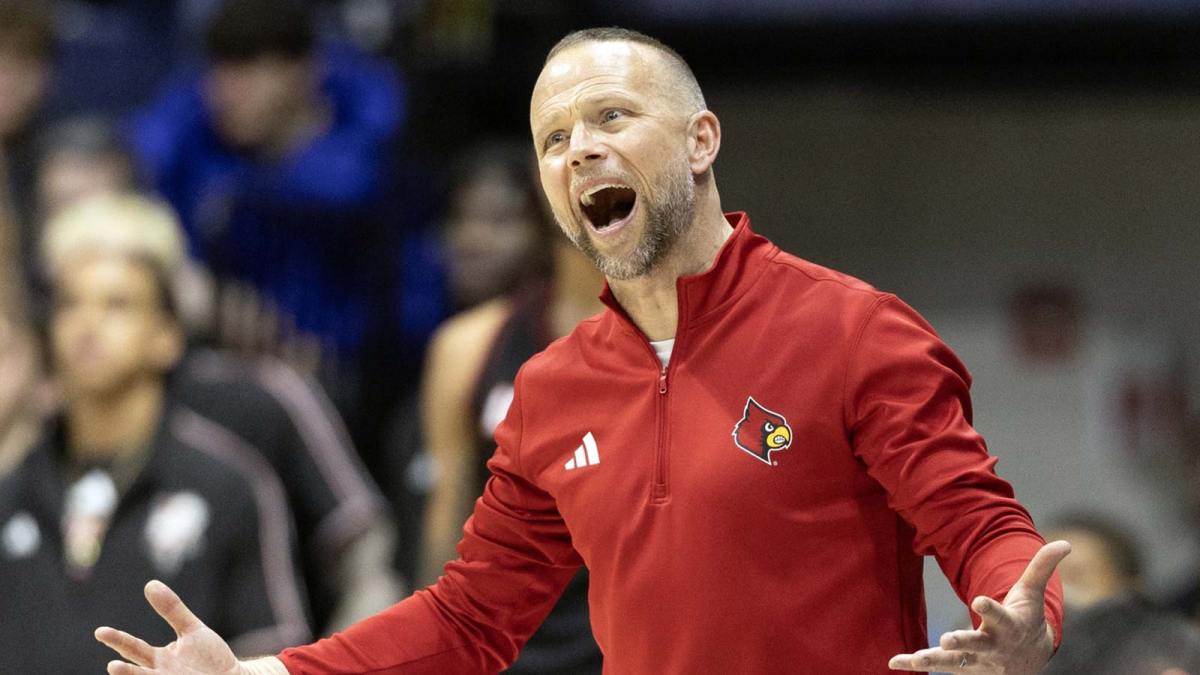
There are losses, and then there are nights that linger — the kind that force a program to look hard in the mirror long after the bus ride home. Louisville’s trip to Cameron Indoor Stadium was supposed to be about progress, resilience, and response. Instead, it became something far more sobering. By the time the final horn sounded on Duke’s 83–52 dismantling of the Cardinals, the score barely captured the full weight of what unfolded. And when Pat Kelsey stepped in front of the microphones, he didn’t try to soften the truth. He said what everyone watching already knew — and the numbers backed him up in brutal fashion.
This was not a narrow loss. This was not a game that slipped away late. This was, in Kelsey’s own words, a “butt-kicking.” And buried inside the box score was one statistic that told the entire story of Louisville’s night: Duke collected 47 percent of its own missed shots, a number so damning it explained everything that followed.
No sugarcoating from a coach who knows rebuilding takes honesty
Pat Kelsey has never been a coach who hides behind clichés. Since taking over at Louisville, he has made it clear that accountability would be a cornerstone of the rebuild. After Wednesday night’s loss, he doubled down on that approach, offering one of the most blunt postgame evaluations of his tenure.
“We got our butt kicked. That’s about the extent of my statement,” Kelsey said flatly. “Not much to say other than it was a butt-kicking. By every metric you would look at, that speaks to a butt-kicking; that’s what the stat sheet says.”
For a fan base desperate for signs of growth after years of frustration, the honesty was jarring — but necessary. Kelsey didn’t deflect. He didn’t point to fatigue, youth, or environment. He pointed to dominance.
“They got 47 percent of their misses,” he continued. “They were plus-21 on the backboard. They were the aggressor. They imposed their will at the basket, in the paint.”
In Cameron Indoor Stadium, where physicality and effort are often magnified, Louisville came up short in every area that matters most.
A rematch that unraveled faster than expected
The Cardinals entered the game with motivation. The January 6 meeting in Louisville had been competitive in stretches, and this return trip was framed internally as an opportunity to measure progress against one of the ACC’s elite programs. For much of the first half, the game suggested Louisville might at least keep things respectable.
Then Duke flipped the switch.
A late first-half run by the Blue Devils transformed a manageable deficit into a commanding lead, and the energy inside Cameron Indoor surged. Louisville never recovered. Every missed shot seemed to bounce back to Duke. Every defensive stand Louisville needed ended with a second-chance basket or a kick-out three.
What had been a test quickly became a lesson.
The stat that said everything: Duke’s dominance on the glass
Basketball games are often explained by shooting percentages or turnover margins, but this one came down to one overwhelming factor: rebounding.
Duke didn’t just win the battle on the boards — it obliterated Louisville. The Blue Devils finished plus-21 in rebounding, a margin that all but guaranteed the outcome. Even more telling was how they did it. Nearly half of Duke’s missed shots ended up right back in their hands.
That 47 percent offensive rebounding rate wasn’t just a number. It was a statement of physical dominance.
Second chances turned into points. Misses turned into momentum. And for Louisville, every defensive possession felt incomplete.
When a team can miss a shot and still feel confident it will get the ball back, the game tilts dramatically. That’s exactly what happened. Duke controlled the paint, the tempo, and the emotional flow of the contest.
Louisville’s offense never found rhythm
Compounding the rebounding issues was Louisville’s inability to score inside. The Cardinals finished five-for-21 on two-point attempts, an astonishingly low figure that underscored Duke’s interior defense.
Every drive was contested. Every post touch was crowded. Duke’s length and discipline erased lanes before they ever fully opened. Louisville’s perimeter shots, often taken out of necessity rather than rhythm, failed to fall consistently enough to keep the game competitive.
Without easy baskets, frustration crept in. Offensive possessions became rushed. Defensive transitions slowed. The gap widened with every minute.
A telling second-half moment
Midway through the second half, the cameras caught a moment that summed up Louisville’s night. After a missed defensive rebound, Duke kicked the ball out for a three-pointer, extending an already comfortable lead. On the sideline, Kelsey’s frustration boiled over as he directed his anger toward forward Sananda Fru.
It wasn’t personal. It was symbolic.
Missed rebounds had become backbreaking. Each one felt like a betrayal of effort. In a building like Cameron Indoor, those moments don’t just cost points — they ignite the crowd and energize the opponent.
That single sequence encapsulated everything Kelsey was talking about: aggression, will, and physical execution.
Duke’s balance and control
While Louisville struggled to find answers, Duke looked every bit like a team built for March. The Blue Devils placed four players in double figures, spreading the scoring load and preventing Louisville from focusing on a single threat.
Freshman star Cameron Boozer led the way with a double-double, reinforcing Duke’s dominance inside. His performance wasn’t flashy, but it was authoritative — rebounds secured in traffic, finishes through contact, and constant pressure on Louisville’s interior defenders.
Duke didn’t rely on hot shooting nights or highlight plays. They relied on fundamentals: rebounding, spacing, and physical defense. Against a rebuilding Louisville squad, that approach proved devastatingly effective.
Why Kelsey’s honesty matters in the long run
For Louisville fans, the immediate reaction to such a loss is frustration. The program’s proud history makes nights like this sting even more. But within Kelsey’s blunt assessment was an underlying message of intent.
“All we can do is dust ourselves off, run back to work, and use this as something that helps us get better,” he said.
That line matters.
Rebuilds are rarely linear. They come with setbacks, especially when facing elite competition on hostile floors. What defines them is how coaches frame those moments. Kelsey chose transparency over spin. He acknowledged the gap — not as an excuse, but as a target.
Cameron Indoor Stadium still exposes flaws like few places can
There is no environment in college basketball quite like Cameron Indoor Stadium. Its intimacy amplifies mistakes. Its crowd feeds on effort lapses. For young or rebuilding teams, it can feel unforgiving.
Louisville learned that the hard way.
Every missed box-out was punished. Every slow rotation was highlighted. Against a Duke team comfortable in that chaos, the Cardinals were forced to confront where they still fall short.
That doesn’t mean progress hasn’t been made this season. It means the climb is steeper than a single win or loss suggests.
What this loss really means for Louisville
At 83–52, the final score will linger in the record books, but the real takeaway lies beneath it. Louisville wasn’t just beaten by a more talented team. They were beaten by a more physical, disciplined, and connected one.
Those qualities don’t develop overnight. They are built through repetition, accountability, and uncomfortable lessons — exactly the kind Kelsey addressed head-on.
For a program trying to reestablish its identity, moments like this can either fracture confidence or forge resilience. Kelsey is betting on the latter.
The path forward
Louisville now returns home with an opportunity to reset. ACC play offers little mercy, but it does offer chances for growth. The Cardinals will review the film, stare at the rebounding numbers, and confront the physical demands required to compete at this level.
If there is any silver lining, it’s clarity. There was no ambiguity about what went wrong. Duke made that unmistakably clear — on the scoreboard, on the glass, and in the paint.
And in a rebuilding season, clarity is often the first step toward change.
A loss that will be remembered — and referenced
Months from now, this game may resurface in conversations about Louisville’s progress under Pat Kelsey. Not because of the score, but because of how the head coach responded.
He didn’t hide. He didn’t hedge. He told the truth.
In Cameron Indoor Stadium, Louisville took a beating. By every metric. And thanks to one glaring statistic — 47 percent of Duke’s misses reclaimed — there was no denying it.
The question now is not whether Louisville was outmatched on this night. It’s whether they use this “butt-kicking” as fuel, or let it become a defining moment for the wrong reasons.




