


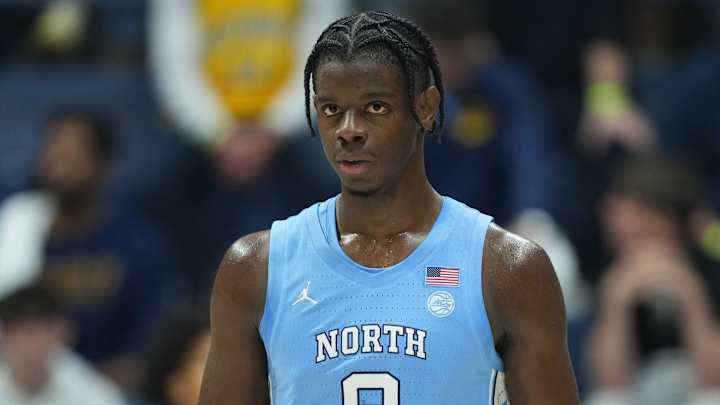
The handshake line is usually a formality — a blur of quick nods, tired smiles, and words no one remembers by the time they reach the locker room. But Wednesday night in Chapel Hill, one brief exchange lingered. Caleb Wilson leaned in, smiled, and delivered a quiet message that carried years of fuel behind it: thank you. Not for the praise. Not for the respect. But for the doubt. Because for Wilson, every overlooked moment, every cut, every slight has become something else entirely — motivation sharpened into dominance.
Not because Shrewsberry praised him. Not because Notre Dame had just watched him torch the Irish for 22 points, seven rebounds, and five assists. But because Shrewsberry — months earlier — had been part of a decision that left Wilson off the USA Basketball U18 AmeriCup team.
That cut stayed with him. And on Wednesday, it fueled him.
A Thank You Rooted in Doubt
In the summer of 2024, Wilson was one of the most talented high school players in the country. Ranked No. 5 nationally in his class, he arrived at USA Basketball trials expecting to compete for a spot. Instead, he left with something else: a chip on his shoulder.
Shrewsberry, then serving as an assistant on the U18 coaching staff, was among those who made the decision to cut Wilson. There was no public explanation. There rarely is.
But for Wilson, it didn’t matter why. It only mattered that it happened.
Fast forward to January. Notre Dame walks into the Smith Center. Wilson doesn’t just play well — he dominates. He controls the game at all three levels, scoring efficiently, facilitating offense, rebounding in traffic, and defending with purpose.
And then comes the handshake line.
“When you see really good players, I always try to compliment them,” Shrewsberry said later during the ACC coaches Zoom call. “I just took a minute to tell him how well he’s playing.”
Wilson’s response? A quiet acknowledgment of the motivation that helped shape him.
“He said, ‘Thanks for motivating me,’” Shrewsberry recalled.
No bitterness. No anger. Just truth.
The Chip That Never Left
Caleb Wilson has never hidden where his edge comes from. In fact, he embraces it.
After UNC’s early-season win over Kansas — his second collegiate game — Wilson offered fans a raw look into his mindset.
“Me personally, I feel like I’ve been disrespected in polls and things like that,” Wilson said. “People telling me I’m not a top three freshman in the ACC, so I’m just gonna keep going out here and killing people.”
It wasn’t arrogance. It was clarity.
Wilson didn’t arrive at North Carolina believing the hype would carry him. He arrived believing he had something to prove — to scouts, to coaches, to peers, and sometimes to himself.
Against Kansas, he didn’t just prove it. He announced it.
Facing Darryn Peterson — ranked higher than him nationally — Wilson finished with 24 points, seven rebounds, four assists, and four steals. He controlled tempo, dictated matchups, and outplayed one of the most heralded prospects in the country on a national stage.
But what made that night even more revealing came afterward.
The Wallpaper That Tells the Story
Wilson admitted he uses unconventional motivation.
“I put stuff on my wallpaper before I play to make sure I’m pissed,” he said.
That night, his phone background was a reminder of the McDonald’s All-American Game — a moment where he felt invisible, where he barely touched the ball while sharing the floor with Peterson.
“I didn’t touch the ball,” Wilson said. “And Darryn Peterson was on my team.”
That image stayed with him. Not as resentment, but as fuel.
Later in the season, Wilson changed his wallpaper again — this time to a photo of himself playing quarterback in Pop Warner football. A reminder of where he came from. A reminder that none of this was guaranteed.
It’s a balance few freshmen find: gratitude without comfort, confidence without complacency.
Wilson has mastered it.
Talent Was Never the Question
From the moment Wilson stepped onto campus, the physical tools were obvious. At 6-foot-9 with guard skills, he has the versatility NBA scouts covet. He can score at all three levels, handle the ball in transition, pass with creativity, and defend multiple positions.
But what’s separated him at UNC hasn’t just been talent — it’s intent.
Wilson doesn’t drift through games. He attacks them.
Whether he’s asked to be the primary scorer or a secondary playmaker, he stays engaged. When shots aren’t falling, he rebounds. When defenders sag, he drives. When teammates struggle, he facilitates.
That adaptability has made him one of Hubert Davis’ most reliable pieces — especially during UNC’s midseason fluctuations.
Shrewsberry’s Perspective: No Regret, Just Respect
Importantly, Shrewsberry made clear that the handshake moment wasn’t tense or awkward. There was no resentment on either side.
“It was kind of a thank you — like, ‘Hey, I’m a great player, but now I’ve got a chip on my shoulder,’” Shrewsberry said. “And he’s playing like that. He’s playing tremendously.”
In fact, Shrewsberry leaned into the humor of it.
“I hope they play Arizona and Texas Tech too so he can run it up on Tommy and Grant,” he joked, referencing fellow U18 staff members Tommy Lloyd and Grant McCasland. “They did just as much of the cutting as I did.”
That’s the irony of basketball development. Coaches make decisions based on limited windows, limited roles, and limited information. Players live with them forever.
Wilson chose not to resent the cut. He chose to weaponize it.
From Proving Them Wrong to Proving Himself Right
As the season has progressed, Wilson’s mindset has subtly evolved.
“At the beginning of the year, I was out to prove everyone wrong,” he admitted. “It’s kind of changed for me because I try to prove myself right now.”
That shift matters.
Early-season motivation driven by anger can burn hot — and fast. Motivation rooted in self-belief lasts longer. Wilson now plays with joy layered on top of intensity. He’s not forcing moments. He’s letting them come.
“Every game I go out, I just have fun and try to play,” he said. “Eventually everybody’s gonna be on your side if you’re winning.”
That perspective speaks to maturity beyond his age.
Why Wilson’s Growth Matters for UNC
North Carolina has relied on freshmen before. But rarely has one combined immediate production, emotional intelligence, and competitive fire the way Wilson has.
As the Tar Heels navigate ACC play and prepare for postseason basketball, Wilson’s presence stabilizes lineups. He can carry offense when needed or blend seamlessly alongside veterans. He doesn’t demand attention — he earns it.
More importantly, he raises the team’s ceiling.
When Wilson is aggressive, UNC looks different. Faster. Sharper. More dangerous.
And unlike many freshmen stars, he hasn’t shied away from defensive responsibility. His length disrupts passing lanes. His effort closes gaps. His engagement never wavers.
That’s why coaches trust him. That’s why teammates lean on him. And that’s why opponents game-plan for him.
The Bigger Picture
Not every great college career begins with universal belief. Some are built through doubt, rejection, and quiet moments no one sees.
Caleb Wilson’s story isn’t about bitterness. It’s about response.
He didn’t complain when he was cut. He didn’t sulk when rankings questioned him. He didn’t wait for validation.
He worked. He remembered. And when the moment came — in a handshake line, under bright lights — he said thank you.
Because sometimes, the best motivation doesn’t come from praise.
Sometimes, it comes from being told no — and deciding that no will never be the final answer.




