


Once upon a time, Kentucky basketball felt eternal. Immovable. Like an empire that could wobble for a season or two but would always reassert dominance when it mattered most. Banners faded into history, names changed on the sideline, but the expectation never did. And yet, somewhere between denial and nostalgia, the ground started to shift. Losses that once felt unthinkable became familiar. Early exits became routine. The laughter at other fallen bluebloods slowly turned uneasy — because the mirror started looking back. The collapse didn’t happen overnight. It happened quietly, piece by piece. And now the question isn’t if Kentucky fell — it’s how, and who allowed it to happen.
An Empire Built on Certainty
Kentucky basketball was never just a program. It was a constant. While other schools cycled through eras of relevance, Kentucky existed above cycles. Coaches came and went, NBA talent flowed through Lexington, and March was assumed to belong to Big Blue Nation.
Even in down years, the belief was unwavering: Kentucky will figure it out.
That belief became a shield — and eventually, a blindfold.
For decades, Kentucky fans didn’t panic at warning signs. Why would they? The program had survived far worse. A bad loss here. A frustrating tournament exit there. Every stumble was followed by a reset, a reload, and a reminder of who Kentucky was supposed to be.
But what happens when resets stop resetting?
The Quiet Beginning of the Slide
The collapse didn’t begin with a single moment. It began with normalization.
In 2020–21, Kentucky finished 9–16. It was shocking. Embarrassing. Historically bad. But the explanation came easily: COVID. No offseason. Young roster. Chaos everywhere.
Fair enough.
Except the issues exposed that season — lack of toughness, roster imbalance, defensive indifference, poor spacing — didn’t disappear when the world stabilized. They lingered.
The following year, Kentucky appeared to bounce back. A 26–7 record. SEC champs. Momentum. The “Revenge Tour.” It felt like order had been restored.
Then Saint Peter’s happened.
Not just a loss — a cultural rupture. A moment that should have forced deep introspection. Instead, it was treated as an anomaly. A fluke. Something that couldn’t possibly define Kentucky basketball.
But history doesn’t care about excuses.
When Losing Stops Being Shocking
From that point forward, the slide accelerated — not because Kentucky got worse overnight, but because losing stopped feeling impossible.
The Round of 32 exit in 2023 didn’t hurt the way it should have. The Oakland loss in 2024 was devastating, but even that became framed as unfortunate rather than unacceptable.
That’s when the empire truly cracked.
Because when standards soften, accountability fades. When accountability fades, culture erodes. And once culture erodes, talent alone can’t save you.
Kentucky became a program that reacted to embarrassment instead of preventing it.
The Calipari Era: From Innovator to Island
John Calipari deserves credit for building one of the most influential eras in modern college basketball. He changed how the game was recruited, sold, and marketed. Kentucky became the NBA’s premier pipeline, and for a time, that was enough.
But innovation has an expiration date.
Over time, Calipari stopped evolving. The game changed — spacing, skill versatility, NIL realities, transfer portal dynamics — and Kentucky stayed stubbornly rigid. The “get the best players and let them figure it out” model stopped working as other programs adapted faster.
More damaging than the strategy was the isolation.
Calipari withdrew. Relationships frayed. Boosters became adversaries. The administration became something to manage rather than collaborate with. Recruiting infrastructure that once thrived quietly withered.
The program didn’t lose talent — it lost cohesion.
When Calipari left, it wasn’t just the end of a coach’s tenure. It was the end of an ecosystem that had stopped sustaining itself.
Administration: The Rot at the Top
Empires fall when leadership chooses comfort over confrontation.
For years, Kentucky’s administration prioritized harmony over hard decisions. Problems were managed quietly instead of addressed publicly. Standards slipped, but nobody wanted to be the villain who enforced them.
The “lifetime contract” symbolized everything wrong with the approach. It didn’t just protect Calipari — it froze the program. Accountability became optional. Tension became inevitable.
By the time real change came, the damage was done.
This wasn’t negligence. It was complacency.
And complacency is fatal to elite programs.
Mark Pope and the Illusion of Reset
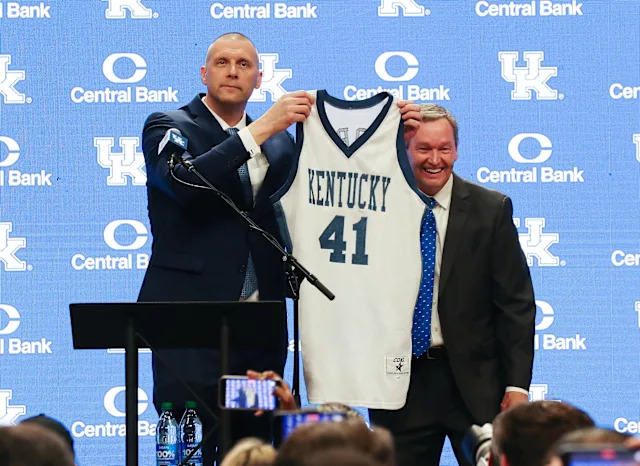
Mark Pope arrived as the emotional counterweight to Calipari. Where Cal was distant, Pope was accessible. Where Cal was insulated, Pope embraced the fanbase. The hire felt right — especially after a Sweet 16 run in year one.
But emotional buy-in isn’t structural reform.
The 2025–26 roster was supposed to be the payoff. The most expensive roster in college basketball. Depth. Talent. Flexibility. The Ferrari.
Instead, it exposed the same issues — effort lapses, slow starts, physical disengagement, mental fragility.
Vanderbilt didn’t just beat Kentucky.
They dismantled them.
And that’s what made it different.
Because Vanderbilt played the very style Kentucky was supposed to embody — toughness, execution, identity. Watching Kentucky get overwhelmed by it felt like watching Rome fall to its own former tactics.
The Most Damning Statistic of All
Since 1976–77, Kentucky has rarely suffered repeated blowout losses.
Now they’re stacking them.
Four losses by 15+ points in a single season. Probation-era territory. Company Kentucky hasn’t kept in decades.
This isn’t variance.
It’s trend.
Combined postseason wins (SEC Tournament + NCAA Tournament) since 2020: six.
Indiana has five.
That comparison used to be insulting.
Now it’s uncomfortable.
Culture Before Talent
Kentucky fans argue about rosters, NIL, coaching schemes, rotations.
But none of that matters if culture is broken.
Effort is free. Physicality is teachable. Engagement is controllable.
And yet, Kentucky repeatedly finds itself unprepared, passive, and reactive — especially away from Rupp Arena.
That’s not about skill.
That’s about belief.
Somewhere along the way, Kentucky stopped expecting to dominate and started hoping to survive.
So… Who’s Really to Blame?
There’s no single culprit. That’s the hardest truth.
Administration allowed standards to slip
Calipari stopped adapting and isolated the program
Barnhart froze the reset too long and botched the transition
Pope hasn’t fixed the core issues fast enough
Each played a role. Each bears responsibility.
This wasn’t sabotage.
It was erosion.
Can the Empire Rise Again?
Yes. But not by pretending nothing is wrong.
Kentucky doesn’t need louder crowds or bigger NIL deals. It needs clarity. Accountability. Alignment between administration, coaching, and identity.
Rome didn’t fall because it lacked soldiers.
It fell because leadership stopped guarding the gates.
Kentucky basketball can still reclaim its place — but only if it confronts why it lost it.
And that conversation is long overdue.
Big Blue Nation — what do you think?
Is this a temporary downturn, or the result of years of ignored warning signs?




