


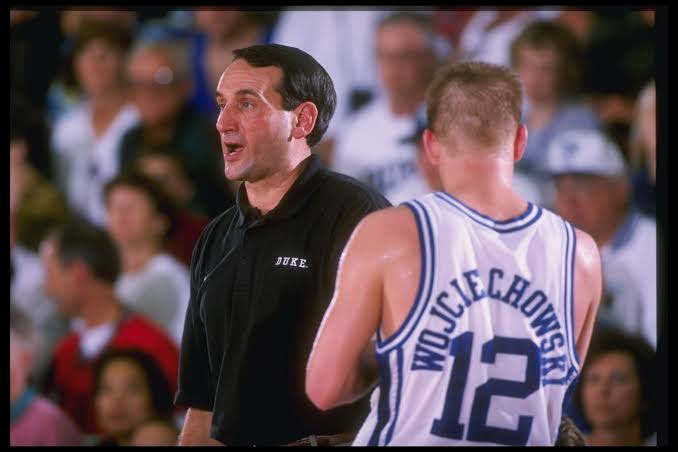
There are college basketball games that live forever in highlight packages — and then there are the ones you stumble upon late at night on YouTube, click out of curiosity, and suddenly realize you’re watching the moment everything changed. Duke’s 95–87 win over No. 1 Arizona in the 1997 Maui Classic falls squarely into that second category. It wasn’t a national title game. It wasn’t March. But in hindsight, it was the unmistakable signal that Duke basketball had fully shaken off its nightmare season and was ready to reclaim its place at the center of the sport.
Context Matters: From Collapse to Reload
To understand why this game matters so much, you have to remember where Duke had been just two years earlier.
The 1995–96 season was a disaster by Duke standards. Injuries, inconsistency, and a loss of identity sent the program spiraling to a 13–18 record — still one of the most shocking seasons of the Mike Krzyzewski era. For a program that had defined excellence for over a decade, it felt like an existential crisis. Was Duke slipping? Had the game passed Coach K by? Was the Blue Devils’ dominance finally over?
The response was swift — and surgical.
By the 1997–98 season, Duke didn’t just reload; it recalibrated. Experience returned. Young talent arrived. Roles were clearer. The program’s edge — physical, mental, and tactical — was back.
This wasn’t a rebuilding team. It was a team waiting for a stage.
Maui: Where Early-Season Truths Are Revealed
The Maui Invitational has always been more than a November tournament. It’s a measuring stick. The environment is neutral, the opponents are elite, and there’s nowhere to hide. When you play in Maui, you find out quickly whether you’re real.
For Duke, Maui in 1997 offered the ultimate test: the defending national champions.
Arizona entered the tournament ranked No. 1 in the country, fresh off its 1997 national title. Lute Olson was at the height of his powers, orchestrating one of the most skilled, disciplined, and confident teams in college basketball. The Wildcats weren’t just talented — they were battle-tested, fearless, and fully aware of their own greatness.
If Duke wanted to announce its return, this was the moment.
A Roster Built for a Statement
Duke’s roster that season was a fascinating blend of experience and emerging stars — a classic Coach K construction.
Veterans like Steve Wojciechowski, Trajan Langdon, Chris Carrawell, and Roshown McLeod gave Duke toughness, leadership, and defensive backbone. These were players who understood the program, understood expectations, and weren’t rattled by big stages.
Then there were the young talents — names that would soon become legends:
Elton Brand, already a physical force
Shane Battier, still forming his identity but dripping with basketball IQ
Will Avery, quick, confident, and fearless
This wasn’t a team relying on one superstar. It was a team with answers everywhere.
The Game: Duke vs. Arizona, Heavyweight vs. Heavyweight
From the opening tip, it was clear this wasn’t going to be a polite early-season game.
Arizona played like champions — attacking, spacing the floor, and refusing to concede anything easily. Duke responded with composure. No panic. No rushing. Just execution.
What made Duke special that night wasn’t flash — it was control.
Duke handled Arizona’s pressure
Duke matched their physicality
Duke made the extra pass
Duke hit timely shots, again and again
Every time Arizona looked ready to surge, Duke answered.
Shane Battier: The First Glimpse of What Was Coming
While Duke’s effort was collective, this game quietly marked the emergence of Shane Battier as a foundational piece.
Battier wasn’t yet the national defensive icon he would become. He wasn’t the Player of the Year. But the traits were unmistakable:
Always in the right spot
Always making the smart play
Always defending without fouling
Always elevating teammates
Years later, when Battier led Duke past Arizona again — this time in the 2001 Final Four — the connection became obvious. The seeds were planted in Maui.
Arizona Pushes — Duke Doesn’t Flinch
Arizona didn’t roll over. Champions never do.
They pushed the tempo. They tested Duke’s depth. They forced Duke to execute late in possessions. And yet, Duke never lost its shape.
This was the most telling part of the game.
Great teams don’t just make runs — they absorb them.
Duke did exactly that.
When Arizona made a push, Duke slowed the game, ran its sets, and trusted its experience. That ability — to dictate the terms of the fight — is what separates good teams from championship-level ones.
The Final Score Tells Only Part of the Story
The final score — Duke 95, Arizona 87 — suggests a high-scoring affair. But what it really represents is confidence.
Duke didn’t steal this game. They didn’t fluke into it. They outplayed the No. 1 team in the country.
By the final minutes, it was clear: Duke was the better team.
And everyone watching knew it.
Why This Game Gets Overlooked
So why isn’t this game talked about more?
Because history is cruel that way.
It wasn’t March
It wasn’t for a title
It didn’t end the season
But early-season games often reveal truths that postseason narratives later confirm.
This one told us everything:
Duke was back
The 1995–96 collapse was an anomaly
Coach K’s program had fully reasserted itself
The next era of Duke basketball had begun
The Ripple Effect: A Program Reclaimed
That win didn’t just boost Duke’s résumé — it reset expectations.
From that point forward:
Duke carried itself like a contender
Opponents treated them as such
Confidence replaced doubt
Identity replaced uncertainty
The late 1990s Duke resurgence — which would culminate in Final Four runs and eventually a national title — traces directly back to moments like this.
A Foreshadowing of 2001
Perhaps the most poetic element of this game is what came later.
In 2001, Duke and Arizona would meet again — this time on the sport’s biggest stage. The Final Four. Shane Battier leading the way. Duke winning again.
The score that night? 82–72.
Different year. Different stakes. Same truth.
Duke had figured Arizona out — and more importantly, figured itself out — years earlier in Maui.
Why You Should Watch It Now
If you’re a Duke fan, this game is required viewing.
Not because it’s flashy — but because it explains everything:
Why Duke’s late-90s teams were so tough
Why Battier became the player he was
Why Coach K’s ability to blend youth and experience was unmatched
Why Duke never stayed down for long
It’s basketball without shortcuts. Basketball with purpose.
Final Thought: The Night Duke Reintroduced Itself
The 1997 Maui Classic Championship wasn’t a coronation — it was a reintroduction.
Duke didn’t shout. It didn’t boast. It simply beat the best team in the country and walked off the floor knowing something had shifted.
Sometimes the most important games aren’t the loudest ones.
Sometimes they’re the ones you find years later, click play, and think:
Oh. This is when it started.
Watch out video 👇
https://youtu.be/K3oUW_jLb9g?si=puC13WbpvA2gQJ0b




