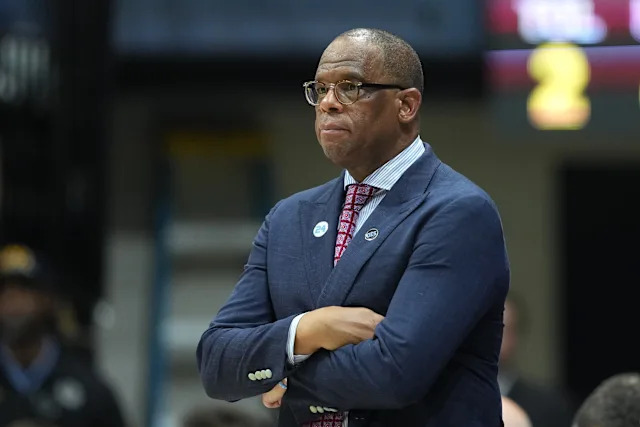
There are nights when a college basketball game is decided by a single moment — a run, a shot, a defensive stand. And then there are nights like Saturday in Atlanta, when the story reveals itself more quietly, possession by possession, pass by pass, until the answer becomes unmistakable. North Carolina’s 91–75 win over Georgia Tech didn’t hinge on one dramatic play. It unfolded through rhythm, trust, and a frontcourt connection that kept growing stronger the longer the game went on. By the time the final buzzer sounded inside McCamish Pavilion, Hubert Davis already knew where it had all begun — and why it mattered far beyond one road victory.
For the 16th-ranked Tar Heels, this was more than just another ACC win. It was a confirmation of identity. It was proof that North Carolina can control games away from Chapel Hill. And most importantly, it was a showcase of how Caleb Wilson and Henri Veesaar are quietly becoming the heartbeat of a team with championship aspirations.
A Second Straight ACC Road Win — and a Statement One
UNC entered Saturday’s matchup against Georgia Tech riding momentum but still seeking validation. Road wins in the ACC are never guaranteed, no matter the opponent, and the Yellow Jackets had shown they were capable of making life uncomfortable inside McCamish Pavilion.
Instead, the Tar Heels walked out with authority.
North Carolina shot efficiently, protected the basketball at a historic level, and leaned on a frontcourt duo that dictated tempo and space from the opening tip. The result was a 91–75 victory that improved UNC to 17–4 overall and 5–3 in ACC play — and perhaps more importantly, showed a team that is starting to understand exactly who it is.
Four Tar Heels finished in double figures, led by Caleb Wilson’s all-around brilliance and Henri Veesaar’s emphatic bounce-back performance. Seth Trimble and Luka Bogavac provided scoring support on the perimeter, but this game belonged to the paint, the pass, and the partnership between two bigs who are learning how to punish defenses in different ways.
“It Started With Caleb”
When Hubert Davis addressed the Tar Heel Sports Network after the game, he didn’t hesitate when explaining where North Carolina’s offensive flow began.
“I just think it started with Caleb at the beginning of the game,” Davis said.
Georgia Tech entered the night with limited size, and Davis knew the Yellow Jackets would have little choice but to double the post. They did — and that decision became their undoing.
Wilson, who finished with 22 points, six rebounds, and five assists, never forced the issue. Instead, he let the game come to him, reading defenders and reacting instantly.
“When you have a gifted player like Caleb, who is just an instinctively willing passer,” Davis continued, “as soon as it touched his hands, he just hit the open guy.”
The numbers back it up. North Carolina assisted on 58.3% of its made baskets, recording 21 assists on 36 field goals. Wilson accounted for five of those assists, marking the fourth time this season he has finished with five or more.
But even those stats don’t fully capture his influence. Every double team he absorbed loosened the defense. Every quick kick-out created an advantage. Every unselfish decision fed the confidence of the players around him.
“It was fun to watch,” Davis said — and it showed.
Historic Ball Security: Two Turnovers, Total Control
Perhaps the most stunning number from the box score wasn’t the points or rebounds. It was the turnovers.
North Carolina committed just two turnovers for the entire game, matching a program record for fewest in a single contest. The only other times UNC accomplished that feat came against Duke in 2018 and Fairfield in 1997.
In a league known for physicality, pressure, and momentum swings, the Tar Heels never gave Georgia Tech free possessions.
“If you can take care of the basketball, you’re guaranteeing that you’re gonna get a shot every possession,” Davis said.
That principle has become a cornerstone of this team’s growth. UNC isn’t built to rely on forcing turnovers defensively, but it doesn’t have to when it protects the ball and executes in the half court.
“We’re not giving gifts to the other team,” Davis added. “That’s just huge.”
Against Georgia Tech, that discipline translated into control. UNC dictated pace, eliminated chaos, and made every trip down the floor count — a recipe that travels well in March.
Henri Veesaar’s Response — And Why It Mattered
Just days earlier, Henri Veesaar endured a difficult night at Virginia. Foul trouble disrupted his rhythm, limiting him to seven points and one rebound in 28 minutes — an uncharacteristically quiet performance for a player whose impact often goes beyond the box score.
Against Georgia Tech, Veesaar answered immediately.
In the first eight minutes alone, he had already posted 11 points and six rebounds, setting a physical tone that never faded. By the end of the night, he finished with 20 points, 12 rebounds, and four blocks — a dominant double-double that reminded everyone of his versatility.
“I mean, he’s one of our guys, man,” Davis said. “I want the ball in his hands every time down the floor.”
Veesaar mixed post play with perimeter shooting, attacked the offensive glass, and protected the rim with authority. More than anything, he played freely — without hesitation, without frustration, and without lingering thoughts of the previous game.
“He was real today,” Davis said simply.
That authenticity matters. Veesaar’s confidence fuels his aggression, and when he’s aggressive, North Carolina becomes significantly harder to defend.
A Frontcourt Connection That’s Growing Fast
What makes Wilson and Veesaar so effective together isn’t just talent — it’s chemistry.
They read each other well. When Wilson draws help, Veesaar finds space. When Veesaar commands attention inside, Wilson becomes a facilitator. Their games don’t overlap; they complement.
Davis highlighted that connection repeatedly after the game.
“Him and Caleb have such a great chemistry between each other,” he said.
That chemistry allows UNC to play through the frontcourt without becoming predictable. It opens driving lanes for guards, creates open shooters, and forces defenses into uncomfortable choices.
Against Georgia Tech, every choice seemed to favor the Tar Heels.
Trimble and Bogavac Provide Balance
While the frontcourt drove the narrative, UNC’s guards made sure the story had depth.
Seth Trimble finished with 18 points and four rebounds, attacking off the dribble and capitalizing on the space created by Wilson and Veesaar inside. His ability to finish through contact kept Georgia Tech from collapsing too aggressively.
Luka Bogavac added 16 points and three assists, providing timely shooting and steady decision-making. When Georgia Tech attempted to shift momentum, Bogavac’s calm presence helped UNC maintain control.
Together, the supporting cast ensured the Tar Heels were never one-dimensional.
Family in the Building, History in the Moment
Saturday night in Atlanta carried meaning beyond the court.
Several former UNC players were in attendance, including Kenny Smith, Charles Scott, Mitch Kupchak, and Tyler Hansbrough, who served as part of the Tar Heel Sports Network broadcast team.
For Davis, the presence of former players is a reminder of what makes North Carolina special.
“It’s not just about the current guys,” he said. “It’s the family.”
That sense of continuity matters — especially for a team still defining itself. The current Tar Heels are building their own story, but they do so within a program where standards are inherited, not invented.
“There’s a bond, and a connection here that is unmatched,” Davis said.
Why This Win Feels Bigger Than the Score
On paper, a 16-point road win over a sub-.500 conference opponent might not jump off the page. But context matters.
UNC didn’t just win. It executed. It shared the ball. It protected possessions. It responded to adversity. And it leaned into its strengths without forcing them.
Most importantly, it showed growth.
This team is learning how to win different kinds of games — gritty games, disciplined games, road games. And as February approaches, those lessons carry weight.
The Tar Heels now return to the Smith Center to face Syracuse on Monday night, armed with momentum and clarity. They know what works. They know who they are. And they know where it starts.
As Hubert Davis made clear, it begins with trust — in the pass, in the post, and in a frontcourt duo that’s quickly becoming the foundation of North Carolina basketball.
And if Saturday night in Atlanta was any indication, the best chapters of this story are still ahead.