


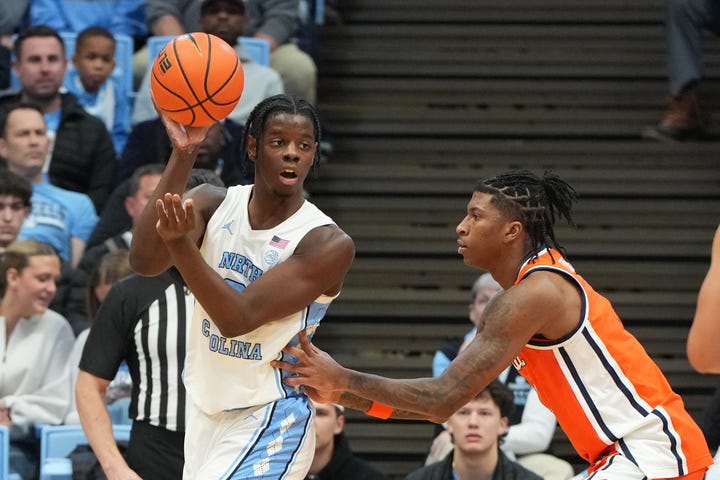
There’s a moment that keeps repeating itself this season at the Smith Center. The crowd rises before the play is fully formed, a split second before logic says they should. A passing lane looks open—until it isn’t. A driver thinks he has a step—until a long shadow appears. Somewhere between anticipation and instinct, Caleb Wilson has trained everyone watching to expect disruption. Not just highlights. Not just points. Something bigger. And that’s the intrigue surrounding North Carolina’s star freshman: even as he dominates box scores, reshapes games, and climbs NBA draft boards, it feels like he’s only scratching the surface of what he can become.
Caleb Wilson is already one of the most productive freshmen in the country. Through 21 games, the 6-foot-10, 215-pound forward has made scoring look routine, rebounding feel inevitable, and transition finishes downright violent. He’s averaging 20.0 points and 9.8 rebounds per game for the 14th-ranked Tar Heels (17-4, 6-3 ACC), numbers that place him firmly among the nation’s elite frontcourt players—regardless of class. His name is already etched into early-season record books, and his trajectory points squarely toward being a top-five pick in the 2026 NBA Draft.
And yet, for all the dunks, all the double-doubles, all the draft buzz, the most important part of Wilson’s evolution may be happening away from the rim, away from the cameras, and sometimes away from the stat sheet entirely.
If Wilson is going to reach even greater heights—both for UNC basketball and his NBA future—it starts on the defensive end.
A Star Who Knows Where Growth Lives
What separates good players from great ones is often awareness. What separates great players from special ones is accountability.
Wilson has both.
After North Carolina’s rocky West Coast trip that resulted in losses to Stanford and Cal, Wilson didn’t deflect responsibility or lean on youth as an excuse. Instead, he turned the lens inward. Speaking after a home win against Syracuse, Wilson openly identified where he needed to be better—not as a scorer, but as a defender.
“I feel like it does a lot for our team, honestly,” Wilson said of his defensive impact. “I have long arms and I’m pretty athletic, so being able to play in the lane, it kind of makes people second guess if they have a driving angle or something like that. I feel like it helps our defense, even if it doesn’t appear on the stat sheet.”
That sentence matters. Because it shows Wilson already understands something many young stars don’t learn until much later: defense isn’t always loud, but it’s always influential.
The Numbers Already Tell a Rare Story
Even before factoring in growth, Wilson’s defensive production is exceptional.
Along with his scoring and rebounding averages, Wilson is posting 1.5 steals and 1.5 blocks per game. According to Bart Torvik’s analytics, he owns a 4.2 block rate and a 2.8 steal rate—numbers that are almost unheard of for a player with his offensive workload.
Nationally, only five players are averaging at least 19 points and 9 rebounds per game. Of that group, only Wilson and Texas Tech’s JT Toppin pair a block rate over 4 with a steal rate above 2. In other words, Wilson isn’t just producing “stocks”—he’s doing so at a volume that places him in a uniquely disruptive category.
Through 21 games, Wilson has recorded 63 stocks (34 steals, 29 blocks), narrowly edging Toppin’s 61. Duke’s Cameron Boozer and Kent State’s Delrecco Gillespie flirt with similar steal numbers but don’t provide the rim protection. West Georgia’s Shelton Williams-Dryden offers blocks without the steals.
Wilson is the rare intersection.
Still, what makes this compelling isn’t what Wilson has done. It’s how much room remains for him to grow.
Where the Ceiling Expands: Off-Ball Defense
Wilson is already a strong on-ball defender. He slides his feet well, absorbs contact, and uses his length to bother shots. That’s the baseline. Where the real leap is happening—and where his ceiling expands dramatically—is off the ball.
“On ball, I feel like I’m pretty good. I feel like that’s my strong suit,” Wilson said. “It’s just being attentive off the ball. I feel like that’s a big thing, coming from high school, that most people have to work on. Because, in college, something’s always coming.”
That awareness—something’s always coming—is the heartbeat of elite college defense. And it’s something UNC head coach Hubert Davis has emphasized relentlessly.
“In order to play defense, you have to play defense before you play defense,” Davis said. “You have to be ready and alert, and aware, that something is always coming. There’s never a time in a possession, even if your man is on the weak side, that you’re not involved in action, that you’re not in the mix.”
Davis has seen Wilson absorb that lesson in real time.
“I think Caleb, every day this year, has gotten better at understanding that he’s always in the mix,” Davis continued. “Whether it’s a primary defender, a help defender, a secondary defender, he’s doing a really good job embracing that.”
For a 6-foot-10 freshman who already carries a massive offensive load, that growth is significant.
The Syracuse Sequence That Explained Everything
Sometimes progress isn’t captured by a box score. Sometimes it’s captured in a sequence.
Against Syracuse, Wilson delivered one of the most revealing defensive stretches of his young career.
Early in the first half, Wilson recognized a middle cutter developing and stepped directly into the passing lane, deflecting the ball before it could reach the paint. As Syracuse tried to recover with a second entry pass, Wilson reset instantly—feet grounded, hands active—before springing up to intercept the ball again, all within seconds.
No block. No steal officially recorded. Just disruption.
It was a moment that showed awareness, discipline, timing, and effort—traits NBA evaluators prize as much as raw athleticism.
“Obviously, his length can block and alter shots,” Davis said. “You’ve seen the effect that he’s had when we pick up full court and press—it’s very difficult. He can get steals, he can get deflections, he’s good on the ball getting steals.
“It’s really the awareness and the readiness, especially off the ball, that has improved a lot since the beginning of the year. When you have somebody 6-10, 6-11, that can do those things, it obviously helps you out defensively.”
For UNC, it changes what’s possible defensively. For Wilson, it changes how high the ceiling goes.
How This Elevates UNC as a March Threat
North Carolina’s season has been defined by stretches of brilliance and moments of vulnerability—particularly on the defensive end. The Tar Heels’ return from California served as a wake-up call, but also as a turning point.
Since then, Wilson’s defensive engagement has helped stabilize UNC’s identity.
With Wilson acting as a roaming disruptor, Carolina can apply pressure earlier, recover faster, and survive breakdowns more effectively. His presence allows guards to be aggressive knowing there’s help behind them. It allows bigs to contest without fear of being beaten on second actions. It turns closeouts into gambles worth taking.
That matters in March.
Tournament games are rarely won by offensive efficiency alone. They’re won by teams that can survive bad shooting nights, grind through scoring droughts, and manufacture stops when sets break down. A versatile defender like Wilson—one who can switch, help, recover, and protect the rim—becomes invaluable in that environment.
If Wilson continues trending upward defensively, UNC’s ceiling shifts from “dangerous” to “legitimate.”
What NBA Scouts Are Really Watching
The NBA already knows Wilson can score. They already know he can rebound. They already know he can jump out of the gym.
What they’re watching now is whether he can anchor defensive schemes.
Modern NBA forwards must do everything: switch onto guards, protect the rim in space, anticipate rotations, and communicate on the fly. Wilson’s length and athleticism give him a head start, but his growth in awareness is what makes scouts lean forward in their seats.
A 6-foot-10 player averaging 20 and 10 will get drafted.
A 6-foot-10 player who can defend everywhere will change a franchise.
Wilson’s improving off-ball instincts suggest he’s moving toward the latter.
The Next Step: Consistency Without Coasting
The challenge ahead isn’t talent. It’s consistency.
Freshmen, even elite ones, can drift—especially when offensive production comes easily. Wilson’s next leap will be about sustaining defensive focus regardless of matchup, opponent, or fatigue. Being “in the mix” for 40 minutes. Being the loudest communicator. Being the first to rotate and the last to relax.
Those habits separate stars from cornerstones.
The encouraging sign? Wilson already knows where to look.
Even Greater Heights Await
Caleb Wilson’s freshman season has been spectacular by any reasonable measure. He’s a star in Chapel Hill, a nightmare matchup for opponents, and a fixture on NBA draft boards. But the most exciting part of his story isn’t what he’s already achieved—it’s what he’s building toward.
As his defensive awareness sharpens and his impact widens beyond scoring, Wilson isn’t just raising his own ceiling. He’s lifting UNC’s. He’s reshaping how games are played around him. And he’s laying the foundation for a future where his influence is felt in every possession, on every floor.
The dunks will always draw the headlines.
The defense? That’s what may take him even higher.




