


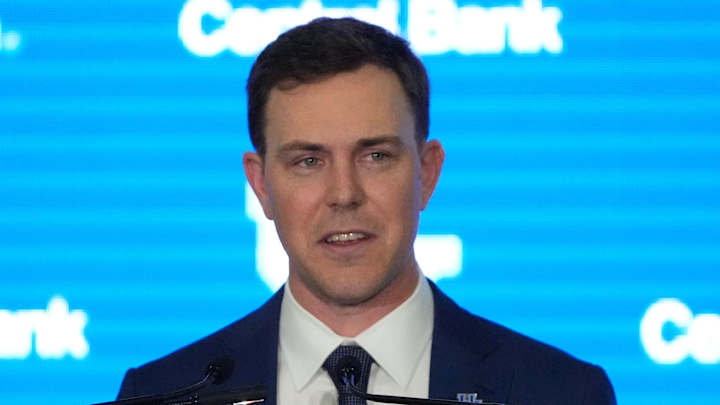
For decades, Kentucky fans have lived with a familiar, quiet dread every time an elite in-state prospect began to rise. The recruiting buzz would build. The offers would pile up. The attention would go national. And eventually, almost inevitably, the heartbreak would arrive — a commitment graphic featuring another school’s colors, usually one with a richer football tradition and a louder national megaphone. It became a pattern so ingrained that optimism felt dangerous. But something is shifting in Lexington. Something fundamental. And if the latest developments are any indication, Notre Dame — long accustomed to cherry-picking Kentucky’s best — may finally be staring at a locked gate instead of an open backyard.
This isn’t just about one recruit. It’s about control. Identity. And a head coach who understands that the future of Kentucky football will be built not by chasing leftovers, but by owning the Bluegrass State before anyone else even thinks about crossing the border.
Welcome to the Will Stein era — where old scars are remembered, but they’re no longer allowed to define the program.
The Ghosts of Recruits Past Still Linger
If you want to understand why this moment matters so much to Kentucky fans, you have to revisit the wounds that never quite healed.
Michael Mayer remains the most painful “what if” of them all. A generational tight end talent, born and raised in Northern Kentucky, developed in the Wildcats’ own backyard — and yet he ended up wearing gold helmets in South Bend. Every Sunday catch he made at Notre Dame, every NFL Draft highlight, felt like a reminder of a failure that went beyond one recruitment. It symbolized Kentucky’s inability to protect its own borders.
And Mayer wasn’t alone.
Shaun Alexander. Damien Harris. Names that still sting. Players who should have been program-defining pillars in Lexington but instead became stars elsewhere. Each departure reinforced the same brutal truth: Kentucky could identify talent, but it couldn’t close when it mattered most.
Over time, fans grew conditioned to expecting “moral victories.” Second-place finishes. Finalists lists that looked impressive but ultimately meant nothing. When Notre Dame, Ohio State, Alabama, or any other power showed real interest, Kentucky braced for disappointment.
That mindset didn’t disappear overnight. It was learned behavior.
But Will Stein didn’t come to Lexington to accept old narratives.
Will Stein’s Vision: Build the Fence First
From the moment Stein was hired, his messaging was consistent — and intentional.
High school recruiting would be the lifeblood of Kentucky football.
Not portal shortcuts. Not late-cycle gambles. Relationships. Evaluation. Trust. And above all else, a fence around the state of Kentucky.
This wasn’t coach-speak. Stein knew exactly what he was inheriting: a program that had improved nationally but still struggled to convince its own elite prospects that staying home was the best path forward. Fixing that required more than slogans. It required credibility.
So Stein went to work — quietly, deliberately, and with a different approach.
Instead of chasing stars late, his staff began investing early. Instead of selling playing time alone, they sold belief. Instead of treating Kentucky recruits as backup plans, they made them the plan.
And just two months into his tenure, the early returns are already loud.
Brady Hull: The First Brick in the Wall
Every culture shift needs a starting point. For Stein, that moment arrived with Pulaski County lineman Brady Hull.
Hull wasn’t a flashy, five-star headline grabber. He was something more important: a foundational piece. A player with legitimate SEC offers from South Carolina, Mississippi State, and Duke — and a decision to stay home anyway.
That mattered.
Hull didn’t choose Kentucky because it was convenient. He chose it because he believed in the vision. Because he felt prioritized. Because he trusted the staff.
“I believe in them, and I know they believe in me,” Hull said. “We’re going to get this thing rolling.”
That quote should resonate with every Kentucky fan. For years, belief was one-sided. Now, it’s mutual.
Hull was the jab. The proof of concept.
What comes next could be the knockout.
Seneca Driver and the Recruitment That Changes Everything
Enter Seneca Driver — the No. 1 player in the Commonwealth and one of the top tight ends in the entire country.
Driver isn’t just another highly ranked recruit. He is the exact archetype Kentucky has historically lost. Elite. In-state. Positionally valuable. Nationally coveted. The kind of player programs like Notre Dame have made a habit of plucking away with ease.
And then Steve Wiltfong dropped the “Fong Bomb.”
Kentucky is now projected to land Driver.
Let that settle for a moment.
This is the kind of recruitment where, in the past, Kentucky fans would emotionally prepare for disappointment. Where “being in the conversation” was treated like an achievement. Where second place was spun into progress.
Not this time.
Because everything about this recruitment feels different — the confidence, the timing, the momentum. Stein didn’t stumble into Driver’s orbit late. He built this relationship intentionally, early, and with purpose.
If Kentucky closes on Driver, it will represent more than a recruiting win. It will be a statement to every powerhouse program in the country:
The Bluegrass State is no longer open season.
Why Tight End Matters So Much in This Story
It’s impossible to ignore the symbolism here.
Kentucky losing Michael Mayer to Notre Dame was more than losing a five-star. It was losing a tight end — a position that Notre Dame has practically trademarked. A position that represents physicality, development, and NFL readiness.
By targeting and potentially landing Seneca Driver, Stein isn’t just flipping a narrative. He’s attacking it head-on.
Driver is ranked among the top five tight ends nationally. His offer list reads like a blue-blood wish list. He is exactly the type of player Kentucky once hoped would “consider” them.
Now, Kentucky isn’t hoping. It’s leading.
That sends a ripple effect through future recruiting cycles. It tells in-state players that staying home doesn’t mean settling. It tells parents that development doesn’t require leaving the state. And it tells rivals that Kentucky is finally recruiting from a position of strength instead of insecurity.
Notre Dame’s Backyard Is Getting Smaller
For years, Notre Dame enjoyed a unique recruiting advantage in Kentucky. Proximity. Tradition. Tight end pedigree. National exposure.
That advantage hasn’t disappeared — but it’s no longer overwhelming.
Stein’s message to the Irish couldn’t be clearer: you’re going to have to look elsewhere.
This isn’t bitterness. It’s evolution.
Kentucky isn’t trying to be Notre Dame. It’s trying to be Kentucky — and that distinction matters. By owning its identity, the program is becoming harder to poach from. When in-state recruits feel wanted, developed, and prioritized, the gravitational pull of traditional powers weakens.
Driver’s recruitment is proof of that shift.
Recruiting Is Culture in Disguise
High school recruiting doesn’t just stock a roster. It reveals a program’s soul.
When a staff emphasizes relationships, players feel it. When it commits early, families feel secure. When it keeps promises, trust spreads.
Stein understands that recruiting wins compound. One commitment begets another. One belief story turns into momentum. Over time, perception changes — and perception is everything in recruiting.
Kentucky fans have waited years for this moment. Not just for a five-star win, but for the feeling that the program is finally operating on its own terms.
Why This Moment Matters Beyond 2026
Landing Seneca Driver — if and when it happens — won’t immediately change win totals. It won’t fix everything overnight. But it will change something more important: expectations.
Once Kentucky proves it can keep elite in-state talent home, the conversation changes. Future prospects won’t ask, “Why Kentucky?” They’ll ask, “Why leave?”
That’s how fences get built. Brick by brick. Commitment by commitment.
And it’s why this feels different.
A New Standard Is Emerging in Lexington
The jab has landed. The knockout punch is coming.
Will Stein didn’t promise miracles. He promised work. He promised relationships. He promised to fight for Kentucky kids before anyone else did.
Now, the results are starting to show.
The frustration of the past hasn’t vanished — but it’s finally being replaced by confidence. The “ones that got away” no longer feel like destiny. They feel like history.
And if Seneca Driver ends up in blue and white, the message will echo far beyond the Commonwealth:
Sorry, Notre Dame. The Bluegrass State is closed for business.




