


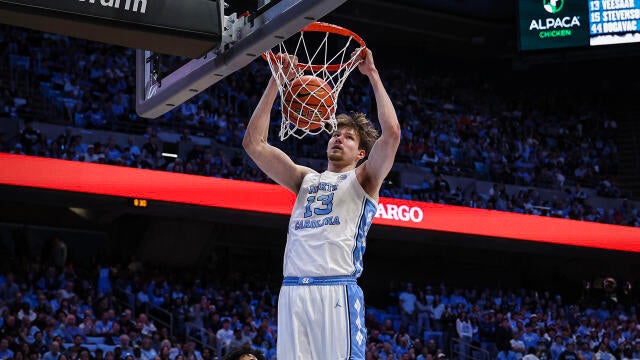
For 39 minutes and 59.6 seconds, it felt like déjà vu all over again. Duke in control. North Carolina chasing. The Dean Dome tense, restless, bracing for another rivalry heartbreak. Then, in the blink of an eye, everything flipped. One possession. One skip pass. One shot that rewrote the night — and maybe the season. After UNC stunned Duke in a finish that left fans screaming, frozen, and searching for replays, Hubert Davis stepped to the microphone with a message that revealed far more than just how the Tar Heels won… but how they finally learned to fight back — together.
For nearly the entire night, the script felt painfully familiar for North Carolina fans. Duke dictated the tempo. Duke won the loose balls. Duke controlled the glass. And UNC, despite playing on its home floor in one of college basketball’s most electric environments, looked like a team struggling to match the moment. The Tar Heels trailed for all but the final 0.4 seconds of the game and fell behind by as many as 13 points. Against the fourth-ranked team in the nation — and their most hated rival — that kind of deficit usually spells doom.
But rivalry games don’t always follow logic. And this one, as history has taught both sides countless times, saved its chaos for the very end.
A Game That Slipped Away — Until It Didn’t
Duke entered the matchup playing some of its best basketball of the season, unbeaten in ACC play and looking every bit like a national title contender. Early on, the Blue Devils backed it up. They punished UNC on the boards, dominated second-chance opportunities, and turned defensive stops into confident offensive possessions. By halftime, Duke held a comfortable advantage, and the body language told a clear story: one team was in control, the other was searching.
For North Carolina, the first half was defined by imbalance. Caleb Wilson was brilliant, aggressive, and fearless — but help was scarce. Duke threw multiple looks at him, yet Wilson kept attacking, scoring, and refusing to let the game drift into blowout territory. Without him, the Tar Heels may never have reached the final moments with a chance to steal it.
Hubert Davis acknowledged that reality after the game, pointing directly to what his team lacked early.
“Every 50/50 loose ball they were getting,” Davis said. “Whether the ball was going up in the air or on the ground, they were the first ones to get it. And we just continued to stick to it.”
That word — stick — mattered. Because for much of the game, UNC didn’t look like a team ready to stick around. They looked tight. Rushed. Over-amped. Duke fed off it.
But something shifted in the second half.
Joining the Fight
If there was a turning point before the final shot, it wasn’t tactical brilliance or a dramatic adjustment on the whiteboard. It was mentality. Hubert Davis described it simply: North Carolina finally joined the fight.
“We were down,” Davis said, “but anytime we got knocked down, not only did we get back up, we kept taking a step forward.”
That shift showed up in subtle ways before it showed up on the scoreboard. Defensive possessions extended longer. Rotations tightened. Rebounding improved. The Tar Heels stopped reaching and started moving their feet. And most importantly, the confidence that had been missing slowly began to return.
Henri Veesaar embodied that change.
After grabbing zero defensive rebounds in the first half, Veesaar completely flipped the narrative after halftime. He attacked the glass with purpose, finished through contact, and anchored UNC inside when Duke had previously owned the paint. By the end of the night, he had recorded a double-double in the second half alone — a stat line that symbolized the Tar Heels’ refusal to fold.
“And then Henri stepped up,” Davis said. “His ability to dominate points in the paint for us was huge.”
Suddenly, Caleb Wilson wasn’t alone anymore.
The Moment the Game Tightened
As UNC chipped away at the deficit, the Dean Dome came alive. What began as anxious energy turned into belief. Every stop felt louder. Every basket felt heavier. Duke, for the first time all night, looked uncomfortable.
The Tar Heels closed the game on a 9–0 run — against one of the nation’s best defenses, under maximum pressure, with everything at stake.
And then came the final possession.
Breaking Down the Final Play
With under five seconds remaining, Hubert Davis didn’t draw up a single-option hero shot. Instead, he trusted preparation.
“No,” Davis said when asked if Seth Trimble was the primary option. “There were a number of options.”
The goal was simple: attack the defense, force help, and make the right read.
Derek Dixon initiated the action, getting downhill and forcing Duke’s defense to collapse. Caleb Wilson rolled hard, drawing attention inside. Henri Veesaar popped to stretch the floor. Duke reacted — just as UNC hoped.
When Trimble’s defender stepped in to help, Dixon made the read UNC practices every day.
“We skipped it to the opposite corner,” Davis explained. “And Derek’s pass was amazing. He checked down all options.”
The ball found Seth Trimble. The shot was pure.
0.4 seconds left.
Game changed.
Seth Trimble’s Moment — and His Place in Carolina History
Trimble finished with 16 points, but none mattered more than the final three. It wasn’t just a shot — it was a release. For the team. For the crowd. For a fanbase that had endured too many rivalry frustrations in recent seasons.
As the ball went through the net, the Dean Dome exploded. Fans stormed the court. Then, after officials reviewed the clock and confirmed time remained, they did it again.
Moments like that don’t fade. They get replayed. Recalled. Passed down.
“Seth Trimble is forever a Tar Heel,” became the immediate sentiment — and it wasn’t hyperbole.
Caleb Wilson: The Foundation of the Comeback
While Trimble delivered the dagger, Hubert Davis was clear about who kept UNC alive long enough for that moment to exist.
“He basically put us on his back in the first half,” Davis said of Caleb Wilson.
Wilson finished with 23 points on 8-of-12 shooting, attacking Duke’s defense with confidence and composure beyond his years. But what stood out most to his coach wasn’t the scoring — it was the mindset.
“He never talks about ‘me,’” Davis said. “He’s always talking about ‘we.’”
That mentality defines championship programs. And on a night where UNC needed leadership, Wilson provided it without forcing it.
The Halftime Adjustment That Wasn’t Tactical
When asked about his halftime speech, Hubert Davis deflected credit in a way that has become his signature.
“The wins go to them and the losses go to me,” he said. “It’s all them.”
Rather than overhaul schemes, UNC focused on fixing mistakes they could fix. Better execution. Cleaner rotations. More trust.
That belief — that problems were solvable — carried the Tar Heels through the final minutes.
Derek Dixon and the Brightest Lights
In rivalry games, poise matters as much as talent. Davis highlighted that when discussing Derek Dixon.
“The light is bright and there’s nowhere to hide,” he said. “They don’t run from it. They run towards it.”
That fearlessness showed in the final seconds, when Dixon didn’t rush, didn’t panic, and didn’t force a shot. He trusted the read — and trusted his teammate.
What This Win Means Moving Forward
Beyond the celebration, this win mattered. It added a Quad 1 victory to UNC’s résumé. It snapped Duke’s ACC unbeaten streak. It reminded the college basketball world that North Carolina is still North Carolina.
But perhaps most importantly, it gave this team proof.
Proof that they can respond.
Proof that they can fight.
Proof that they can win games where nothing comes easy.
For Hubert Davis, that belief may be the biggest takeaway of all.
As fans filed out of the Dean Dome — some hoarse, some stunned, some still shaking — one thing was clear: this wasn’t just about beating Duke.
It was about finding themselves.
And in one unforgettable corner three, the Tar Heels did exactly that.




