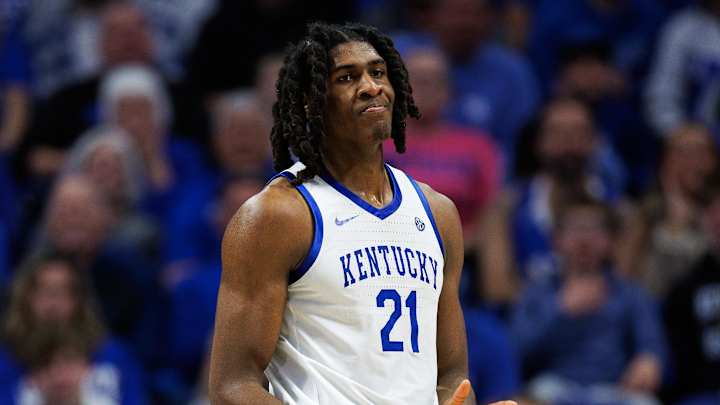
There’s a moment every Kentucky basketball season when the noise fades and the questions get louder. The banners, the expectations, the history — they don’t disappear, but they start demanding answers. Not later. Not in March. Now. As the 2025–26 season rolls into its defining stretch, Kentucky isn’t short on talent, belief, or ambition. What it is short on is clarity. And lurking beneath the wins, the losses, and the nightly box scores are three burning questions that may ultimately decide whether this season becomes another proud chapter in Big Blue Nation lore — or a lingering “what if” fans debate long after the final buzzer.
Three Burning Questions for the Remainder of the 2025–26 Kentucky Basketball Season
Kentucky basketball has never been about surviving a season. It’s about defining one.
With the calendar turning toward the heart of conference play and March slowly creeping into view, the Wildcats find themselves in a familiar but uncomfortable place: talented enough to beat anyone, flawed enough to lose to anyone, and fascinating enough that every game feels like a referendum on who they really are.
The remainder of the 2025–26 season will not be decided by one player, one game, or one hot shooting night. It will be decided by how Kentucky answers three massive questions — questions that touch identity, leadership, and championship viability.
1. Who Is Kentucky When the Game Gets Tight?
This might be the most important question of them all.
Kentucky has shown flashes of brilliance this season — dominant stretches where the offense hums, the defense suffocates, and the Wildcats look every bit like a Final Four contender. But those flashes have often been followed by moments of hesitation when games slow down, the crowd gets loud, and every possession carries weight.
Late-game identity is the currency of March basketball.
When the shot clock dips under ten, who does Kentucky trust? Is it a primary scorer creating off the bounce? A veteran making the right read? A system built on spacing and movement? Or does the offense stall into isolation and hope?
The best Kentucky teams of the past had answers to this question long before Selection Sunday. Think about the poise of past guards who demanded the ball, the bigs who could get a bucket when nothing else worked, or the teams that defended so well they didn’t need late heroics.
This current roster is still searching for that certainty.
There are nights when the Wildcats close with confidence — moving the ball, attacking mismatches, and defending with urgency. And there are nights when the final minutes feel like a test they weren’t fully prepared for. Turnovers creep in. Shot selection slips. Defensive rotations arrive half a step late.
If Kentucky wants this season to be remembered for more than potential, it must decide — and commit to — its late-game identity. Not just who can take the shot, but who should, and how the other four players support that moment.
Because in March, close games aren’t the exception. They’re the rule.
2. Can This Team Defend at a Championship Level for 40 Minutes?
Effort is not the issue. Consistency is.
Kentucky’s defense has oscillated between overwhelming and vulnerable, sometimes within the same half. When locked in, the Wildcats can pressure the ball, contest shots, protect the rim, and turn defense into offense. When focus slips, however, opponents have found clean looks, second-chance points, and rhythm that shouldn’t exist against a roster this athletic.
Championship defense is boring, ruthless, and relentless.
It’s not about highlights. It’s about communication on every switch, rebounding through contact, and guarding without fouling when legs are tired. It’s about defending the same way whether you’re up ten or down five.
One of the defining traits of elite Kentucky teams has always been defensive pride. Not just individual defenders, but a collective understanding that stops matter more than style points. The question facing this group is whether that mindset can be sustained across an entire game — and across weeks of high-pressure basketball.
Conference play has a way of exposing defensive habits. Opponents know your tendencies. They hunt matchups. They force you to guard multiple actions in a single possession. Kentucky will not outscore every opponent it faces, especially against disciplined teams that value possessions.
If this team can string together 40 minutes of connected defense — not once, but repeatedly — it raises the ceiling of the season dramatically. If not, the margin for error shrinks in ways that even elite talent can’t always overcome.
Defense doesn’t win headlines in January.
It wins banners in April.
3. Will Leadership Emerge When the Season Demands It Most?
Every Kentucky team eventually reaches a crossroads where talent alone stops being enough.
That’s when leadership matters.
Not the loud, chest-thumping kind — but the steady presence that calms chaos, holds teammates accountable, and sets the tone when adversity hits. This season’s roster features a blend of experience and youth, skill and athleticism. What it is still developing is a clear emotional compass.
Who speaks when things unravel?
Who challenges effort in practice?
Who refuses to let a two-minute lapse become a ten-minute problem?
Leadership reveals itself most clearly in uncomfortable moments — after a tough road loss, during a scoring drought, or when momentum shifts against you. The teams that survive March aren’t flawless. They’re resilient.
Kentucky’s leaders don’t need to be perfect. They need to be present.
That presence can come from a veteran who has seen the grind of a full season, or a rising star who understands the weight of the jersey. Sometimes it comes from multiple voices, each reinforcing the same standard. What matters is that when pressure rises, someone steps forward and says, this is how we respond.
The remainder of the season will test this group emotionally as much as physically. Back-to-back games. Hostile environments. Tight turnarounds. Expectations that never fade.
If leadership crystallizes, Kentucky becomes dangerous in ways statistics can’t fully capture. If it doesn’t, talent alone may not be enough when the lights are brightest.
What These Questions Really Mean for Kentucky’s Ceiling
None of these questions exist in isolation.
Late-game identity feeds into leadership.
Defense fuels confidence.
Leadership reinforces defensive commitment.
If Kentucky answers all three the right way, the ceiling isn’t just a strong tournament run — it’s legitimate championship contention. If the answers remain incomplete, the season could still be good, but good has never been the standard in Lexington.
Big Blue Nation doesn’t measure seasons by effort.
It measures them by moments that last.
The next stretch of games will quietly shape those moments. Each possession, each defensive stand, each response to adversity will chip away at uncertainty. By March, the answers will be obvious — one way or another.
The only question left is whether Kentucky likes what it sees when the mirror finally stops fogging.