


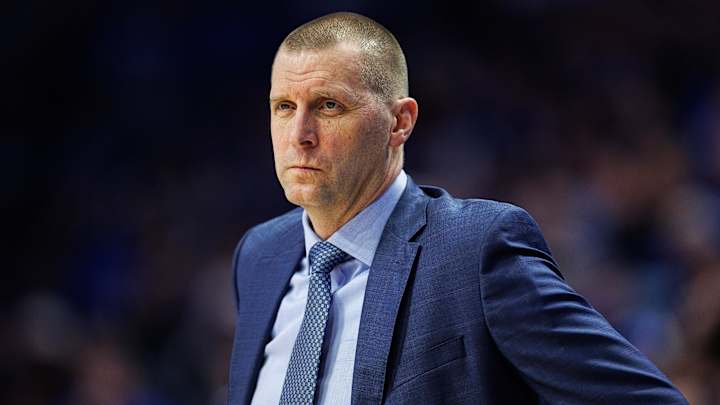
What if Kentucky’s biggest problem isn’t on the court? What if it isn’t shot selection, defensive rotations, or late-game execution? What if the real issue — the one that could quietly shape the future of the program — is happening behind closed doors, in text messages with agents, in late-night portal evaluations, and in decisions about who gets paid what? When Jeff Goodman suggested that Kentucky needs a general manager, it wasn’t just a casual opinion. It was a warning. And in today’s version of college basketball, ignoring that warning could cost Mark Pope far more than a bad recruiting class — it could cost him control of the program’s trajectory.
The Modern Reality Kentucky Can’t Ignore
College basketball is no longer just about coaching. It’s about management.
The transfer portal opens almost immediately after the national championship game. NIL budgets are negotiated like pro contracts. Agents play a larger role than ever. Recruiting high school players is now only part of the equation; evaluating transfer value, negotiating compensation, and structuring a balanced roster are equally critical.
Programs that treat this like the NBA — with front-office infrastructure — are gaining an edge.
Kentucky, according to Goodman, isn’t structured that way.
“You have to have somebody devoted to this that really is plugged in to the agents,” Goodman said on The Field of 68 podcast.
That word — devoted — matters.
Because right now, Kentucky’s entire staff is made up of coaches.
And coaching and managing are two different jobs.
The $22 Million Question
Goodman didn’t tiptoe around the issue.
“When you have 22 million, I would take a million of that and go hire somebody that is so plugged in to that part of it so you’re not pissing away money by overpaying,” he said.
That’s the heart of the argument.
Kentucky reportedly assembled one of the most expensive rosters in college basketball this season. Yet while the Wildcats have shown impressive turnaround and resilience, the results haven’t necessarily reflected that financial investment.
The issue isn’t that Kentucky lacks talent.
The issue is allocation.
If you’re spending like a Final Four program, you expect Final Four-level roster precision.
And Goodman’s belief is clear: Kentucky overpaid — broadly.
“You’re Kentucky, you shouldn’t overpay. They overpaid on, like, everyone on this team.”
That’s not about effort. That’s about structure.
Mark Pope’s Strength — and His Load
Let’s be clear about something: this isn’t an indictment of Mark Pope as a coach.
If anything, it’s the opposite.
Pope has orchestrated an impressive turnaround. He rebuilt a roster, restored competitiveness, and positioned Kentucky as a real SEC contender again. On the floor, his system works. His teams shoot well. They compete. They’ve shown resilience in big moments.
But Pope is being asked to do more than coach.
He’s scouting portal players.
He’s negotiating NIL.
He’s managing agent conversations.
He’s evaluating mid-major prospects.
He’s recruiting high school talent.
He’s preparing for SEC opponents.
That’s a full-time front office and a full-time coaching job combined into one.
Goodman’s point? That’s unsustainable.
The Overcorrection Problem
Last season, Kentucky prioritized shooting and playmaking — players who fit Pope’s spacing-heavy system.
This year, the roster appears more focused on athleticism and defensive potential.
Neither approach is inherently wrong.
But swinging too far in one direction creates imbalance.
Goodman believes Pope should have realized earlier that roster construction wasn’t ideal.
“Pope should have understood early that, hey, listen, the roster construction wasn’t right,” Goodman said.
The fix isn’t blame.
The fix is infrastructure.
What a GM Actually Does
In today’s college basketball ecosystem, a general manager would:
Build and manage relationships with agents year-round
Track NIL market values to prevent overpaying
Evaluate portal prospects before the window opens
Maintain a live “board” of potential transfers
Identify undervalued mid-major players
Help structure roster balance (shooting, size, defense, depth)
Coordinate NIL strategy with performance expectations
Goodman emphasized something critical:
“You need a guy who is locked in 100 percent of the time into looking at tape of every mid-major guy who might be on the board.”
That’s not something assistant coaches — who are preparing scouting reports and recruiting — can fully dedicate themselves to during the season.
Delegation isn’t weakness.
It’s strategy.
The Portal Timing Problem
The transfer portal opens immediately after the national championship game ends.
That means schools that prepared months in advance move first.
Schools that react late scramble.
“If you go to the Sweet 16 again,” Goodman warned, “so many of these kids, by the time they go in the portal, it’s already done.”
Relationships matter.
If Kentucky waits until April to identify targets, other programs may already have conversations lined up.
That’s the modern reality.
Why Kentucky Is Different
Goodman’s frustration stems from one central belief:
Kentucky shouldn’t be playing catch-up.
This is Kentucky.
Top-tier brand.
Top-tier resources.
Massive NIL backing.
National reach.
Programs with fewer resources are hiring GMs.
Programs with smaller budgets are building roster construction teams.
Kentucky should be ahead of the curve — not reacting to it.
Is It Really About Overpaying?
The criticism about “overpaying” isn’t just financial.
It’s about value.
If a player costs premium NIL money, that player should provide premium production — or at least fill a precise strategic need.
Goodman’s implication is that Kentucky paid high market prices without optimized roster fit.
That’s not about generosity.
That’s about leverage.
When you’re Kentucky, players want the brand. You shouldn’t have to overspend to attract them.
Unless negotiations aren’t being handled strategically.
Coaching vs. Constructing
There’s a reason NBA teams separate roles:
Head Coach
General Manager
President of Basketball Operations
Scouting Department
Even elite NBA coaches don’t build rosters alone.
College basketball is quickly moving toward that model.
Mark Pope is an excellent on-court coach.
But even the best coaches need help navigating NIL markets and portal timing.
That’s not weakness.
That’s adaptation.
The Risk of Waiting
Here’s the danger in ignoring Goodman’s advice:
The SEC is evolving.
Programs like Alabama, Tennessee, and Florida are investing in structure. They’re not just recruiting — they’re managing assets.
If Kentucky continues to rely solely on coaching staff to handle front-office responsibilities, the gap could widen.
And in the NIL era, gaps widen quickly.
Waiting another year doesn’t just delay progress.
It risks falling behind.
The Competitive Window
Kentucky is competitive right now.
The Wildcats have rebounded strongly.
They’ve beaten quality opponents.
They’re climbing in the SEC.
But success can mask structural issues.
A Sweet 16 run might quiet critics.
A Final Four appearance might silence them.
But long-term sustainability depends on system design — not momentum.
Goodman’s warning is about five years from now, not just this season.
A Team, Not Just a GM
Interestingly, Goodman noted it doesn’t have to be one person.
“Even if it’s not a GM… just someone, or a group of people, that can do that as their job.”
That’s the key.
Dedicated personnel.
Full-time evaluation.
Full-time negotiation.
Full-time planning.
Let coaches coach.
Let managers manage.
Why This Is Bigger Than Kentucky
This conversation reflects a broader shift in college basketball.
The NIL era has turned roster building into economics.
The portal has turned recruiting into speed chess.
Agents now function like pro sports intermediaries.
Schools that adapt structurally will win consistently.
Schools that rely on old models will struggle.
Kentucky has the resources to adapt.
The question is whether it will.
The Final Thought
Jeff Goodman’s argument isn’t anti-Pope.
It’s pro-Pope.
It’s about protecting him.
It’s about ensuring he isn’t overwhelmed when the portal opens.
It’s about ensuring $22 million is spent wisely.
It’s about preventing the kind of miscalculations that cost seasons.
Because if Kentucky waits — if it assumes strong coaching alone is enough — the portal won’t wait with them.
And in this era, hesitation can cost more than money.
It can cost momentum.
It can cost roster balance.
It can cost championships.
Kentucky has the brand.
Kentucky has the budget.
Kentucky has the coach.
Now the question is simple — and urgent:
Will they build the structure to match?




