


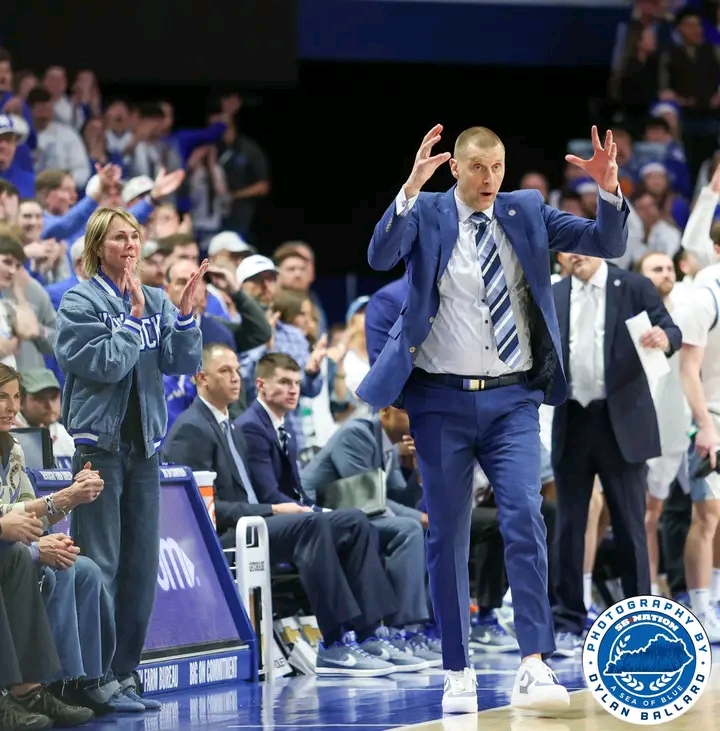
What does it mean when a head coach doesn’t deflect, doesn’t spin, and doesn’t disguise a loss behind clichés? What does it say about a program when its leader publicly says, “I probably made mistakes on matchups,” after a tough road defeat? In the immediate aftermath of Kentucky’s loss in Gainesville, the frustration was obvious. The turnovers were glaring. The missed defensive rotations were painful. But the most compelling moment of the afternoon didn’t happen on the hardwood — it happened in a quiet postgame radio interview.
And that’s where the real story begins.
When Kentucky fell to Florida in a physical, emotionally charged SEC battle, it wasn’t just another tally in the loss column. It was a revealing moment — for the players, for the locker room, and especially for head coach Mark Pope.
A Loss That Felt Bigger Than the Scoreboard
Anyone who watched the game saw the same pattern unfold. Kentucky struggled to maintain offensive rhythm. The Wildcats turned the ball over in critical moments. Defensive breakdowns allowed Florida to find comfort beyond the arc. Whenever Kentucky clawed back into the game, something slipped — a missed rotation, a rushed shot, an ill-timed foul.
Florida dictated the physicality. Florida controlled the glass. Florida capitalized on momentum swings.
Kentucky, meanwhile, felt reactive.
But instead of focusing solely on execution errors by his players, Mark Pope did something that immediately shifted the tone of the postgame narrative: he took responsibility.
Accountability From the Top
When Pope sat down with Tom Leach for his postgame radio interview, there was no sugarcoating. No convenient deflection toward officiating. No coded criticism aimed at his roster.
“I thought it was the difference in the game,” Pope admitted when asked about Florida’s three-big lineup and perimeter shooting. “We took some terrible routes. We need to clean that up. I probably made mistakes on matchups… I felt like their backcut hurt us tonight.”
Those are not empty words.
They are specific.
They are self-critical.
They are rare in a sport where coaches often choose safer language.
When Leach pressed for clarification on exactly which matchups Pope believed he mishandled, Pope declined to elaborate. “No,” he said simply.
That restraint may have been just as important as the admission.
He owned the strategic shortcomings — but refused to publicly isolate individual players. In an era of instant analysis and social media blame, that balance matters.
The Matchup Problem That Haunted Kentucky
Anyone who watched closely could identify the trouble spots.
Urban Klavzar repeatedly found himself alone beyond the arc. Kentucky’s defensive rotations were slow, sometimes indecisive. On multiple possessions, help defenders overcommitted to dribble penetration, leaving perimeter shooters unattended.
Klavzar finished 5-of-11 from deep.
Each of those makes felt deflating.
Momentum-killers.
Kentucky would cut the lead. The building would quiet. Then a defensive lapse would gift Florida three more points.
This wasn’t accidental. It was structural.
Florida’s spacing forced Kentucky into uncomfortable decisions. When the Wildcats collapsed into the paint to combat Florida’s size, shooters were available. When they stayed home on shooters, interior physicality punished them.
That tension is what Pope referenced.
Matchups matter in SEC basketball. Rotational discipline matters even more.
And on this night, Florida exploited both.
The Turnover Avalanche
Defensive lapses weren’t the only issue.
Kentucky’s ball security faltered at critical moments. Several possessions ended with forced drives into traffic or hurried passes into congested lanes. Florida converted those mistakes into transition opportunities.
Against a team that thrives on rebounding and inside-out offense, live-ball turnovers are especially dangerous.
Instead of controlling tempo, Kentucky found itself chasing.
The Wildcats’ shot selection also betrayed impatience. Rather than working through sets to create high-percentage looks, they occasionally settled for contested jumpers early in the shot clock.
That combination — turnovers and rushed shots — allowed Florida to maintain rhythm.
And rhythm, especially on the road, is everything.
A Silver Lining Named Malachi Moreno
If there was one undeniable bright spot for Kentucky, it was freshman big man Malachi Moreno.
In just 20 minutes of action, Moreno recorded 11 points and 11 rebounds before fouling out.
Let that sink in.
A double-double.
In 20 minutes.
Projected across a full 40-minute game, that production translates to an eye-popping 22 points and 22 rebounds — numbers that would headline any box score.
“Yeah, he did it in 20 minutes, 11 and 11 in 20 minutes is really hard,” Pope said. “The fourth foul was a killer; it was a young play. Ever since kind of getting beat up at Vandy, he has demonstrated a real presence on the floor.”
There’s a lot embedded in that quote.
First, recognition. Pope sees Moreno’s growth.
Second, instruction. The “young play” comment highlights developmental learning curves.
Third, belief. Moreno isn’t just filling minutes — he’s evolving into a presence.
Unfortunately for Kentucky, that fourth foul forced him to the bench at a pivotal juncture.
Florida immediately attacked the interior once Moreno exited.
Sometimes the margin between competitive and controlled hinges on one whistle.
The Cost of Youthful Mistakes
Moreno’s foul trouble underscores a broader theme for Kentucky this season: youth and adjustment.
Young players bring energy, upside, and flashes of brilliance. They also bring occasional lapses in positioning, timing, and emotional discipline.
Florida, by contrast, appeared composed in crucial moments.
When Kentucky made small runs, the Gators responded methodically — often with a clean half-court set or a timely three-pointer.
That contrast in poise was noticeable.
It wasn’t that Kentucky lacked talent.
It lacked sustained precision.
A Frustrated Locker Room
Pope didn’t hide the mood inside the locker room.
“The guys are pretty disappointed, every game is huge right now,” he told Leach. “We know Florida played really well, and they are a really good team. We feel like we could play so much better, and that is frustrating for us.”
Frustration can be destructive — or catalytic.
The Wildcats are entering the most consequential stretch of their season. With six games remaining, four likely need to land in the win column to secure favorable postseason positioning and momentum.
There’s no time for prolonged self-pity.
There’s only time for correction.
No Excuses, Just Urgency
What stands out most about Pope’s response is the absence of excuse-making.
He didn’t cite fatigue.
He didn’t criticize officiating.
He didn’t blame the environment.
He pointed inward.
That tone matters for culture.
When players hear their coach accept responsibility, it eliminates defensiveness. It signals shared ownership.
But accountability must translate into adjustment.
Identifying matchup mistakes is step one.
Fixing them before the next SEC battle is step two.
The Road Ahead: Georgia and Beyond
Kentucky’s next opportunity arrives at home against Georgia, a team coming off a lopsided loss to Oklahoma.
On paper, it’s a chance to reset.
But paper rarely determines SEC outcomes.
Kentucky must:
Tighten defensive rotations
Protect the basketball
Sustain interior presence without foul trouble
Convert frustration into focus
Momentum heading into March isn’t built on intention — it’s built on execution.
Four wins in six games isn’t just a target. It’s a necessity for seeding and confidence.
What Did Pope Really Mean?
The most intriguing element of the postgame interview wasn’t what Pope said.
It was what he didn’t.
When asked to specify matchup mistakes, he declined.
Why?
Perhaps because calling out individual defensive assignments publicly risks fracturing trust.
Perhaps because the adjustments will occur internally — on film, in practice, in private conversations.
Perhaps because he knows accountability is more powerful when paired with discretion.
Whatever the reason, the message was clear: the blueprint must improve.
Can the Cats Bounce Back?
That’s the question now.
Can Kentucky transform a frustrating road loss into growth?
Can Moreno continue ascending while avoiding costly fouls?
Can the Wildcats clean up defensive routes and limit open perimeter looks?
Can Pope refine matchups to neutralize physical frontcourts?
The margin between disappointment and resurgence is thin.
But it exists.
Kentucky still possesses talent. It still holds postseason aspirations. It still commands one of the most passionate fanbases in college basketball.
Frustration is real.
But so is opportunity.
Final Reflection: Leadership in Defeat
Losses reveal leadership more than wins.
When everything goes right, praise flows easily. When things unravel, character surfaces.
Mark Pope’s willingness to own coaching mistakes after Kentucky’s loss in Gainesville doesn’t erase the defensive lapses. It doesn’t correct the turnovers. It doesn’t reverse the scoreboard.
But it sets a tone.
And tone shapes trajectory.
With six games left and March looming, Kentucky’s season will be defined not by what happened in Florida — but by how they respond to it.
The Cats have been challenged.
Now we find out how they answer.




