


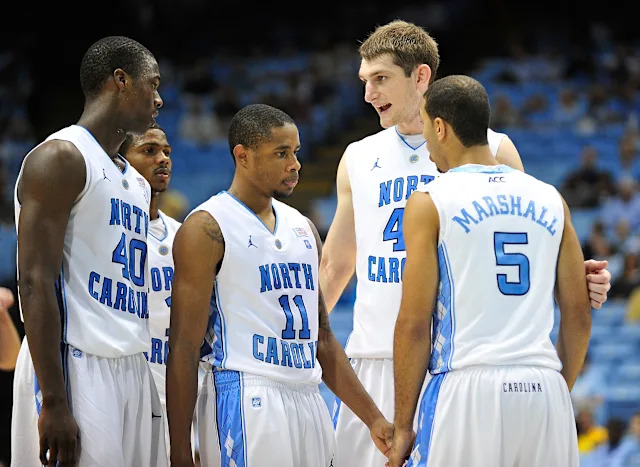
It only takes a split second. One drive to the rim. One awkward fall. One silence that swallows an arena whole. For a program as historic and decorated as North Carolina, greatness has often felt inevitable — banners, Final Fours, and NBA stars forming a rhythm as steady as the Carolina Blue that defines them. But every so often, history pivots not on a shot made, but on a player lost. And for Tar Heel fans, one particular injury still lingers like a question that was never fully answered: what might have been?
Injuries are an unavoidable part of basketball. The game demands pace, explosion, and contact. Players sprint, plant, pivot, collide, and rise — all within seconds. When a reserve player goes down, teams adjust. When a starter misses time, rotations tighten. But when the heartbeat of a championship contender is suddenly removed, the impact can ripple through decades of memory.
North Carolina has experienced its share of painful injuries over the years. From key contributors missing tournament games to stars battling through pain at the worst possible moments, Tar Heel fans have seen momentum shift in cruel ways. Yet if we are asking which injury stands as the most impactful in UNC basketball history, one moment towers above the rest: Kendall Marshall’s broken wrist in the 2012 NCAA Tournament.
To understand why that injury resonates so deeply, we must first revisit the context of that season. The 2011–12 Tar Heels were loaded. Roy Williams had assembled a roster that blended elite size, experience, and scoring. Harrison Barnes was a preseason All-American. Tyler Zeller anchored the interior with efficiency and veteran poise. John Henson protected the rim with his length and defensive instincts. The team was ranked near the top of the polls all year. Expectations weren’t just high — they were national championship or bust.
But what made that team truly special was Kendall Marshall.
Marshall wasn’t the flashiest scorer. He didn’t overwhelm opponents with highlight-reel dunks or 30-point explosions. What he did was control the game. He dictated tempo. He saw plays two passes ahead. He delivered the ball exactly where it needed to be, often before the defense realized it was out of position. In many ways, he was the connective tissue that turned immense talent into a cohesive machine.
Marshall led the ACC in assists and ranked among the national leaders as well. His ability to push the ball in transition unlocked easy scoring opportunities for Barnes and Zeller. His chemistry with Henson in the pick-and-roll made UNC nearly impossible to defend when operating at full speed. More importantly, his calm presence steadied the team in high-pressure moments.
Yet even before the NCAA Tournament, adversity had begun to chip away at UNC’s depth. Dexter Strickland had already suffered a season-ending knee injury. Leslie McDonald was also sidelined. John Henson battled through injuries during the ACC Tournament. The Tar Heels were still elite, but the margin for error was shrinking.
Then came the Sweet Sixteen matchup against Creighton.
Late in that game, Marshall drove toward the basket. As he went up for a layup, he was knocked off balance and crashed to the floor. The arena went quiet. Marshall clutched his wrist. The diagnosis soon followed: a broken wrist. His tournament was over.
Just like that, the identity of a championship contender was fundamentally altered.
UNC managed to survive the Sweet Sixteen, narrowly escaping Ohio in overtime behind heroic efforts from Barnes and Zeller. Freshman Stillman White stepped into Marshall’s role and competed admirably, showing composure beyond his years. But the drop-off was undeniable. The offense no longer flowed with the same precision. The transition game slowed. The rhythm that had defined the Tar Heels all season felt disrupted.
When North Carolina faced Kansas in the Elite Eight, the absence of Marshall became even more pronounced. Kansas was disciplined, athletic, and relentless defensively. Without their floor general, UNC struggled to generate consistent quality looks. The game remained competitive, but the edge was gone. The Tar Heels fell short, their championship dreams ending not with a decisive collapse, but with the haunting sense that something vital had been missing.
It is impossible to prove that UNC would have won the national championship with a healthy Marshall. March is unpredictable. Matchups matter. Momentum swings wildly. But context matters too.
Earlier that season, North Carolina had lost to eventual champion Kentucky by just one point at Rupp Arena — one of the toughest venues in college basketball. That narrow defeat suggested that UNC was more than capable of competing with — and perhaps beating — the nation’s best teams. The talent was there. The balance was there. The confidence was there.
Marshall’s injury didn’t just remove a starter. It removed the architect of the offense at a moment when the team had already lost multiple contributors. It forced role changes under the brightest lights imaginable. It altered the psychological makeup of a group that had spent months building continuity.
That’s what makes the injury so impactful. It didn’t just affect one game. It may have reshaped the legacy of an entire roster.
Consider the ripple effects. Harrison Barnes left for the NBA without reaching a Final Four in his sophomore season. Tyler Zeller’s decorated career ended without a national championship. Roy Williams, who had built another powerhouse, was denied what felt like a prime opportunity to add another title to his résumé. For a program defined by banners, near-misses feel magnified.
Of course, UNC history includes other painful injuries worth mentioning.
In 1984, Michael Jordan battled foot injuries during his early NBA career, but in college his health remained largely intact. James Worthy broke his ankle late in the 1982 season but returned in time to help secure a national championship. In 1997, point guard Ed Cota dealt with ankle injuries during tournament play. In 2022, Caleb Love played through nagging injuries during UNC’s surprising Final Four run.
Yet none of those moments quite match the combination of timing, stakes, and structural importance that surrounded Marshall’s injury.
Basketball is often described as a “guard’s game,” especially in March. The point guard is the decision-maker, the tempo-setter, the stabilizer when chaos erupts. Losing that piece is uniquely devastating. It’s not just about assists or scoring averages. It’s about leadership, spacing, timing, and trust.
When Caleb Wilson’s recent injury prompted fans to revisit history, it highlighted how quickly optimism can turn into anxiety. Wilson represents promise, explosiveness, and star potential. Missing time, especially in a single-season window, feels heavy. But perspective reminds us that some injuries linger longer than others in collective memory.
Marshall’s injury lingers because it felt like a turning point — not just in a game, but in possibility itself.
What if he hadn’t fallen?
Would UNC have beaten Kansas? Would they have advanced to the Final Four? Could they have faced Kentucky again for redemption? Would that 2012 team be remembered as one of the great champions in program history instead of one of the great “what ifs”?
These questions are unanswerable, and perhaps that’s why they endure.
North Carolina basketball has thrived for decades because of resilience. The program doesn’t crumble after disappointment. It reloads. It evolves. Roy Williams would eventually win another national championship in 2017. The Tar Heels would return to the Final Four multiple times. The standard remains excellence.
Yet the beauty — and heartbreak — of college basketball lies in its finality. Players get limited seasons. Windows close quickly. When injury interrupts that narrow window, the loss feels magnified.
Marshall’s broken wrist didn’t diminish his talent. He went on to be a first-round NBA draft pick. It didn’t erase UNC’s greatness. But it altered a specific moment in time when everything seemed aligned.
And perhaps that’s the true measure of impact.
The most impactful injury isn’t necessarily the one that sidelines the biggest name or lasts the longest. It’s the one that changes trajectory. The one that interrupts momentum at its peak. The one that transforms a season from destiny to debate.
For many Tar Heel fans, that moment came in 2012.
Of course, debates will continue. Some may argue that earlier injuries in program history carried equal weight. Others might contend that future seasons could present even more painful examples. Basketball is unpredictable. So is fate.
But if you ask those who lived through that tournament run — who watched Marshall orchestrate one of the most fluid offenses in college basketball — the memory is vivid. The silence after the fall. The sight of him leaving the court. The uneasy realization that everything had changed.
UNC basketball has celebrated iconic shots, legendary players, and championship confetti. Yet woven into that tapestry is one fragile moment that still sparks conversation more than a decade later.
What is the most impactful injury in North Carolina basketball history?
For many, the answer remains clear.
It was the night the floor general fell and with him, perhaps, a championship.




