


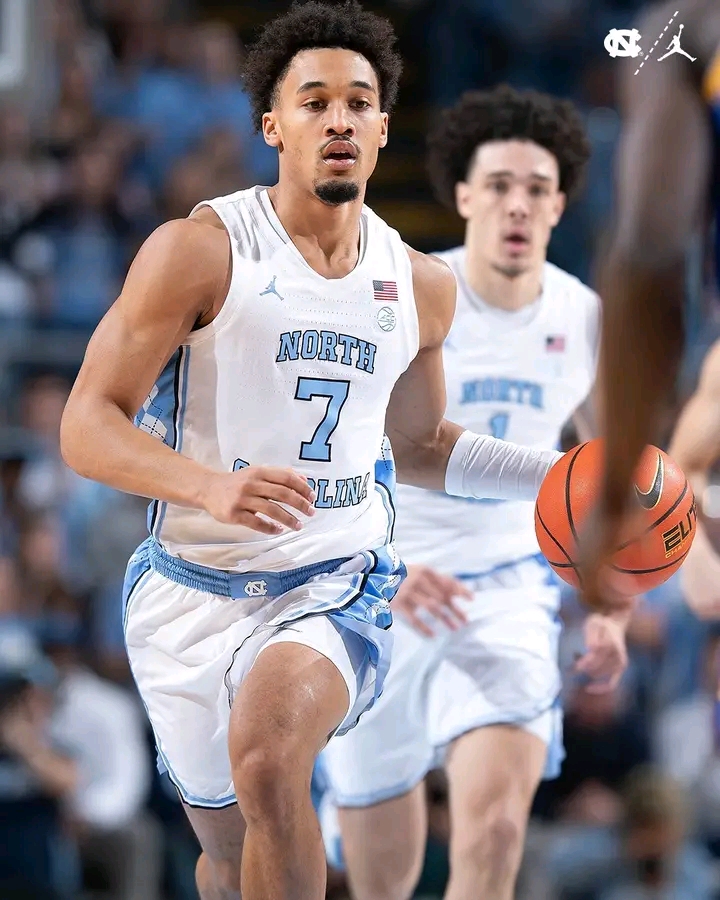
For weeks, Seth Trimble has been the missing heartbeat of North Carolina Tar Heels men’s basketball — the defensive spark plug, the relentless slasher, the emotional tone-setter. Now, as tip-off approaches and anticipation builds across Chapel Hill, one question refuses to fade: could tonight be the night he returns? The silence from the coaching staff has only fueled the suspense, leaving fans scanning pregame warmups, reading between the lines of interviews, and wondering whether a familiar No. 7 might suddenly jog onto the floor and change everything in an instant.
The Absence You Can Feel
Some injuries take a scorer off the floor. Others remove a role player from the rotation. But occasionally, an injury takes something less measurable — rhythm, edge, defensive bite, emotional stability. That’s what Trimble’s absence has meant for North Carolina.
He isn’t just another guard. He’s the kind of player who pressures the ball 94 feet, who turns routine defensive possessions into chaos, who dives for loose balls in February like it’s April. In a season already marked by emotional swings and uneven stretches, his absence has amplified everything — the highs feel fragile, and the lows feel heavier.
When North Carolina is at its best, it plays with force. It defends with purpose. It runs. It turns stops into momentum. Trimble embodies that identity.
Without him, the Tar Heels have had to adjust — sometimes successfully, sometimes painfully.
What Happened — And Why It Matters
Trimble’s injury earlier in the season was more than a short-term setback. A broken bone in his left forearm required surgery and sidelined him indefinitely. For a guard whose game relies on physicality, strength, and contact, that’s no minor hurdle.
Recovery timelines in college basketball can be tricky. Players often return sooner than expected, but “available” and “fully back” are two very different realities. Conditioning, timing, and confidence don’t simply reappear because a medical clearance is granted.
And that’s where the mystery begins.
Recent updates have indicated that Trimble has been progressing in practice. He has reportedly participated in five-on-five work. He has been around the team, engaged, and visibly improving. Yet there has been no definitive statement confirming a return date.
In college basketball, that kind of silence is strategic. Coaches don’t always reveal their hand. Opponents prepare differently depending on who is in uniform. And sometimes, uncertainty itself becomes a tactical advantage.
So is tonight different? Is the buildup leading somewhere? Or is this simply the natural progression of recovery?
Why His Return Changes Everything
To understand the anticipation, you have to understand what Trimble brings.
He’s not the leading scorer. He’s not the headline star. But he’s often the momentum shifter.
On-Ball Defense: Trimble’s ability to pressure opposing guards changes matchups instantly. He disrupts rhythm. He forces teams deeper into the shot clock. In tight conference games, that matters.
Transition Force: When UNC runs, it looks confident. Trimble fuels that by turning steals into fast breaks. Easy baskets erase droughts.
Emotional Catalyst: Every team has a temperature. Trimble raises it. A big defensive stop. A hard drive through contact. A roar after a steal. Energy is contagious.
This season has shown how thin the margin can be. A few possessions decide outcomes. A single defensive stop flips momentum. In those moments, having Trimble available isn’t just helpful — it’s potentially decisive.
The Roller Coaster Season Context
North Carolina’s season hasn’t been linear. There have been signature wins that reignited belief and frustrating losses that exposed vulnerabilities. Consistency has been elusive.
In games where the Tar Heels have struggled defensively or allowed opposing guards to control tempo, you can’t help but imagine what Trimble’s presence might have meant.
Would that late-game defensive lapse have happened?
Would that opposing point guard have been as comfortable?
Would that 8-0 run have ever started?
It’s easy to romanticize the return of an injured player. Reality is often more nuanced. But in this case, the fit is obvious.
UNC doesn’t need Trimble to score 20 points. It needs him to restore balance.
Hubert Davis and the Art of Patience
Head coach Hubert Davis has been careful with his words regarding Trimble’s recovery. Measured. Supportive. Noncommittal.
That’s not accidental.
Coaches at this level understand long seasons. Rushing a player back for a single game — even a significant one — can create long-term consequences. The ACC grind demands durability. March demands health.
Davis has emphasized progression rather than pressure. The message has been clear: Trimble will return when he’s truly ready.
Still, that hasn’t stopped speculation.
Because tonight feels important.
What a Return Would Look Like
If Trimble does return, expectations must be realistic.
He may come off the bench.
Minutes may be limited.
Timing may be slightly off.
But even 15–20 minutes of his intensity could change rotations. It could allow other guards to play more naturally. It could reduce defensive breakdowns.
More subtly, it could boost morale.
Teammates feel it when a missing piece returns. The bench energy rises. Confidence increases. Practices sharpen. The psychological effect can be immediate.
Sometimes the impact of a returning player isn’t statistical — it’s emotional.
What If He Doesn’t Return?
If Trimble doesn’t suit up tonight, it reinforces a different storyline: caution and long-term focus.
And perhaps that’s the smarter play.
North Carolina’s ambitions stretch beyond a single regular-season matchup. Health entering postseason play is everything. A fully recovered Trimble in March is more valuable than a partially ready version in February.
In that sense, the waiting game might be strategic rather than concerning.
But fans are wired differently. They live in the immediacy of the moment. Tonight matters. The next possession matters.
That’s why the question lingers.
The Broader Picture: Identity and Toughness
North Carolina basketball has always carried a certain identity — skill blended with toughness, talent paired with effort.
Trimble fits that lineage.
He represents the blue-collar edge inside a program known for tradition and excellence. In tight games, that edge becomes essential.
His return would symbolize more than healing. It would symbolize resilience.
And for a team searching for consistency, resilience might be the missing ingredient.
Watching Warmups Differently
If you’re watching tonight’s game, pay attention to pregame warmups.
Is Trimble in full uniform?
Is he participating fully?
How does he move?
How do teammates interact with him?
Sometimes, the first clue isn’t an official announcement. It’s body language.
College basketball seasons often hinge on subtle shifts. A player returns. A rotation tightens. A defensive identity sharpens.
Those shifts can start quietly.
The Psychological Edge
Opponents prepare differently when Trimble is active. Scouting reports adjust. Ball handlers brace for pressure. Coaches tweak matchups.
Even the possibility of his return forces preparation changes.
Uncertainty can be leverage.
And if he does take the floor unexpectedly, the emotional swing could be immediate.
Momentum in college basketball is fragile. A crowd eruption following a surprise return could ignite something bigger.
The Final Question
So will Seth Trimble return tonight?
As of the latest official updates, there has been no confirmed announcement clearing him for game action. His progress has been encouraging, but definitive word has not arrived.
Which leaves us here — in suspense.
And perhaps that suspense is fitting.
Because Trimble’s game has always been about anticipation. A passing lane jumped at just the right moment. A drive timed perfectly. A defensive stop that shifts everything.
Maybe his return will mirror that style — sudden, impactful, impossible to ignore.
Until then, North Carolina waits.
And in Chapel Hill, waiting always feels louder than silence.




