


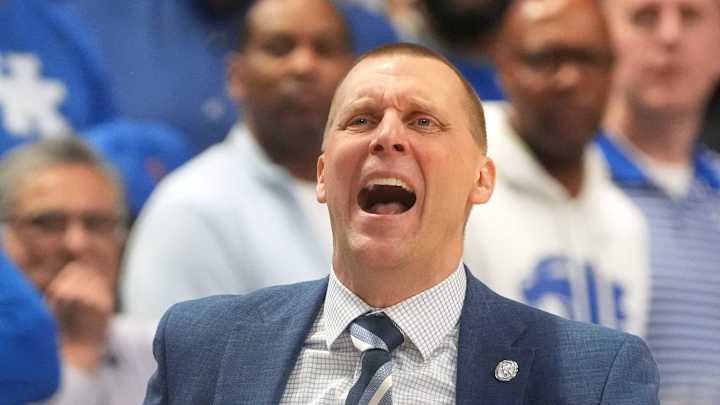
For a brief stretch inside Rupp Arena, it looked safe again. The Wildcats had control. The crowd had belief. An eight-point first-half lead against Georgia felt like the reset Kentucky desperately needed. And then, almost without warning, it all unraveled — passes stopped moving, defensive rotations slowed, and the confidence that once filled the building turned into frustration.
By the final buzzer of an 86-78 loss, the most stunning moment wasn’t the collapse itself. It was what Mark Pope said afterward.
Kentucky didn’t just lose to Georgia. They exposed a flaw that has quietly haunted this team all season — and their head coach finally said it out loud.
After building early momentum at home, the Wildcats allowed Georgia to seize control before halftime. The Bulldogs, hungry for a résumé win and winless inside Rupp Arena since 2009, suddenly looked like the more disciplined, connected team. Kentucky, meanwhile, looked disconnected.
The warning signs had already appeared in previous losses — most notably in the defeat to Florida — but Tuesday night magnified them under bright lights. The offense stalled into isolation plays. Ball movement vanished. Defensive communication broke down. What started as an opportunity became another entry in a growing list of frustrating collapses.
And then came Pope’s brutally honest assessment.
“We are stuck in the mess of a 13-assist team, we’re just not very good.”
That line hit harder than the final score.
The Assist Column That Told the Whole Story
If you want to diagnose Kentucky’s collapse, you don’t need advanced analytics. You only need to glance at the box score.
Georgia finished with 20 assists on 29 made field goals. Kentucky had just 13.
That difference isn’t just a number — it’s identity. Teams that share the basketball force defenses to rotate. They create open looks. They build rhythm. Teams that don’t? They rely on individual brilliance.
And Kentucky doesn’t consistently have that luxury.
Otega Oweh poured in 28 points in a strong individual performance. But as Pope emphasized, that kind of scoring doesn’t solve systemic issues. When the Wildcats reverted to one-on-one basketball, Georgia’s defense tightened. The Bulldogs switched into zone late, daring Kentucky to move the ball crisply.
Instead, fatigue and hesitation set in.
With 1:17 remaining and the game within reach, Kentucky came out of a timeout and faced Georgia’s zone. The inbound went deep to Oweh. Instead of resetting, he attacked into traffic and dribbled the ball off his leg — a backbreaking turnover that deflated the comeback attempt. He finished with four turnovers.
When asked about the sequence, Pope referenced fatigue.
“I think it was partly fatigue.”
That explanation didn’t sit well with many in Big Blue Nation. In late February, conditioning shouldn’t decide execution. Decision-making should.
And that’s where the concern deepens.
When Ball Movement Disappears, So Does Margin for Error
Kentucky shot the ball reasonably well from three. On paper, they had enough offensive firepower to win. But shot-making can mask deeper problems — until it can’t.
When possessions devolve into stagnant dribbling and forced drives, turnovers follow. When players stop making the extra pass, teammates stand still. Defenses relax. Spacing shrinks.
Pope acknowledged it plainly: this team struggles to make plays for each other.
That’s not just a tactical flaw. It’s a chemistry issue.
The SEC Tournament is approaching quickly. Rotations are tightening. Opponents are scouting tendencies relentlessly. If Kentucky continues to function as what Pope called a “13-assist team,” their ceiling lowers dramatically.
In March, isolation-heavy offenses become predictable. Predictable teams become vulnerable.
A Defensive Disaster-Class
If the offense was frustrating, the defense was alarming.
Georgia knocked down 14 three-pointers at a 45% clip. Time after time, Kentucky failed to close out properly. Screens weren’t communicated. Help rotations lagged. Open shooters found rhythm.
Georgia isn’t known for elite shooting percentages. But leave any capable team wide open often enough, and they will make you pay.
“Defensively, it was really frustrating… our commitment to guard our yard,” Pope said.
The Bulldogs also recorded 20 assists and committed just seven turnovers — a stark contrast to Kentucky’s offensive struggles. That gap speaks to discipline.
Even more troubling was Pope’s mention of physicality. Kentucky’s young frontcourt, including Malachi Moreno, endured what Pope described as a tough learning experience against Georgia’s pressure.
“We did not respond well,” he admitted.
That phrase might be the most revealing of all.
Taking Possessions Off?
Pope’s final quote of the night may echo louder than any stat.
“These guys will compete. We didn’t play well tonight, and there were moments where we took some possessions off.”
That’s the part that should unsettle Big Blue Nation.
Kentucky has already suffered decisive losses to Vanderbilt, Gonzaga, and Michigan State. In those games, effort lapses were visible. Now, as postseason play approaches, hearing that players are still taking possessions off suggests the lesson hasn’t fully landed.
In March, one possession can end a season.
There is no room for drifting.
The Bigger Concern: Identity
Every successful Kentucky team has had a clear identity — relentless defense, elite transition offense, suffocating pressure, or dominant inside play.
What is this team’s identity?
They can shoot. They have individual talent. They can compete in spurts.
But consistency remains elusive.
When the ball moves, they look dangerous. When it sticks, they look ordinary. When the defense communicates, they can string stops together. When they relax, opponents surge.
Pope made it clear that roster limitations are not excuses. Depth may be thin. Fatigue may be real. But execution is non-negotiable.
The SEC Tournament will not wait for growth.
A Critical Test at Auburn
It doesn’t get easier.
Kentucky now travels to Auburn — one of the toughest environments in the conference. A bounce-back performance is essential, not just for résumé purposes, but for morale.
If the Wildcats respond with crisp ball movement, defensive intensity, and sustained focus, this Georgia loss becomes a painful but useful lesson.
If the same issues resurface — stagnant offense, defensive breakdowns, possession lapses — the concerns will grow louder.
Because Pope has already identified the problem.
The question now is whether his team can fix it in time.
Kentucky didn’t just lose a home game.
They confronted a truth.
And Mark Pope didn’t hide from it.
Whether that honesty becomes the turning point of the season — or simply another warning unheeded — will be decided over the next few weeks.
Big Blue Nation is watching.




