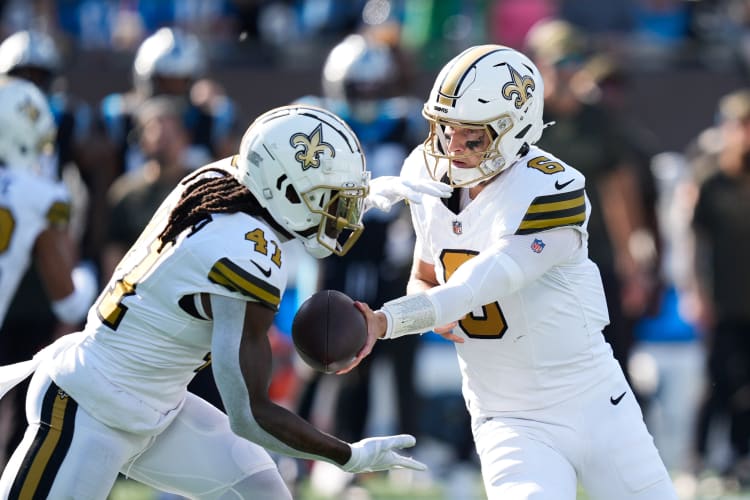
There is something important New Orleans Saints fans need to understand about this latest 2026 mock draft projection: it’s not just about adding talent — it’s about declaring a direction. Every selection sends a message. And if this scenario were to unfold, the message would be loud and clear — the Saints are fully committing to building around Tyler Shough and reshaping the roster with bold, calculated aggression.
The Saints are entering a pivotal era. After years of quarterback uncertainty following the departure of franchise legend Drew Brees, the organization finally invested significant draft capital in Tyler Shough in 2025. Now, the question becomes: how do you accelerate his development while strengthening a roster that has struggled with inconsistency?
This 7-round mock draft paints a fascinating blueprint.
Round 1 (Pick No. 8): Jeremiyah Love, Running Back, Notre Dame
The first shocker arrives immediately.
Instead of targeting a flashy wide receiver or defensive star, the Saints take dynamic Notre Dame running back Jeremiyah Love with the eighth overall pick. It’s bold — maybe even controversial — but it makes sense when you look deeper.
Love is not just a traditional running back. He’s explosive in space, a threat in the passing game, and capable of turning short gains into long touchdowns. In a modern offense under Kellen Moore, versatility is king. Pairing Love with Shough gives New Orleans an offensive identity built around balance and explosiveness.
A dominant run game would ease pressure on Shough, force defenses into difficult decisions, and create cleaner throwing lanes. If the Saints truly believe Shough is their quarterback of the future, giving him a reliable backfield weapon is a power move.
Round 2 (Pick No. 42): Zion Young, EDGE, Missouri
After addressing offense early, New Orleans pivots to the defensive side.
Zion Young brings athleticism and raw pass-rush potential. The Saints’ defense has long prided itself on generating pressure without excessive blitzing. Young’s length, burst, and motor would fit seamlessly into that philosophy.
Adding another pass rusher allows the defense to stay fresh late in games and maintain consistent pressure on opposing quarterbacks. For a division that features evolving offenses, pass rush is not optional — it’s essential.
Round 3 (Pick No. 73): Connor Lew, Interior Offensive Line, Auburn
Protecting the quarterback is non-negotiable.
Connor Lew may not grab headlines, but this selection could quietly become one of the most important in the draft. Interior line stability is critical, especially for a young quarterback. Lew offers toughness, intelligence, and long-term upside.
Injuries slowed parts of his college career, but his tape shows a player capable of anchoring against power rushers and moving defenders in the run game. If Shough is going to succeed, he needs time. This pick directly supports that mission.
Round 4 (Pick No. 132): Tacario Davis, Cornerback, Washington
The NFL has become a pass-heavy league, and cornerback depth is no luxury.
Tacario Davis brings size and length that defensive coordinators covet. His ability to disrupt routes at the line of scrimmage makes him a developmental piece with serious upside. Even if he doesn’t start immediately, his physical profile suggests he could grow into a key rotational defender.
For a Saints defense aiming to remain competitive in the NFC, adding young secondary talent is smart roster management.
Round 4 (Pick No. 137): Taurean York, Linebacker, Texas A&M
Taurean York provides energy and physicality.
Linebackers are often the heartbeat of a defense, and York plays with visible intensity. He can contribute on special teams right away while developing into a reliable rotational option.
Depth in the middle of the defense becomes crucial over a long NFL season. Injuries are inevitable — preparation is not.
Round 5 (Pick No. 148): C.J. Daniels, Wide Receiver, Miami
The Saints continue building offensive weapons.
C.J. Daniels adds speed and route versatility. Whether lining up outside or in the slot, he presents another option for Shough. In today’s NFL, you can never have too many pass catchers.
The strategy here is clear: surround the quarterback with options, create competition, and force defenses to defend every blade of grass.
Round 5 (Pick No. 170): DeMonte Capehart, Defensive Tackle, Clemson
Interior defensive line depth matters more than most fans realize.
DeMonte Capehart offers size and strength to plug gaps and support the run defense. Rotational defensive linemen keep starters fresh and maintain physicality throughout four quarters.
This pick reinforces the Saints’ commitment to maintaining defensive toughness.
Round 6 (Pick No. 189): Tanner Koziol, Tight End, Houston
The tight end position remains an intriguing variable for New Orleans.
Tanner Koziol brings reliable hands and red-zone potential. In modern offenses, tight ends are matchup nightmares. Even if he develops slowly, having a young option in the pipeline ensures long-term stability at the position.
The Bigger Picture: A Clear Organizational Vision
What makes this mock draft fascinating isn’t just the names — it’s the philosophy.
The Saints are not panicking. They are not chasing a quarterback. They are not overcorrecting. Instead, they are investing in infrastructure: run game, pass protection, defensive depth, and versatile weapons.
It signals belief in Tyler Shough.
That belief matters.
Franchises often sabotage young quarterbacks by failing to build properly around them. This projection shows a front office avoiding that mistake. By strengthening both sides of the ball while adding offensive firepower, the Saints position themselves for sustainable success rather than short-term fixes.
The Pressure on Kellen Moore
Head coach Kellen Moore’s offensive creativity could be the key to unlocking this roster’s potential.
With a dynamic running back like Love, a growing quarterback in Shough, and added receiving depth, Moore would have the flexibility to design mismatches weekly. Play-action, motion, tempo — the possibilities expand dramatically.
The draft alone doesn’t guarantee success. Development, coaching, and health will determine the outcome. But structurally, this class addresses major needs.
Risk vs. Reward
Of course, mock drafts are projections — not promises.
Running backs in the top ten always spark debate. Developmental linemen carry risk. Mid-round defenders aren’t guaranteed contributors. But bold teams often separate themselves from cautious ones.
If even half of these selections reach their potential, the Saints’ trajectory could shift dramatically.
Final Thoughts
The 2026 mock draft isn’t just about filling roster spots. It’s about identity.
It’s about saying the Saints are no longer searching aimlessly for answers at quarterback. It’s about committing to a plan. It’s about building a roster that supports growth rather than reacting to failure.
If this projection becomes reality, New Orleans could enter the 2026 season with renewed confidence, clearer direction, and a roster tailored to maximize its young quarterback’s strengths.
And for Saints fans hungry for stability and long-term vision, that might be the most important development of all.