


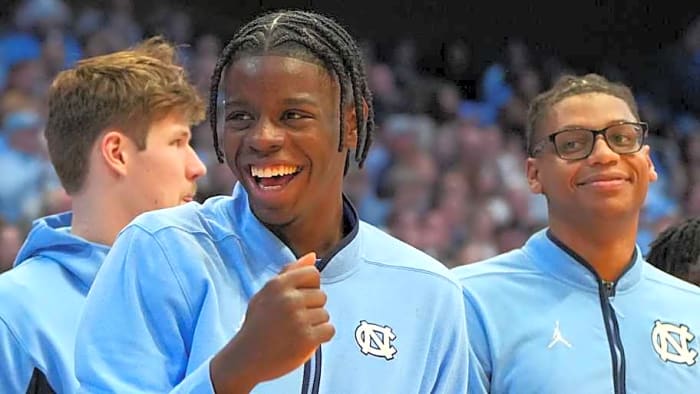
The mood around North Carolina basketball has shifted dramatically in just a matter of days. Since losing star forward Caleb Wilson to injury, the Tar Heels have stumbled to a 1–2 stretch that has exposed uncomfortable truths about this roster. What once felt like a team with direction and identity now feels uncertain, searching, and shaken.
The loss to NC State only magnified those concerns. Energy was flat. Confidence looked fragile. And perhaps most troubling of all, there hasn’t been a clear answer to the question every contender must solve when adversity strikes: Who steps up?
Through three games without Wilson — including the Miami contest in which he was injured — UNC has struggled to find stability. Instead of a rallying response, there’s been inconsistency, missed opportunities, and visible frustration. Two areas in particular have stood out as deeply disappointing.
First, Seth Trimble has not embraced the moment the way many expected.
For years, Trimble has waited for his opportunity to lead in Chapel Hill. His role has gradually expanded, his responsibility has grown, and in an era where NIL opportunities encourage quick exits, he chose loyalty. He stayed. He developed. He waited his turn.
Now that the spotlight is squarely on him, the production simply hasn’t followed.
In the three games UNC has needed him most, Trimble scored just four points in two of them. Less than five points twice in a three-game stretch — during a period when the team desperately needs scoring punch — is alarming. For a senior guard expected to anchor the offense, it’s not just underwhelming; it’s crippling.
Even more concerning is the perimeter shooting drought. Trimble has not hit a single three-pointer in those three games. The confidence that once fueled his late-game heroics — including the unforgettable winner against Duke — appears to have faded under increased pressure.
The contrast is stark. Just weeks ago, he was riding high, delivering clutch moments and soaking in the spotlight. Now, with the offense running through him more frequently, he seems tentative rather than assertive. Whether it’s defensive attention, internal pressure, or simple cold shooting, the results have been historically poor at the worst possible time.
Perhaps Trimble is best suited as a complementary piece rather than the centerpiece. There’s no shame in that. But if he cannot elevate into the “main guy” role, UNC must quickly recalibrate its expectations and offensive structure.
The second major disappointment lies in the backcourt as a whole.
Trimble’s struggles would be easier to stomach if others compensated. Instead, the guard unit collectively has faltered. Freshman point guard Derek Dixon, tasked with orchestrating the offense, has endured a brutal shooting stretch — 4-of-26 from the field and 2-of-18 from beyond the arc in the three games without Wilson.
Those numbers are difficult to process. For any player, they’re troubling. For the starting point guard at North Carolina, they’re debilitating.
To Dixon’s credit, he is a freshman shouldering immense responsibility. Fans have granted him some grace because of that reality. Still, the Tar Heels need more stability at the lead guard spot, particularly when their primary scoring option is unavailable.
Luka Bogavac has been serviceable, but only that — serviceable. There hasn’t been a breakout performance or offensive spark to lift the team. Kyan Evans has struggled to make a meaningful impact, leaving head coach Hubert Davis with limited dependable guard options.
At this point, Davis may be forced to consider giving freshman Isaiah Denis extended minutes. When the current rotation isn’t producing, experimentation becomes necessity rather than luxury.
Ultimately, Wilson’s injury has revealed how dependent UNC’s offense was on his presence. Without him drawing defensive attention and providing reliable production, the backcourt has looked overwhelmed instead of empowered.
If the Tar Heels are going to stay afloat in the ACC race, someone must seize control. Whether that’s Trimble rediscovering his confidence, Dixon settling into his role, or a surprise contributor emerging, the status quo is not sustainable.
Three games may not define a season. But they’ve exposed vulnerabilities that can no longer be ignored in Chapel Hill.




