


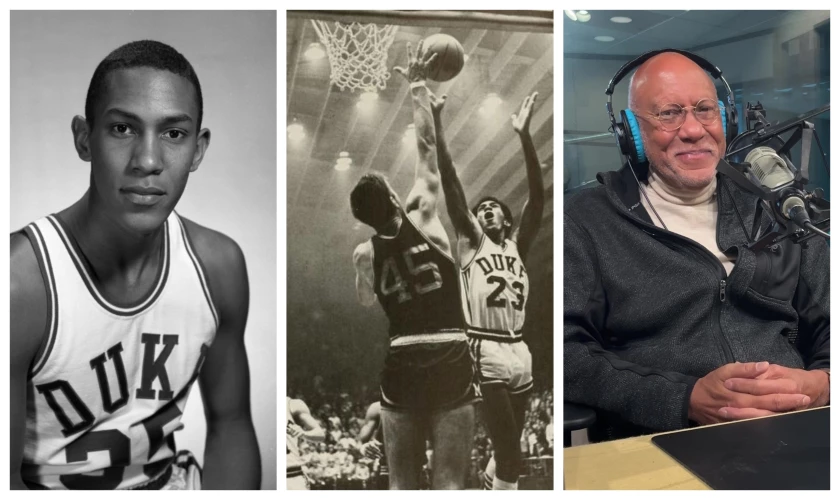
Before the roaring crowds. Before the national championships. Before Duke basketball became a global brand. There was a young man who quietly stepped onto a court and carried more than just a basketball in his hands. And decades later, in a different kind of arena — a warm kitchen filled with memory and spice — a daughter is carrying forward a legacy just as powerful. One story is about breaking barriers in one of college basketball’s most storied programs. The other is about preserving a Southern culinary institution that shaped a community. Together, they reveal how history lives on — not just in headlines, but in courage, culture, and family.
A Conversation with C.B. Claiborne, Duke’s First Black Basketball Player
College basketball is woven into the fabric of North Carolina’s Triangle region. In towns like Durham and Chapel Hill, players quickly become household names. Jerseys are retired, banners hang, and legacies are debated over barbecues and barbershop conversations.
But not every name is remembered the way it should be.
Claudius “C.B.” Claiborne holds a place in Duke history that cannot be overstated. He was the first Black basketball player at Duke Blue Devils men’s basketball — a milestone that came during a turbulent and transformative period in American history.
Yet for many fans, his name is not as instantly recognizable as some of the stars who followed.
That reality is precisely why his story matters.
Breaking Barriers at Duke
When Claiborne joined Duke’s basketball program, he did so at a time when integration in college athletics was still a charged and often hostile process. The late 1960s and early 1970s marked a period of profound social change across the South. Institutions were grappling with desegregation. Communities were divided. Progress was uneven.
For Claiborne, stepping onto the court meant more than competing for playing time. It meant navigating isolation, scrutiny, and expectation — often all at once.
The pressure on “the first” is different. There is no blueprint. There are no predecessors to lean on for advice about how to handle slights, silence, or subtle exclusion. Every practice, every road trip, every locker-room conversation carries weight.
Claiborne has reflected on what it meant to be both a player and a symbol. He was a student-athlete pursuing his degree, focused on improving his game. But he also understood that his presence alone represented change.
And change is rarely easy.
“C.B.: Power to the Player”
A new documentary short film, C.B.: Power to the Player, shines a light on Claiborne’s journey. The film captures not only his role in Duke basketball history but also the broader social landscape in which he played.
The title itself is powerful. “Power to the Player” evokes both athletic agency and the larger civil rights movement that shaped the era. It underscores that Claiborne was not simply acted upon by history — he was an active participant in it.
Through interviews and archival footage, the documentary reveals the personal dimensions of his experience: the quiet resilience, the mental strength, the determination to succeed not just for himself, but for those who might follow.
Claiborne would go on to earn a PhD, building a distinguished academic career. His life reflects a truth often overshadowed in sports narratives: athletes are multidimensional. Their contributions extend far beyond the hardwood.
The Importance of Remembering
In a region where college basketball is almost sacred, remembering pioneers like Claiborne is essential. Modern Duke players compete in packed arenas and national spotlight. They benefit from decades of integration and progress.
But that progress was built step by step.
Claiborne’s story reminds us that representation in sports did not simply “happen.” It was earned — through courage, perseverance, and sometimes quiet endurance.
As conversations about race and equity continue across the country, revisiting these histories is not about dwelling in the past. It is about understanding how far institutions have come — and how far they still have to go.
In honoring Claiborne, Duke acknowledges a chapter that helped shape its identity.
Southern Roots: Mama Dip’s Legacy Lives On
While Claiborne’s story unfolds on the basketball court, another story — equally rich and deeply Southern — unfolds in the kitchen.
For decades, Mama Dip’s Kitchen was more than a restaurant in Chapel Hill. It was an institution. A gathering place. A culinary landmark.
Founded by the legendary Mildred Council, affectionately known as “Mama Dip,” the restaurant became synonymous with authentic Southern cooking. Fried chicken. Collard greens. Cornbread. Sweet tea served with stories.
When Mama Dip’s Kitchen closed last year, it felt like the end of an era.
But as it turns out, it was not an ending — it was a transition.
A Daughter’s Tribute
Spring Council, Mama Dip’s youngest child, has taken the flavors and memories of her mother’s kitchen and poured them into a new cookbook: Southern Roots: Recipes and Stories from Mama Dip’s Daughter.
The book is more than a collection of recipes. It is part memoir, part family history, and part love letter to a culinary matriarch.
Spring grew up immersed in the rhythms of the restaurant — the early mornings, the aroma of spices, the constant flow of customers who felt like extended family. Those experiences shaped not just her palate, but her identity.
In Southern Roots, she honors traditional dishes while adding her own contemporary twists. It is a testament to how traditions evolve without losing their soul.
Food as Cultural Memory
Southern cuisine carries history in every bite. It reflects resilience, adaptation, and creativity — particularly within Black communities in the South.
Mama Dip’s recipes were rooted in family, church gatherings, and community celebrations. They were born from necessity and elevated by love.
By preserving these recipes in print, Spring Council ensures that the legacy will not fade with the restaurant’s closing doors.
Cookbooks can be time capsules. They freeze moments. They capture not only ingredients and instructions, but voices and values.
Through storytelling woven between recipes, Spring invites readers into her family’s journey — the struggles, triumphs, and deep pride in what Mama Dip built.
The Closure That Wasn’t the End
When Mama Dip’s Kitchen shut its doors, longtime patrons mourned. For many, the restaurant was intertwined with personal milestones — graduation dinners, first dates, Sunday lunches after church.
But closure does not erase impact.
Instead, it often sparks reflection.
Southern Roots allows those flavors to live on in home kitchens across the country. It transforms a physical space into something portable — memory you can recreate at your own table.
In that way, Spring Council becomes a bridge between generations.
Two Legacies, One Region
At first glance, a pioneering basketball player and a Southern cookbook author might seem unrelated. But both stories are deeply rooted in the Triangle region of North Carolina.
Both are about legacy.
Both are about perseverance.
And both reveal how individuals shape institutions — whether those institutions are universities or restaurants.
Claiborne broke barriers at Duke, expanding who belonged on that court. Mama Dip built a restaurant that welcomed everyone, creating a space where food brought people together.
Each story underscores the importance of visibility.
Why These Stories Matter Now
In today’s fast-moving media landscape, attention often gravitates toward the newest headline, the latest viral moment. But there is power in pausing to look back.
Claiborne’s journey invites reflection on race, progress, and the courage required to be “the first.”
Spring Council’s cookbook invites reflection on heritage, family, and the enduring power of food.
Both narratives resist erasure.
They remind us that history is not abstract. It is lived — by people whose names deserve to be spoken.
The Role of Storytelling
Leoneda Inge, co-host of WUNC’s “Due South,” has spent more than three decades telling stories of race and Southern culture. Her conversation with Claiborne and Spring Council highlights the connective tissue between past and present.
Journalism at its best illuminates overlooked narratives. It amplifies voices that might otherwise fade.
Through thoughtful interviews and careful storytelling, these conversations become more than features. They become preservation.
And preservation matters.
Because without it, pioneers are forgotten. Legacies dissolve. Lessons vanish.
Carrying It Forward
C.B. Claiborne’s presence on the Duke basketball court opened doors for future generations of Black athletes. His legacy is etched into the program’s history — whether every fan knows his name or not.
Spring Council’s cookbook ensures that Mama Dip’s flavors continue to grace tables far beyond Chapel Hill. Her work transforms memory into something tangible.
Both are acts of continuity.
Both are reminders that progress and tradition can coexist.
As Duke basketball continues to thrive and as Southern cuisine continues to evolve, these foundational stories offer grounding.
They ask us to consider who paved the way. Who stirred the pot. Who stood firm when it would have been easier to step back.
A Legacy That Endures
He broke Duke’s color barrier — not with fanfare, but with fortitude.
She carries her mother’s recipes — not as relics, but as living traditions.
Together, their stories paint a portrait of the South that is layered, complex, and resilient.
And perhaps that is the most powerful thread connecting them: the understanding that legacy is not about nostalgia. It is about action.
It is about stepping onto a court when history is watching.
It is about writing a cookbook so that flavors and the stories behind them are never lost.
In the Triangle, where basketball and barbecue both inspire devotion, these stories remind us that culture is built one courageous step and one shared meal at a time.




